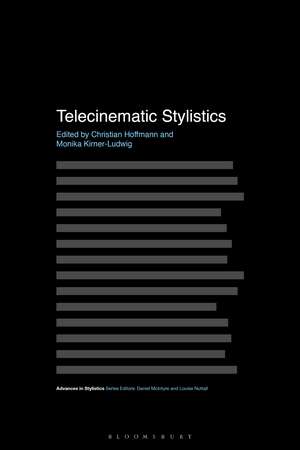
Telecinematic Stylistics: Advances in Stylistics
Editat de Christian Hoffmann, Monika Kirner-Ludwigen Limba Engleză Paperback – 18 noi 2021
Din seria Advances in Stylistics
- 16%
 Preț: 262.05 lei
 -
 Preț: 282.22 lei
 - 15%
 Preț: 284.45 lei
 -
 Preț: 260.54 lei
 - 27%
 Preț: 235.30 lei
 - 15%
 Preț: 258.41 lei
 -
 Preț: 283.55 lei
 -
 Preț: 278.68 lei
 - 15%
 Preț: 285.15 lei
 - 16%
 Preț: 277.20 lei
 -
 Preț: 279.14 lei
 - 25%
 Preț: 231.40 lei
 - 15%
 Preț: 285.37 lei
 - 16%
 Preț: 277.48 lei
 - 25%
 Preț: 242.55 lei
 - 25%
 Preț: 248.32 lei
 - 23%
 Preț: 235.79 lei
 - 26%
 Preț: 216.19 lei
 -
 Preț: 214.50 lei
 - 28%
 Preț: 211.43 lei
 - 25%
 Preț: 194.26 lei
 -
 Preț: 279.80 lei
Preț: 220.47 lei
Preț vechi: 294.56 lei
-25%
Carte tipărită la comandă
Livrare economică 30 noiembrie-14 decembrie
Specificații
ISBN-10: 1350294527
Pagini: 352
Dimensiuni: 156 x 234 mm
Greutate: 0.49 kg
Editura: Bloomsbury Publishing
Colecția Bloomsbury Academic
Seria Advances in Stylistics
Locul publicării:London, United Kingdom
V-ar putea interesa
Descriere
Over the last two decades, the study of discourse in film and television has become one of the most promising research avenues in stylistics and pragmatics due to the dazzling variety of source material and the huge pragmatic range within it. Meanwhile, with the advent of streaming and the box set, film and television themselves are becoming separated by an increasingly blurred line.This volume closes a long-standing gap in stylistics research, bringing together a book-level pragmastylistic showcase. It presents current developments from the field from two complementary perspectives, looking stylistically at the discourse in film and the discourse of and around film. This latter phrase comes to mean the approaches which try to account for the pragmatic effects induced by cinematography. This might be the camera work or the lighting, or the mise en scène or montage. The volume takes a multimodal approach, looking at word, movement and gesture, in keeping with modern stylistics.The volume shows how pragmatic themes and methods are adapted and applied to films, including speech acts, (im)politeness, implicature and context. In this way, it provides systematic insights into how meanings are displayed, enhanced, suppressed and negotiated in both film and televisual arts.
Cuprins
1. Introduction: introducing telecinematic stylistics, Christian R. Hoffmann (University of Augsburg, Germany) and Monika Kirner-Ludwig (University of Albany, State University of New York, USA)2. Adapting Medieval stuff to fit the Modern Screen: a cognitive-pragmatic approach to strategies of evoking and ridiculing obsolete frames to entertain today's recipient, Monika Kirner-Ludwig (University of Albany, State University of New York, USA)3. "Drucilla, we need to talk": The formulaic nature of problem-oriented talk in soap operas, Sabine Jautz (Universität Siegen, Germany) and Verena Minow (Ruhr-Universität, Germany)4. On the usefulness of the Sydney Corpus of television dialogue (SydTV) as a reference point for corpus linguistic and stylistic analyses of TV series, Monika Bednarek (University of Augsburg, Germany)5. "I shouldn't have let this happen": demonstratives in film dialogue and film representation, Maria Pavesi (Università degli Studi di Pavia, Italy)6. Ideology in the multimodal discourse of television documentaries on Irish travellers' and gypsies' communities in the UK, Roberta Piazza (University of Sussex, UK)7. Voice-over and presenter narration in TV documentaries, Jan Chovanec (Masaryk University, Czech Republic)8. How comics communicate on the screen: telecinematic discourse in comic-to-film adaptations, Christina Sanchez-Stockhammer (Ludwig Maximilian University of Munich, Germany)9. A multimethod analysis of autism spectrum disorder representation in fictional television, Susan Reichelt (University of Lancaster, UK)10. Metatextual devices in Alfred Hitchcock's Notorious (1946), Adriana Gordejuela (Universidad de Navarra, Spain)11. The Visual Discourse of Shots and Cuts: applying the Cooperative Principle to horror film cinematography, Christoph Schubert (Universität Vechta, Germany)12. Repetition in sitcom humour, Thomas Messerli (University of Basel, Switzerland)13. 'Subtitles have to become my ears not my eyes': pragmatic and stylistic choices behind Closed Captions for deaf and hard-of-hearing people: the example of the television programme Breaking Bad, Annie Dahne (Chatteris Educational Foundation (Hong Kong) and Roberta Piazza (University of Sussex, UK)14. Relevance in film trailer communication: a multimodal account, Heike Krebs (University of Augsburg, Germany)BibliographyIndex
Recenzii
Telecinematic Stylistics draws together a number of innovative studies to explore central themes and style choices in narratives from both film and screen. The chapters consider a range of telecinematic texts (from horror films to trailers and captions) through an equally comprehensive range of theoretical approaches (from corpus methods to cognitive pragmatics). These exemplary analyses successfully demonstrate the breadth of methodologies and topics within this exciting new field of research, and highlight how telecinematic discourse - in all its various contexts - can be examined rigorously and meaningfully through a stylistic perspective.
Telecinematic Stylistics provides its readers with a rich repertoire of locutionary (and visual) patterns observed in a wide variety of telecinematic products (including several understudied ones) ... The vast array of topics and methodological approaches [are] of interest not only to scholars interested in pragmatics, stylistics and their intersections, but also to those active in the fields of media linguistics and discourse analysis at large.
Telecinematic Stylisticsprovides its readers with a rich repertoire of locutionary (and visual) patterns observed in a wide variety of telecinematic products (including several understudied ones) ... The vast array of topics and methodological approaches [are] of interest not only to scholars interested in pragmatics, stylistics and their intersections, but also to those active in the fields of media linguistics and discourse analysis at large.
Notă biografică
Christian Hoffmann is Senior Lecturer at the University of Augsburg, Germany.Monika Kirner-Ludwig is Assistant Professor at the University of Innsbruck, Austria