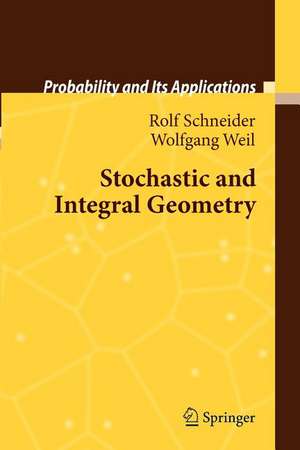
Stochastic and Integral Geometry: Probability and Its Applications
Autor Rolf Schneider, Wolfgang Weilen Limba Engleză Paperback – 25 noi 2010
EDIȚIA: Publicat în seria Probability and Its Applications, volumul Stochastic and Integral Geometry din 2008 reprezintă o sinteză riguroasă a fundamentelor matematice necesare pentru modelarea structurilor geometrice aleatorii. Față de abordările introductive, această ediție consolidează legătura dintre geometria integrală și modelele stochastice, introducând capitole esențiale despre modelele non-staționare și transformările geometrice integrale. Subliniem faptul că autorii Rolf Schneider și Wolfgang Weil au structurat materialul pentru a servi cercetătorilor, punând accent pe modelele staționare — seturi aleatorii, procese punctuale și mozaicuri. Reținem organizarea logică a volumului, care debutează cu bazele geometriei stochastice și progresează spre concepte extinse de geometrie integrală, incluzând măsuri invariante și fapte din geometria convexă. Cititorii familiarizați cu Stochastic Geometry de A. Baddeley vor aprecia aici profunzimea tratamentului teoretic al mediilor geometrice în raport cu măsurile invariante, oferind o bază matematică mult mai densă pentru aplicațiile în științele naturii sau inginerie. În contextul operei lui Rolf Schneider, acest tratat reprezintă punctul culminant al cercetărilor sale în geometria convexă și stochastică, fiind o lucrare de referință net diferită de incursiunile sale în traduceri literare precum König Lear. Volumul reușește să demonstreze interdependența dintre probabilitățile geometrice și geometria integrală, oferind note detaliate la finalul fiecărei secțiuni pentru a ghida cititorul prin literatura de specialitate vastă.
Din seria Probability and Its Applications
- 15%
 Preț: 705.76 lei
 - 18%
 Preț: 949.88 lei
 - 23%
 Preț: 564.62 lei
 - 18%
 Preț: 811.07 lei
 - 15%
 Preț: 753.67 lei
 - 18%
 Preț: 767.61 lei
 - 18%
 Preț: 735.90 lei
 -
 Preț: 390.96 lei
 -
 Preț: 325.77 lei
 -
 Preț: 407.91 lei
 - 15%
 Preț: 669.81 lei
 -
 Preț: 468.65 lei
 - 15%
 Preț: 511.02 lei
 - 15%
 Preț: 727.27 lei
 - 15%
 Preț: 630.91 lei
 - 18%
 Preț: 1118.95 lei
 - 18%
 Preț: 748.92 lei
 - 18%
 Preț: 644.93 lei
 - 18%
 Preț: 1127.49 lei
 - 15%
 Preț: 573.38 lei
 - 18%
 Preț: 911.49 lei
Preț: 914.96 lei
Preț vechi: 1115.81 lei
-18%
Carte tipărită la comandă
Livrare economică 30 noiembrie-14 decembrie
Specificații
ISBN-10: 3642097669
Pagini: 708
Ilustrații: XII, 694 p.
Dimensiuni: 155 x 235 x 38 mm
Greutate: 1.05 kg
Ediția:Softcover reprint of hardcover 1st ed. 2008
Editura: Springer
Colecția Probability and Its Applications
Seria Probability and Its Applications
Locul publicării:Berlin, Heidelberg, Germany
V-ar putea interesa
-
 Geometry Ancient and ModernJohn R. Silvester-28%Preț: 399.90 lei557.35 lei
 -
 Flips for 3-folds and 4-foldsAlessio Corti-33%Preț: 676.51 lei1005.19 lei
 -
 The Many Facets of Geometry: A Tribute to Nigel HitchinOscar Garcia-Prada-31%Preț: 793.84 lei1149.31 lei
 -
 The Arithmetic of Elliptic CurvesJoseph H. SilvermanPreț: 403.52 lei
 -
 Convex PolytopesBranko Grünbaum-15%Preț: 488.08 lei574.21 lei
 -
 Curves and Fractal DimensionClaude TricotPreț: 411.88 lei
 -
 Algebraic GeometryJoe Harris-15%Preț: 497.27 lei585.03 lei
 -
 MatroidsGary GordonPreț: 422.50 lei
 -
 Elliptic CurvesHenry Mckean-11%Preț: 417.77 lei469.41 lei
 -
 -19%Preț: 671.13 lei828.55 lei
 -
 Classical Algebraic GeometryIgor V. Dolgachev-14%Preț: 976.82 lei1135.84 lei
 -
 A First Course in Computational Algebraic GeometryWolfram DeckerPreț: 142.70 lei
 -
 Vectors, Pure and AppliedT. W. KörnerPreț: 450.98 lei
 -
 Complex Abelian VarietiesChristina Birkenhake-18%Preț: 930.44 lei1134.68 lei
 -
 Introduction to Étale CohomologyGünter Tamme-15%Preț: 559.96 lei658.77 lei
 -
 The Red Book of Varieties and SchemesDavid Mumford-15%Preț: 474.05 lei557.71 lei
 -
 TriangulationsJesus De Loera-23%Preț: 779.40 lei1012.21 lei
 -
 Curves and SurfacesM. Abate-15%Preț: 497.65 lei585.47 lei
Public țintă
ResearchDe ce să citești această carte
Recomandăm acest volum cercetătorilor care au nevoie de un fundament matematic solid pentru analiza structurilor spațiale aleatorii. Spre deosebire de manualele aplicate, această lucrare oferă demonstrații riguroase și o acoperire sistematică a mozaicurilor și proceselor punctuale. Este o resursă esențială pentru a înțelege cum geometria integrală devine un instrument de calcul în probabilitățile moderne.
Despre autor
Rolf Schneider este Profesor Emeritus la Facultatea de Matematică și Fizică din cadrul Universității Albert-Ludwigs din Freiburg, Germania. Este recunoscut la nivel internațional pentru contribuțiile sale fundamentale în geometria convexă și geometria stochastică. Wolfgang Weil, co-autor al acestui tratat, a colaborat extensiv cu Schneider pentru a defini standardele moderne în studiul măsurilor invariante și al modelelor geometrice aleatorii, poziționând școala germană de matematică în avangarda acestui domeniu interdisciplinar.
Descriere scurtă
Cuprins
Recenzii
“In ‘Stochastic and Integral Geometry,’ R. Schneider and W. Weil give priority to the basic concepts in stochastic geometry … while keeping from integral geometry only what is relevant for applications in stochastic geometry. … Each chapter section is concluded by notes in which the main references are cited and numerous possible extensions are discussed. … Stochastic and Integral Geometry is a profound work by two eminent specialists which is essential reading for those willing to learn deep theory.” (Pierre Calka, Mathematical Geosciences, Vol. 45, 2013)
“This book … provides the systematic and exhaustive account of mathematical foundations of stochastic geometry with particular emphasis on tools from convex geometry. … The thorough and up-to-date presentation in this text makes it an invaluable source for researchers pursuing studies not only in stochastic geometry, but also in convex geometry and various applications … . an absolutely indispensable part of all mathematical libraries. … also beneficial for personal collections of all mathematicians who ever deal with probability measures on spaces of geometric objects.” (Ilya S. Molchanov, Zentralblatt MATH, Vol. 1175, 2010)
“The book presents a number of results that are otherwise scattered among an immense number of research papers and mostly provides full proofs for them. … The most remarkable aspect of the book is the reader-friendly structure and the style in which it has been written. The book is also worth owning not only for those working in stochastic geometry and immediately related fields of theoretical and applied probability and spatial statistics. … This book … will be an essential part of every mathematical library.” (V. K. Oganyan, Mathematical Reviews, Issue 2010 g)
Notă biografică
Wolfgang Weil: Born 1945, Studies of Mathematics and Physics in Frankfurt/M, Diploma 1968, PhD 1971 (Frankfurt), Habilitation 1976 (Freiburg), 1978 Akademischer Rat Univ. Freiburg, 1980 Professor Univ. Karlsruhe
Textul de pe ultima copertă
As a combination of probability theory and geometry, the volume is intended for readers from either field. Probabilists with interest in random spatial structures, or motivated by the prospect of applications, will find an in-depth presentation of the geometric background. Geometers can see integral geometry "at work" and may be surprised to learn how classical results from convex geometry have elegant applications in a stochastic setting.