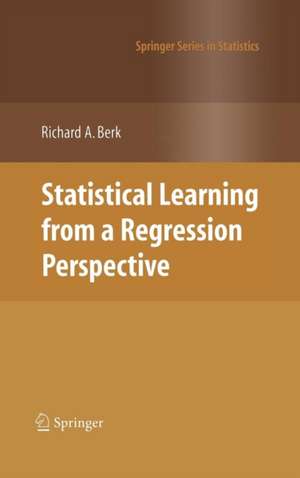
Statistical Learning from a Regression Perspective
Autor Richard A Berken Limba Engleză Hardback – 31 iul 2008
În peisajul academic actual, unde analiza datelor a devenit fundamentul cercetării aplicate, Statistical Learning from a Regression Perspective se poziționează ca un manual esențial pentru programele de studii avansate în statistică, științe sociale și bioinformatică. Observăm o abordare pragmatică ce elimină bariera dintre statistica tradițională și informatică, tratând învățarea supervizată nu ca pe o entitate izolată, ci ca pe o extensie firească a analizei de regresie. Această perspectivă este crucială în absența unui model teoretic predefinit, oferind cercetătorului instrumente flexibile pentru explorarea distribuțiilor condiționate. Remarcăm faptul că această ediție extinde cadrul conceptual propus de The Elements of Statistical Learning de Trevor Hastie, aducând date noi și discuții despre consecințele inferenței statistice post-selecție și impactul „Big Data”. Spre deosebire de An Introduction to Statistical Learning, care oferă o privire de ansamblu accesibilă, lucrarea lui Richard A. Berk pătrunde mai adânc în tensiunile dintre acuratețea predictivă și transparența algoritmică, o temă recurentă în opera sa, vizibilă și în Thinking about Program Evaluation. Structura volumului este riguros organizată, începând cu bazele regresiei și avansând către tehnici complexe precum arborii de clasificare (CART), Random Forests și Boosting. Găsim în această ediție capitole noi dedicate rețelelor neuronale și învățării prin întărire (Reinforcement Learning), reflectând progresele tehnologice recente. Un punct forte este integrarea codului R, care permite cititorului să aplice imediat procedurile de reeșantionare și metodele de tip Support Vector Machines pe seturi de date reale. Este o resursă care nu doar predă algoritmi, ci cultivă un „meșteșug” al analizei datelor, punând accent pe legătura fundamentală dintre colectarea datelor și calitatea rezultatelor.
Preț: 648.84 lei
Preț vechi: 763.34 lei
-15%
Carte disponibilă
Livrare economică 17-31 octombrie
Specificații
ISBN-10: 0387775005
Pagini: 360
Ilustrații: XVII, 360 p.
Dimensiuni: 155 x 235 x 21 mm
Greutate: 0.58 kg
Ediția:2008 edition
Editura: Springer
Locul publicării:New York, NY, United States
V-ar putea interesa
-
 -18%Preț: 935.44 lei1140.78 lei
 -
 Time Series Analysis for the Social SciencesJanet M. Box-SteffensmeierPreț: 292.42 lei
 -
 Thinking about Program EvaluationPeter H. Rossl-15%Preț: 608.48 lei715.86 lei
 -
 Regression AnalysisRichard A. Berk-27%Preț: 789.23 lei1081.14 lei
 -
 Analysis of Biomarker DataStephen W. Looney-27%Preț: 806.43 lei1104.69 lei
 -
 Social Media SurveysHill-8%Preț: 483.82 lei525.88 lei
 -
 Designing and Conducting Survey ResearchLouis M Rea-8%Preț: 493.88 lei536.83 lei
 -
 Bayesian Inference in the Social SciencesIvan Jeliazkov-9%Preț: 812.74 lei893.13 lei
 -
 Preț: 268.59 lei
 -
 -18%Preț: 2334.74 lei2847.24 lei
 -
 Preț: 549.41 lei
 -
 The SAGE Handbook of Innovation in Social Research MethodsMalcolm WilliamsPreț: 372.99 lei
 -
 -15%Preț: 564.42 lei664.02 lei
 -
 FragebogenRolf PorstPreț: 278.48 lei
 -
 -5%Preț: 357.98 lei376.81 lei
Public țintă
ResearchDe ce să citești această carte
Recomandăm această carte cercetătorilor care doresc să treacă de la regresia parametrică clasică la metodele moderne de învățare automată fără a pierde rigoarea statistică. Cititorul câștigă o înțelegere profundă a modului în care algoritmii de deep learning și random forests pot fi utilizați în științele sociale și biologice. Este un ghid practic, ancorat în cod R, care abordează frontal problemele actuale de etică și echitate în utilizarea algoritmilor.
Despre autor
Richard A. Berk este profesor emerit în cadrul Departamentului de Sociologie și al Programului Interdivizionar de Statistică de la University of California, Los Angeles (UCLA). De asemenea, acesta deține funcția de director al Centrului pentru Studiul Mediului și Societății. Expertiza sa vastă acoperă domenii variate, de la justiția penală la politici publice, fiind recunoscut pentru capacitatea de a aplica metode statistice complexe în rezolvarea problemelor sociale reale. Lucrările sale anterioare, precum Regression Analysis, demonstrează un angajament constant față de claritatea metodologică și integritatea datelor, elemente care definesc și prezenta lucrare publicată în prestigioasa serie Springer Series in Statistics.
Cuprins
Recenzii
"I believe that the practical utility of statistical learning over more traditional non- and parametric regression approaches has yet to be truly demonstrate but the procedures presented in this text do show considerable potential…. The mathematical prerequisites for using this book are minimal…. Some familiarity with using a computer is necessary in order to gain the most benefit for the text, and some previous experience of using a statistical software package would be advantageous." (C.M. O’Brien, International Statistical Review, 2009, 77, 1)
"The readers of this book will obtain the knowledge of the dialectic of the regression modeling problems arising in the study of predictor –response. A large percent of the contents is devoted to discuss how to understand phenomena through regression equation fitting. … I recommend it for practitioners and professors have the responsibility of teaching on the subject, the book gives an interesting perspective for dealing with regression." (Sovandep.H. Kumar, Revista Investigación Operacional, Vol. 30 (2), 2009)
"On the positive side, SLRP is a nice addition to the data mining literature, more accessible than ESL. It gives good references and provides statistical detail. In general, I enjoyed the philosophical discussions about how statistical learning fits in with statistical inference. I may not hand it over to my colleagues in Biology and Sociology, but I will seriously consider recommending it to the undergraduates in my data mining seminar." (Richard D. DE VEAUX, The American Statistician, Novemeber 2009, Volume 63, Number 4, pp. 297-411)
“…The strength of this book is its extensive discussion of practical issues. Algorithmic details are a starting point for discussing why and how methods work, comparison with other methodologies, limitations and strengths, and so on. Throughout the book, examples are worked through in detail. Each chapter except the first and the last end with a section headed ‘Software Considerations’, followed by ‘Summary and Conclusions’ and data analysis exercises. …Regression methods, both the theory and the practice, remain a work in progress… .Berk has made a good start in pulling together commentary on issues of major importance.” (Journal of Statistical Software, Vol. 29, Book Review 12, February 2009)
“This book is unique in that statistical learning is discussed by a sociology–PhD scientist, Professor Richard Berk, who has extensive research accomplishments in the intersection of social science and statistics. …The key strength of this book is in its emphasis on practical applications and hands-on learning of the statistical learning methods. Each chapter has real data examples … and goes through their analyses using statistical software R (2009). This design effectively illustrates the use of the methods in practice. ‘Software consideration’ given at the end of each chapter provides discussions oncurrently available computational tools, both functions/packages of R and other software, and is useful in practice. Emphasis on using R that is freely available worldwide is a major advantage in terms of readers’ accessibility to the methods. Furthermore, each chapter contains exercises for practicing different aspects of the methods in the chapter. The solutions and R codes of these exercises are provided at the author’s website…: this is another useful feature enhancing the hands-on learning. …A notable difference…is that this book is written with little mathematics. …Consequently, emphasis is not to understand the statistical-learning methods mathematically. Rather, the methods are explained mostly algorithmically in English, providing readers story-like descriptions of them. This would appeal to readers who are users of the statistical-learning methods but are not mathematically oriented. …” (Biometrics 65, 1309–1310, December 2009)
“The author covers a remarkable terrainin a relatively short book. Up-to-date methods are presented, and their main features are explained with a minimum of mathematical notation. … The problems at the end of each chapter are a real jewel: they lead the reader to a clear understanding of the issues treated in the chapter … . The book will no doubt be useful for the intended readership. Even the mathematically trained reader … may find useful ideas in it.” (Ricardo Maronna, Statistical Papers, Vol. 52, 2011)
Textul de pe ultima copertă
Real applications are emphasized, especially those with practical implications. One important theme is the need to explicitly take into account asymmetric costs in the fitting process. For example, in some situations false positives may be far less costly than false negatives. Another important theme is to not automatically cede modeling decisions to a fitting algorithm. In many settings, subject-matter knowledge shouldtrump formal fitting criteria. Yet another important theme is to appreciate the limitation of one’s data and not apply statistical learning procedures that require more than the data can provide.
The material is written for graduate students in the social and life sciences and for researchers who want to apply statistical learning procedures to scientific and policy problems. Intuitive explanations and visual representations are prominent. All of the analyses included are done in R.
Richard Berk is Distinguished Professor of Statistics Emeritus from the Department of Statistics at UCLA and currently a Professor at the University of Pennsylvania in the Department of Statistics and in the Department of Criminology. He is an elected fellow of the American Statistical Association and the American Association for the Advancement of Science and has served in a professional capacity with a number of organizations such as the Committee on Applied and Theoretical Statistics for the National Research Council and the Board of Directors of the Social Science Research Council. His research has ranged across a variety of applications in the social and natural sciences.