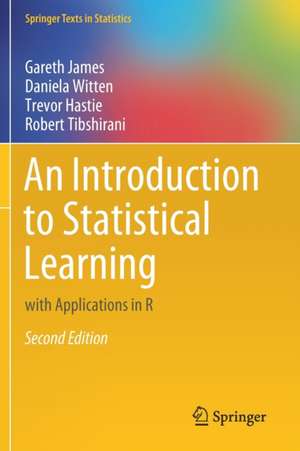
An Introduction to Statistical Learning: Springer Texts in Statistics
Autor Gareth James, Daniela Witten, Trevor Hastie, Robert Tibshiranien Limba Engleză Paperback – 30 iul 2022
Adresat în egală măsură studenților, cercetătorilor și practicienilor din domenii diverse — de la biologie la finanțe și astrofizică — acest volum oferă un set de instrumente esențiale pentru gestionarea seturilor de date complexe. Reținem că An Introduction to Statistical Learning reușește să democratizeze accesul la tehnici avansate de modelare și predicție, eliminând bariera matematică riguroasă a algebrei matriciale în favoarea unei înțelegeri intuitive și aplicate. Credem că valoarea principală a acestei ediții a doua constă în actualizarea masivă a conținutului, introducând capitole noi dedicate rețelelor neuronale (deep learning) și analizei de supraviețuire, reflectând astfel evoluția rapidă a domeniului din ultimul deceniu. Structura cărții urmărește o progresie logică, pornind de la conceptele fundamentale de învățare statistică și regresie liniară, trecând prin metode de resantionare și regularizare, până la tehnici sofisticate precum mașini cu vectori suport (SVM) și învățare nesupervizată. Găsim în această lucrare o punte necesară între teorie și practică, fiecare capitol fiind susținut de grafice color sugestive și tutoriale detaliate în R. Cititorii familiarizați cu The Elements of Statistical Learning vor aprecia acest volum ca pe o variantă mai accesibilă și mai orientată spre aplicabilitate imediată, în timp ce cei care au parcurs A First Course in Statistical Learning de Johannes Lederer vor găsi aici o aprofundare mai vastă a metodelor bazate pe R, în contrast cu abordările centrate pe Python. Autorii Trevor Hastie și Robert Tibshirani își consolidează prin acest titlu poziția de lideri în pedagogia statisticii moderne. Spre deosebire de alte lucrări ale lui Gareth James, cum ar fi The Final Table, care explorează strategii decizionale în contexte competiționale, acest manual rămâne ancorat strict în rigoarea academică a seriei Springer Texts in Statistics, fiind un instrument de referință pentru oricine dorește să transforme datele brute în informație utilă.
Din seria Springer Texts in Statistics
- 15%
 Preț: 641.17 lei
 - 18%
 Preț: 788.33 lei
 - 17%
 Preț: 566.02 lei
 - 20%
 Preț: 780.41 lei
 - 15%
 Preț: 700.93 lei
 - 15%
 Preț: 581.87 lei
 - 15%
 Preț: 653.70 lei
 - 23%
 Preț: 832.83 lei
 - 18%
 Preț: 829.38 lei
 - 15%
 Preț: 606.85 lei
 -
 Preț: 443.52 lei
 -
 Preț: 415.60 lei
 - 18%
 Preț: 1039.77 lei
 - 15%
 Preț: 630.32 lei
 - 19%
 Preț: 608.59 lei
 - 18%
 Preț: 996.42 lei
 - 18%
 Preț: 785.06 lei
 - 18%
 Preț: 844.02 lei
 - 15%
 Preț: 667.29 lei
 - 15%
 Preț: 686.20 lei
 - 18%
 Preț: 1271.64 lei
 - 18%
 Preț: 853.52 lei
 - 18%
 Preț: 1122.89 lei
 -
 Preț: 429.69 lei
 - 18%
 Preț: 813.62 lei
 - 18%
 Preț: 770.24 lei
 - 18%
 Preț: 1606.27 lei
 -
 Preț: 405.09 lei
 - 15%
 Preț: 619.96 lei
 - 15%
 Preț: 725.31 lei
 -
 Preț: 418.73 lei
 - 18%
 Preț: 930.24 lei
 - 15%
 Preț: 572.89 lei
 - 18%
 Preț: 922.51 lei
 -
 Preț: 423.48 lei
 - 15%
 Preț: 534.69 lei
 -
 Preț: 421.87 lei
 - 5%
 Preț: 665.32 lei
 -
 Preț: 399.96 lei
 -
 Preț: 412.75 lei
 - 18%
 Preț: 984.21 lei
 - 23%
 Preț: 786.24 lei
 - 19%
 Preț: 677.94 lei
Preț: 416.05 lei
Preț vechi: 489.47 lei
-15%
Carte disponibilă
Livrare economică 07-21 noiembrie
Livrare express 24-30 octombrie pentru 54.21 lei
Specificații
ISBN-10: 1071614207
Pagini: 624
Ilustrații: XV, 607 p. 191 illus., 182 illus. in color.
Dimensiuni: 155 x 235 x 34 mm
Greutate: 0.93 kg
Ediția:Second Edition 2021
Editura: Springer
Colecția Springer Texts in Statistics
Seria Springer Texts in Statistics
Locul publicării:New York, NY, United States
V-ar putea interesa
-
 -27%Preț: 739.28 lei1012.71 lei
 -
 Preț: 411.91 lei
 -
 Workouts in Intermediate MicroeconomicsHal R VarianPreț: 350.25 lei
 -
 The Capital Budgeting Decision: Economic Analysis of Investment ProjectsHarold Bierman, Jr.-18%Preț: 1626.90 lei1984.03 lei
 -
 Professional English in Use FinanceIan MacKenziePreț: 129.00 lei
 -
 Export & Import - Winning in the Global MarketplaceLeif HolmvallPreț: 283.77 lei
 -
 Global PaymentsCarol Coye BensonPreț: 222.65 lei
 -
 Preț: 233.14 lei
 -
 Supply Chain MetricsCecerePreț: 412.50 lei
 -
 The Bitcoin StandardSaifedean AmmousPreț: 185.26 lei
 -
 DeFi and the Future of FinanceAshwin RamachandranPreț: 152.48 lei
 -
 The Cultural Dimension of Global BusinessGary P. Ferraro-9%Preț: 626.97 lei688.98 lei
 -
 Technology and Innovation for MarketingEleonora PantanoPreț: 430.01 lei
 -
 The Global Business Culture GuideLothar KatzPreț: 180.79 lei
 -
 -8%Preț: 617.09 lei670.75 lei
 -
 Sustainable InnovationAnshu Saxena Arora-15%Preț: 408.90 lei481.06 lei
De ce să citești această carte
Recomandăm această carte oricărui profesionist care dorește să utilizeze tehnici de machine learning fără a se pierde în demonstrații matematice abstracte. Cititorul câștigă competențe practice imediate prin tutorialele R integrate, învățând să aplice algoritmi moderni de clasificare, regresie și clustering. Este resursa ideală pentru tranziția de la statistica clasică la analiza modernă a datelor, oferind claritate într-un domeniu adesea supra-complicat.
Despre autor
Echipa de autori reunește unii dintre cei mai citați experți în statistică la nivel mondial. Trevor Hastie și Robert Tibshirani, profesori la Universitatea Stanford, sunt pionieri ai metodelor statistice moderne, fiind cunoscuți pentru dezvoltarea modelelor aditive generalizate și a metodei Lasso. Gareth James și Daniela Witten completează acest grup academic de elită, aducând o perspectivă pedagogică proaspătă și expertiză în biostatistică și analiză de date de dimensiuni mari. Contribuția lor colectivă la seria Springer Texts in Statistics a definit standardele de predare în data science pentru noua generație de analiști.
Cuprins
Notă biografică
Daniela Witten is a professor of statistics and biostatistics, and the Dorothy Gilford Endowed Chair, at the University of Washington. Her research focuses largely on statistical machine learning techniques for the analysis of complex, messy, and large-scale data, with an emphasis on unsupervised learning.
Trevor Hastie and Robert Tibshirani are professors of statistics at Stanford University, and are co-authors of the successful textbook Elements of Statistical Learning. Hastie and Tibshirani developed generalized additive models and wrote a popular book of that title. Hastie co-developed much of the statistical modeling software and environment in R/S-PLUS and invented principal curves and surfaces. Tibshirani proposed the lasso and is co-author of the very successful An Introduction to the Bootstrap.
Textul de pe ultima copertă
Two of the authors co-wrote The Elements of Statistical Learning (Hastie, Tibshirani and Friedman, 2nd edition 2009), a popular reference book for statistics and machine learning researchers. An Introduction to Statistical Learning covers many of the same topics, but at a level accessible to a much broader audience. This book is targeted at statisticians and non-statisticians alike who wish to use cutting-edge statistical learning techniques to analyze their data. The text assumes only a previous course in linear regression and no knowledge of matrix algebra.
This Second Edition features new chapters on deep learning, survival analysis, and multiple testing, as well as expanded treatments of naïve Bayes, generalized linear models, Bayesian additive regression trees, and matrix completion. R code has been updated throughout to ensure compatibility.