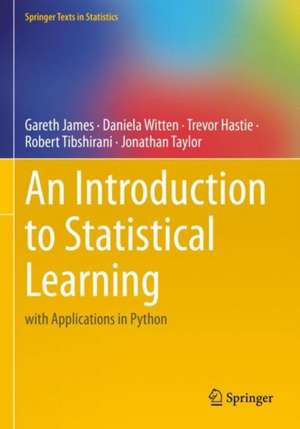
An Introduction to Statistical Learning
Autor Gareth James, Daniela Witten, Trevor Hastie, Robert Tibshirani, Jonathan Tayloren Limba Engleză Paperback – 2 iul 2024
Notăm cu interes apariția ediției 2023 a volumului An Introduction to Statistical Learning, o resursă fundamentală care se încadrează în nucleul programelor de studiu pentru statistică, econometrie și știința datelor. Această versiune marchează o tranziție esențială în pedagogia disciplinei: păstrează rigoarea teoretică a predecesorului său bazat pe R, dar implementează toate laboratoarele și exemplele practice în Python. Credem că această actualizare este vitală pentru studenții și profesioniștii care navighează într-un ecosistem tehnologic unde Python a devenit standardul de facto. Din punct de vedere al conținutului, volumul extinde cadrul propus de A First Course in Statistical Learning de Johannes Lederer prin includerea unor capitole dedicate metodelor de tip deep learning și analizei de supraviețuire, oferind o perspectivă mai largă asupra modelării predictive. Putem afirma că lucrarea reușește să democratizeze accesul la tehnici complexe precum mașinile cu vector suport (SVM) sau metodele bazate pe arbori de decizie, fără a sacrifica profunzimea analitică. Structura este una progresivă, pornind de la regresia liniară clasică și avansând către metode de regularizare, selecția modelelor și învățarea nesupravegheată, culminând cu testarea multiplă. Spre deosebire de The Elements of Statistical Learning, scris de aceiași Trevor Hastie și Robert Tibshirani, care se adresează unui public cu o pregătire matematică avansată, acest titlu prioritizează intuiția și aplicabilitatea imediată. Utilizarea graficelor color și a exemplelor din lumea reală — din finanțe până în astrofizică — facilitează asimilarea conceptelor abstracte, transformând un manual tehnic într-un ghid aplicat extrem de coerent.
Preț: 529.55 lei
Preț vechi: 623.00 lei
-15%
Carte disponibilă
Livrare economică 17 noiembrie-01 decembrie
Livrare express 31 octombrie-06 noiembrie pentru 69.76 lei
Specificații
ISBN-10: 3031391896
Pagini: 624
Ilustrații: XV, 60 p. 600 illus., 575 illus. in color.
Dimensiuni: 178 x 254 x 32 mm
Greutate: 1.29 kg
Ediția:2023
Editura: Springer
Locul publicării:Cham, Switzerland
De ce să citești această carte
Recomandăm această carte oricărui analist care dorește să treacă de la simpla utilizare a bibliotecilor Python la înțelegerea mecanismelor statistice din spatele algoritmilor. Cititorul câștigă o bază solidă în modelarea datelor, învățând nu doar cum să ruleze un cod, ci și cum să interpreteze validitatea rezultatelor. Este resursa definitivă pentru tranziția de la statistică teoretică la machine learning aplicat.
Despre autor
Echipa de autori reunește unii dintre cei mai influenți cercetători în domeniul statisticii moderne. Trevor Hastie și Robert Tibshirani, profesori la Universitatea Stanford, sunt pionieri ai metodelor de regularizare (precum Lasso) și au modelat fundamental domeniul învățării statistice prin lucrările lor anterioare. Gareth James, Daniela Witten și Jonathan Taylor completează acest colectiv, aducând expertiză în biostatistică și analiză multivariată. Deși unii dintre autori au explorat și domenii de nișă, cum ar fi strategia în afaceri sau istoria sportivă, contribuția lor principală rămâne dezvoltarea de instrumente matematice care permit extragerea de sens din seturi de date complexe.
Cuprins
Introduction.- Statistical Learning.- Linear Regression.- Classification.- Resampling Methods.- Linear Model Selection and Regularization.- Moving Beyond Linearity.- Tree-Based Methods.- Support Vector Machines.- Deep Learning.- Survival Analysis and Censored data.- Unsupervised Learning.- Multiple Testing.- Index.
Recenzii
Notă biografică
Gareth James is the John H. Harland Dean of Goizueta Business School at Emory University. He has published an extensive body of methodological work in the domain of statistical learning with particular emphasis on high-dimensional and functional data. The conceptual framework for this book grew out of his MBA elective courses in this area.
Daniela Witten is a professor of statistics and biostatistics, and the Dorothy Gilford Endowed Chair, at University of Washington. Her research focuses largely on statistical machine learning techniques for the analysis of complex, messy, and large-scale data, with an emphasis on unsupervised learning.
Trevor Hastie and Robert Tibshirani are professors of statistics at Stanford University and are co-authors of the successful textbook Elements of Statistical Learning. Hastie and Tibshirani developed generalized additive models and wrote a popular book with that title. Hastie co-developed much of the statistical modeling software and environment in R, and invented principal curves and surfaces. Tibshirani invented the lasso and is co-author of the very successful book, An Introduction to the Bootstrap. They are both elected members of the US National Academy of Sciences.
Jonathan Taylor is a professor of statistics at Stanford University. His research focuses on selective inference and signal detection in structured noise.
Textul de pe ultima copertă
An Introduction to Statistical Learning provides an accessible overview of the field of statistical learning, an essential toolset for making sense of the vast and complex data sets that have emerged in fields ranging from biology to finance, marketing, and astrophysics in the past twenty years. This book presents some of the most important modeling and prediction techniques, along with relevant applications. Topics include linear regression, classification, resampling methods, shrinkage approaches, tree-based methods, support vector machines, clustering, deep learning, survival analysis, multiple testing, and more. Color graphics and real-world examples are used to illustrate the methods presented. This book is targeted at statisticians and non-statisticians alike, who wish to use cutting-edge statistical learning techniques to analyze their data.
Four of the authors co-wrote An Introduction to Statistical Learning, With Applications in R (ISLR), which has become a mainstay of undergraduate and graduate classrooms worldwide, as well as an important reference book for data scientists. One of the keys to its success was that each chapter contains a tutorial on implementing the analyses and methods presented in the R scientific computing environment. However, in recent years Python has become a popular language for data science, and there has been increasing demand for a Python-based alternative to ISLR. Hence, this book (ISLP) covers the same materials as ISLR but with labs implemented in Python. These labs will be useful both for Python novices, as well as experienced users.