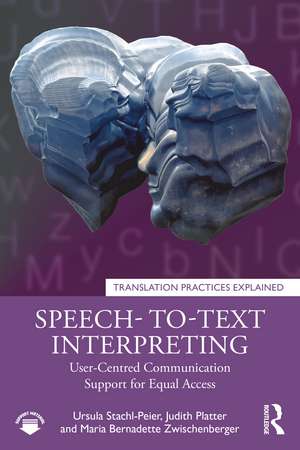
Speech-to-Text Interpreting: User-Centred Communication Support for Equal Access: Translation Practices Explained
Autor Ursula Stachl-Peier, Judith Platter, Maria B. Zwischenbergeren Limba Engleză Paperback – 21 sep 2027
Grounded in Translation & Interpreting Studies, the book demonstrates user-centred STTI implementation across typical interpreting settings. Drawing on video recordings, comparative text analysis, and interviews with users and over 30 interpreters, it provides practical assessment tools considering user expectations and multimodal communication contexts. The book addresses critical professional challenges from stress management to ethical dilemmas, outlining essential competences for user-centred service delivery. Each chapter features enriching activities and problem-solving exercises, with additional resources. Particularly timely amid advancing AI transcription technology, the book articulates human STTI's continued value through user support, individualized orientation, trust-building, and data security. A global survey of STTI service provision further informs the analysis.
Beyond equipping interpreters with theoretical and practical tools, the book supports training development and guides policymakers in establishing communication support guidelines. The text highlights DHH advocacy while advancing STTI understanding as a profession and an academic discipline. An essential text for students, teachers and researchers working in STTI , this is also a valuable resource for public institutions and private individuals employing STT interpreters.
Din seria Translation Practices Explained
-
 Preț: 386.01 lei
 -
 Preț: 388.94 lei
 -
 Preț: 349.79 lei
 -
 Preț: 356.28 lei
 -
 Preț: 364.85 lei
 -
 Preț: 455.04 lei
 -
 Preț: 380.83 lei
 -
 Preț: 372.88 lei
 -
 Preț: 353.08 lei
 -
 Preț: 387.76 lei
 -
 Preț: 413.79 lei
 -
 Preț: 466.88 lei
 -
 Preț: 322.07 lei
 -
 Preț: 374.38 lei
 -
 Preț: 407.46 lei
 -
 Preț: 386.00 lei
 -
 Preț: 374.53 lei
 -
 Preț: 354.87 lei
 -
 Preț: 347.03 lei
 - 18%
 Preț: 1246.62 lei
 - 18%
 Preț: 1246.62 lei
 -
 Preț: 444.13 lei
 -
 Preț: 381.25 lei
 -
 Preț: 395.84 lei
 - 15%
 Preț: 437.99 lei
 - 8%
 Preț: 425.85 lei
 - 15%
 Preț: 421.01 lei
 -
 Preț: 428.57 lei
 -
 Preț: 378.60 lei
 -
 Preț: 412.71 lei
Preț: 344.85 lei
Preț vechi: 386.89 lei
-11% Precomandă
Puncte Express: 517
Carte nepublicată încă
Livrare prin curier în România Precomanda se expediază când titlul devine disponibil.
Transport gratuit de la 400.00 lei Plată online sau ramburs, în funcție de opțiunile comenzii.
Retur gratuit în 14 zile Comandă securizată și suport în română.
Doresc să fiu notificat când acest titlu va fi disponibil:
Se trimite...
Specificații
ISBN-13: 9781032603841
ISBN-10: 1032603844
Pagini: 256
Ilustrații: 16
Dimensiuni: 156 x 234 mm
Ediția:1
Editura: Taylor & Francis
Colecția Routledge
Seria Translation Practices Explained
Locul publicării:Oxford, United Kingdom
ISBN-10: 1032603844
Pagini: 256
Ilustrații: 16
Dimensiuni: 156 x 234 mm
Ediția:1
Editura: Taylor & Francis
Colecția Routledge
Seria Translation Practices Explained
Locul publicării:Oxford, United Kingdom
Public țintă
Postgraduate and Professional Practice & DevelopmentCuprins
List of illustrations
List of abbreviations
About the book
Overview of chapters
PART I
1.1 Fundamentals
1.1.1 Speech-to-text interpreting for deaf and hard-of-hearing people: What’s in a name?
1.1.2 The history of STTI
1.1.2.1 The origins of speech-to-text: Written notes and print literacy
1.1.2.2 STTI after 1900
1.1.2.3 The emergence of a profession
1.2 Translation & Interpreting Studies and intralingual speech-to-text conversion: From the margins to the centre – with help from accessibility legislation
1.2.1 STT and the impact of accessibility legislation
1.2.2 TIS and accessibility studies: Recent trends
1.2.3 Speech-to-text interpreting: Still a marginal field in TIS
1.2.4 Opening the TIS door to STTI research
1.2.5 Further pertinent research
PART II
2.1 STTI methods and equipment
2.1.1 ‘Basic kit’
2.1.2 Conventional keyboards
2.1.3 Stenotype and CART
2.1.4 Palantype
2.1.5 Velotype
2.1.6. Repeaking
2.1.7 Automatic speech-recognition (ASR)
2.1.8 Live interpreted text and transcript
2.2 Configuring the physical and virtual STTI meeting space
2.2.1. Display devices and audio sources
2.2.2 Room configurations and seating setups
2.2.3 Preparing for the assignment
2.2.4 Remote speech-to-text interpreting (R-STTI)
2.2.4.1 Research into R-STTI
2.2.5 Practising R-STTI
2.2.5.1 Possible configurations for R-STTI
2.2.5.2 Technical preparation for R-STTI
2.2.5.3 Technical management at location of participants
2.2.5.4 Recommendations for meeting organisers
2.3 International and national standards pertinent to STTI service provision
2.3.1 Standards developed by the International Organization for Standardization (ISO)
2.3.2 Standards developed by the International Telecommunication Union (ITU)
2.3.3 National standards
2.4 The STT interpreters’ working language(s)
2.4.1 Classifications of levels of language proficiency
2.4.2 Language skills for STTI: Listening, writing, reading, speaking
2.4.3 Enhancing your linguistic competence
PART III
3.1 Accessibility, disability and universal design
3.1.1 The evolution of disability rights and accessibility legislation
3.1.2 Accessibility, accessible design and universal design
3.1.3 Legislative ideals and DHH people’s daily reality
3.1.4 Resurgence of the ‘medical model’?
3.1.5 Proactive and user-led as new approaches in communication access
3.2 Accessibility and user-centred STTI
3.2.1 From audience design to user-centred translation
3.2.2 User-centredness and accessibility in speech-to-text practises
3.2.2.1 Readability
3.2.2.2 Legibility and the reception of subtitles
3.2.3 Verbatim versus edited – and user-centred STTI
PART IV
4.1 Assessing STT quality
4.1.1 Defining quality and quality assessment
4.1.2 Models of live-subtitling quality assessment
4.1.2.1 WER method
4.1.2.2 NER model
4.1.2.3 Concept-based rendition assessment
4.1.2.4 WIRA model
4.1.2.5 QIT model
4.1.3 Summary and appraisal
4.2 Practising user-centred STTI
4.2.1 Conduits versus active participants with their own agency
4.2.2 STTI as a discourse process within a socio-cultural context
4.2.2.1 Communicative transaction within a socio-cultural context
4.2.2.2 Interpreting as interaction
4.2.2.3 Interpreting as a discourse process
4.2.2.4 The multimodal nature of interpreter-mediated interaction
4.2.3 Analysing and assessing STTI-mediated events
4.2.4 Pedagogical approach and format of activities
4.3 STTI as single-speaker events
4.3.1 Introduction
4.3.2 Learning units
4.4 STTI for conversational encounters
4.4.1 Introduction
4.4.2 Learning units
4.5 STTI at multi-party events
4.5.1 Introduction
4.5.2 Learning units
4.6 STTI in educational settings
4.6.1 Introduction
4.6.2 Learning units
4.7 User-centred STTI: A possible model of assessment
4.7.1 Assessing STTI
4.7.2 Appraisal of the interpretations as a product and communicative process
4.7.3 User-centredness?
4.7.4 Appraisal of the interpretations as a service
4.7.5 Protocols and instruments for ensuring user satisfaction
PART VI
5.1 Codes of ethics and STTI as a professional practice
5.1.1 Fundamentals
5.1.1.1 Codes of ethics and professional associations
5.1.1.2 Codes of ethics: Help or hindrance?
5.1.1.3 Deontological, teleological and virtue-based codes
5.1.1.4 Contents of codes of ethics
5.1.1.5 Arguments against a wider conception of the interpreter’s role
5.1.2 Codes of professional ethics for STT Interpreters and the Demand Control Schema
5.1.2.1 Four codes of professional ethics for STT interpreters
5.1.2.2 Resolving ethical dilemmas using DCS
5.1.3 Ethics and the concept of Role Space
5.1.4 Codes of ethics and professional practice revisited
5.2 Cognitive processing and interpreting strategies
5.2.1 Cognitive research into interpreting
5.2.1.1 Daniel Gile’s effort model
5.2.1.2 Sylvia Kalina’s cognitive and pragmatic discourse model of interpreting
5.2.2 Research into cognitive processing in STT
5.2.2.1 Cognitive models of respeaking
5.2.3 How can the models support STT interpreters?
5.2.3.1 Pre-task preparation and cognitive load: Some examples
5.2.4 Team collaboration analysed from a 4E(A) perspective
5.2.5 Investigating team collaboration
5.2.5.1 Explorative study of team collaboration
5.2.5.2 A wider conception of collaboration
5.3 Interlingual live subtitling and transpeaking (on the PORTAL)
PART VI
6.1 Knowledge skills and competences: From novice to professional expert
6.1.1 TI competence research: An overview
6.1.2 TI competence models
6.1.3 Modelling STTI competence: the LiveTextAccess project
6.1.4 Learning outcomes for STTI
6.2 Initial STTI education and professional development planning
6.2.1 Principles of interpreter education
6.2.1.1 Learning environments and instructional formats
6.2.2 Curricula design, implementation and attainment
6.2.2.1 Assessment practices
6.2.3 Certification and accreditation
6.3 Practice and self-care
6.3.1 Practice makes perfect
6.3.2 Deliberate practice
6.3.3 Professional development planning
6.3.3.1 Skills audit and interpreter profile
6.3.4 Self-care
7 The future of STTI
References
Recenzii
"This textbook on speech to text interpreting is as long awaited as it is sorely needed. This important accessibility craft needs a manual, and this is book is not only based on state of the art research, it is also very pedagogical"
Jan Petersen, Stockholm University
"This carefully compiled resource book provides a comprehensive and much-needed overview of human intralingual speech-to-text interpreting (STTI). It presents a valuable compilation of resources and is sure to become essential reading for translation and interpreting educators, practitioners, and students who want to gain an in-depth insight into this important accessibility service. It engages readers in reflective activities, in-depth analyses, and reading and listening activities that facilitate individual and group learning."
Sonja Pöllabauer, Centre for Translation Studies, University of Vienna
"This timely and much-needed volume offers a comprehensive and empirically grounded exploration of speech-to-text interpreting (STTI), standing out as a unique contribution in a context where AI is often assumed to provide universal solutions. By foregrounding user-centredness as essential to equitable access and drawing on extensive data and analyses, the authors deliver an exceptionally thorough and insightful examination of STTI practice. An invaluable resource for professionals, trainers, and students in translation and interpreting, committed to ensuring high-quality, inclusive communication for Deaf and hard-of-hearing communities."
Carlo Eugeni, University of Leeds
Jan Petersen, Stockholm University
"This carefully compiled resource book provides a comprehensive and much-needed overview of human intralingual speech-to-text interpreting (STTI). It presents a valuable compilation of resources and is sure to become essential reading for translation and interpreting educators, practitioners, and students who want to gain an in-depth insight into this important accessibility service. It engages readers in reflective activities, in-depth analyses, and reading and listening activities that facilitate individual and group learning."
Sonja Pöllabauer, Centre for Translation Studies, University of Vienna
"This timely and much-needed volume offers a comprehensive and empirically grounded exploration of speech-to-text interpreting (STTI), standing out as a unique contribution in a context where AI is often assumed to provide universal solutions. By foregrounding user-centredness as essential to equitable access and drawing on extensive data and analyses, the authors deliver an exceptionally thorough and insightful examination of STTI practice. An invaluable resource for professionals, trainers, and students in translation and interpreting, committed to ensuring high-quality, inclusive communication for Deaf and hard-of-hearing communities."
Carlo Eugeni, University of Leeds
Notă biografică
Ursula Stachl-Peier was previously a lecturer in the School of Translation Studies at the University of Graz, Austria. Currently she is teaching part-time at Stockholm University's Conference Interpreting Program.
Judith Platter is senior lecturer and researcher at the Centre for Translation Studies of the University of Vienna. She also is the co-founder of Austrian speech-to-text interpreters’ association (OESDV).
.Maria B. Zwischenberger is a PhD candidate at the University of Vienna’s Centre for Translation Studies.
Judith Platter is senior lecturer and researcher at the Centre for Translation Studies of the University of Vienna. She also is the co-founder of Austrian speech-to-text interpreters’ association (OESDV).
.Maria B. Zwischenberger is a PhD candidate at the University of Vienna’s Centre for Translation Studies.
Descriere
Speech-to-Text Interpreting explores user-centred STTI for equitable deaf and hard-of-hearing communication access. Drawing on interviews with 30+ interpreters and users, it provides practical tools addressing professional challenges. . Essential for students, researchers, and institutions.