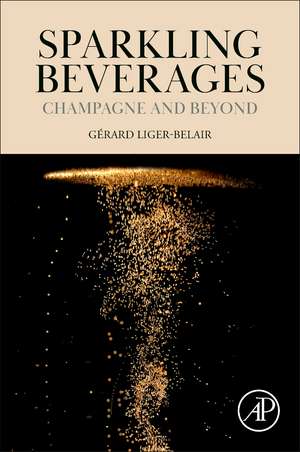
Sparkling Beverages: Champagne and Beyond
Autor Gérard Liger-Belairen Limba Engleză Paperback – 25 sep 2025
Written by a true expert on the topic and complete with beautiful, original photography, this unique, interdisciplinary work will interest researchers and industry producers alike.
- Summarizes the latest scientific advances in sparkling beverages, with a special focus on champagne and sparkling wines
- Comprehensively covers the sensory science of champagne, an iconic sparkling drink recognized worldwide, from uncorking the bottle to the action of the bubbles bursting in glasses
- Discusses the mechanisms of CO2 solubility and resulting bubble dynamics
Preț: 788.40 lei
Preț vechi: 1133.47 lei
-30%
Puncte Express: 1183
Carte tipărită la comandă
Livrare economică 02-16 decembrie
Livrare prin curier în România Termenul estimat este afișat lângă disponibilitate.
Transport gratuit pentru acest produs Plată online sau ramburs, în funcție de opțiunile comenzii.
Retur gratuit în 14 zile Comandă securizată și suport în română.
Specificații
ISBN-13: 9780443341021
ISBN-10: 0443341028
Pagini: 302
Dimensiuni: 191 x 235 x 19 mm
Greutate: 0.59 kg
Editura: ELSEVIER SCIENCE
ISBN-10: 0443341028
Pagini: 302
Dimensiuni: 191 x 235 x 19 mm
Greutate: 0.59 kg
Editura: ELSEVIER SCIENCE
V-ar putea interesa
-
 Preț: 95.27 lei
 -
 Let's Get FizzicalPippa Guy-18%Preț: 60.26 lei73.16 lei
 -
 Adventures in FermentationJohnny DrainPreț: 166.76 lei
 -
 -20%Preț: 159.10 lei198.93 lei
 -
 Liquid IntelligenceDave ArnoldPreț: 314.69 lei
 -
 UncorkedGerard Liger-BelairPreț: 176.35 lei
 -
 Preț: 110.87 lei
 -
 -23%Preț: 244.51 lei318.47 lei
 -
 Spritz!: Cheers to 100+ Refreshing, Sparkling CocktailsThe Coastal KitchenPreț: 129.33 lei
 -
 Let's Get FizzicalPippa GuyPreț: 101.89 lei
 -
 Preț: 69.97 lei
 -
 Flavor Lab CreationsLogan RichardsonPreț: 242.95 lei
 -
 Fizz: 70+ Homemade Artisan SodasAndrea Lynn-19%Preț: 93.60 lei115.10 lei
 -
 ChampagneAllan I. MacInnesPreț: 92.97 lei
 -
 Bursting BubblesRobert WaltersPreț: 130.75 lei
 -
 Making Sparkling WinesDonald HebbsPreț: 81.50 lei
 -
 Kanpai!Naomi ColemanPreț: 119.98 lei
 -
 Uncorking the Physics of WineLutz KasperPreț: 188.81 lei
Cuprins
Part 1. Introduction
Part 2. Carbon dioxide, a key ingredient in sparkling beverages
1. A few words about CO2 solubility and carbonation levels
2. CO2 Henry’s constants in sugar and water-ethanol solutions
Part 3. Champagne and sparkling wines
3. History of Champagne and Sparkling Wines
4. From harvest to the sealed bottle: the Méthode traditionnelle in a few key steps
5. From uncorking the bottle to the bursting of bubbles in the glass
6. The cork popping revisited through high-speed imaging
7. The action of pouring champagne in a glass: A key step for CO2
8. An energy barrier to overcome for CO2 bubble nucleation
9. Ascending bubble dynamics
10. Flute versus coupe: Is there an ideal glass to drink champagne?
11. Unveiling ascending bubble-driven flow patterns in glasses
12. Bursting bubbles provide an aromatic boost to sparkling wines
Part 2. Carbon dioxide, a key ingredient in sparkling beverages
1. A few words about CO2 solubility and carbonation levels
2. CO2 Henry’s constants in sugar and water-ethanol solutions
Part 3. Champagne and sparkling wines
3. History of Champagne and Sparkling Wines
4. From harvest to the sealed bottle: the Méthode traditionnelle in a few key steps
5. From uncorking the bottle to the bursting of bubbles in the glass
6. The cork popping revisited through high-speed imaging
7. The action of pouring champagne in a glass: A key step for CO2
8. An energy barrier to overcome for CO2 bubble nucleation
9. Ascending bubble dynamics
10. Flute versus coupe: Is there an ideal glass to drink champagne?
11. Unveiling ascending bubble-driven flow patterns in glasses
12. Bursting bubbles provide an aromatic boost to sparkling wines