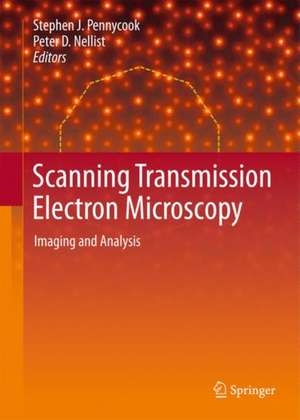
Scanning Transmission Electron Microscopy
Editat de Stephen J. Pennycook, Peter D. Nellisten Limba Engleză Hardback – 22 mar 2011
În volumul Scanning Transmission Electron Microscopy, considerăm că cititorul beneficiază de una dintre cele mai riguroase sinteze tehnice asupra microscopiei electronice cu scanare prin transmisie, o metodă care a redefinit standardele de imagistică la scară atomică. Lucrarea debutează cu o analiză detaliată a opticii electronice și a corecției aberațiilor, elemente critice pentru obținerea unei rezoluții sub-angstrom. Această bază teoretică este esențială pentru a înțelege evoluția instrumentației moderne, oferind fundamentul necesar pentru capitolele dedicate formării imaginii și teoriei împrăștierii. Recomandăm acest tratat pentru modul în care reușește să integreze spectroscopia (EELS și EDX) cu imagistica structurală, o abordare care completează organic lucrările anterioare ale lui Stephen J. Pennycook, precum Characterization of High Tc Materials and Devices by Electron Microscopy. Dacă în acea lucrare accentul era pus pe materiale supraconductoare, volumul de față extinde aria de aplicabilitate către oxizi complecși, aliaje, catalizatori și dispozitive semiconductoare. Cititorul care a aplicat deja metodele fundamentale descrise în High-Resolution Electron Microscopy de John C. H. Spence va găsi aici o specializare necesară pe configurația STEM, unde controlul fasciculului sondă și detectorii segmentați oferă un contrast diferit față de microscopia TEM convențională. Structura editorială este organizată progresiv, de la principii fizice la metodologii de nișă, cum ar fi tomografia 3D și difracția nanobeam. Această succesiune transformă textul dintr-un manual universitar într-un instrument de lucru indispensabil pentru cercetătorii din știința materialelor și nanotehnologie, oferind studii de caz concrete care demonstrează sensibilitatea tehnicii în detectarea atomilor individuali.
Preț: 1383.03 lei
Preț vechi: 1686.61 lei
-18%
Carte tipărită la comandă
Livrare economică 08-22 iulie
Specificații
ISBN-10: 1441971998
Pagini: 776
Ilustrații: XII, 762 p.
Dimensiuni: 183 x 260 x 47 mm
Greutate: 1.62 kg
Ediția:2011
Editura: Springer
Locul publicării:New York, NY, United States
V-ar putea interesa
-
 High-Resolution Electron MicroscopyJohn C. H. Spence-30%Preț: 349.94 lei498.92 lei
 -
 Obstetric Imaging: Fetal Diagnosis and CareJoshua A. Copel-29%Preț: 1688.51 lei2380.10 leiRecomandat
 -
 Topics in Electron Diffraction and Microscopy of MaterialsPeter. B Hirsch-9%Preț: 1351.47 lei1485.14 lei
 -
 NanocharacterisationAngus I Kirkland-14%Preț: 1354.82 lei1575.37 lei
 -
 XAFS for EveryoneScott Calvin-9%Preț: 723.66 lei795.24 lei
 -
 Low Voltage Electron MicroscopyDavid C. Bell-23%Preț: 620.29 lei805.57 lei
 -
 -9%Preț: 1066.04 lei1171.48 lei
 -
 Scanning Electron Microscopy and X-Ray MicroanalysisJoseph I. Goldstein-19%Preț: 671.99 lei829.63 lei
 -
 MicrocosmosBrandon BrollPreț: 139.37 lei
 -
 NanocharacterisationAngus I Kirkland-14%Preț: 1261.68 lei1467.08 lei
 -
 Advances in the Characterisation of CeramicsRobert Freer-9%Preț: 972.28 lei1068.44 lei
 -
 Springer Handbook of MicroscopyPeter W. Hawkes-18%Preț: 2092.64 lei2552.00 lei
 -
 Scanning Probe MicroscopyErnst MeyerPreț: 442.73 lei
 -
 -23%Preț: 743.30 lei965.32 lei
 -
 Characterization of Condensed MatterYujun Song-23%Preț: 607.82 lei789.39 lei
 -
 -19%Preț: 586.55 lei724.13 lei
 -
 Image Analysis in Earth SciencesRenée Heilbronner-18%Preț: 942.03 lei1148.83 lei
 -
 Electron Microscopy in Science and EngineeringKrishanu Biswas-18%Preț: 974.98 lei1189.00 lei
 -
 Microstructural Characterisation TechniquesGunturi Venkata Sitarama SastryPreț: 374.09 lei
 -
 In-Situ Transmission Electron MicroscopyLitao Sun-24%Preț: 982.14 lei1292.28 lei
Public țintă
Professional/practitionerDe ce să citești această carte
Această lucrare este esențială pentru specialiștii în microscopie și cercetătorii care doresc să stăpânească tehnicile de analiză la rezoluție atomică. Cititorul câștigă o înțelegere profundă a interacțiunii electron-probă și a metodelor de corecție a aberațiilor, fundamentale pentru interpretarea corectă a datelor experimentale în nanotehnologie și fizica stării solide. Este un ghid complet care transformă teoria complexă în expertiză practică pentru laborator.
Despre autor
Stephen J. Pennycook este un cercetător de renume mondial, recunoscut pentru contribuțiile sale de pionierat în dezvoltarea microscopiei electronice cu scanare prin transmisie (STEM) și a tehnicii de tip Z-contrast. Peter D. Nellist este profesor la Universitatea Oxford, specializat în optica electronică și reconstrucția fazei. Împreună, cei doi editori au reușit să coordoneze un colectiv de 44 de autori distinși pentru a documenta statutul actual al domeniului. Expertiza lor este reflectată în numeroase publicații academice de prestigiu, fiind considerați responsabili pentru transformarea STEM într-o tehnică de analiză standard în știința materialelor la nivel global.
Descriere scurtă
Cuprins
Recenzii
“To describe in 18 chapters the current status in a wide field, a dazzling list of no less than 44 distinguished authors has been assembled. Fortunately, the role of the editors has continued well beyond the point of producing their own chapters to ensure that these different contributions are reasonably well integrated with a useful index….The editors’ assertion that the experiment of focusing a beam of electrons down to an atomic scale and measuring its scattering has spectacular outcomes is most abundantly proved here.”
--Archie Howie, Microscopy and Microanalysis
“The book opens with a magnificent 90-page history of STEM by S.J. Pennycook, which traces the story of the instrument from von Ardenne’s microscope of the late 1930s to such very recent innovations as the confocal mode of operation. … Very readable, lavishly illustrated and extremely thorough, this will remain a key publication on the history of the STEM.” (Ultramicroscopy, Vol. 116, 2012)