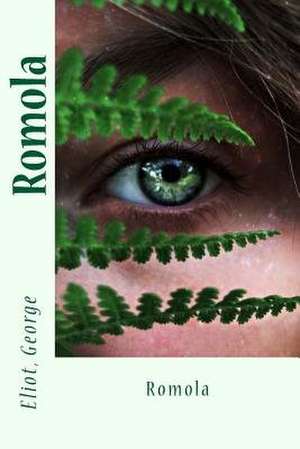
Romola
Autor George Eliot Editat de Sir Angelsen Limba Engleză Paperback
Preț: 166.08 lei
Puncte Express: 249
Carte disponibilă
Livrare economică 12-26 noiembrie
Livrare prin curier în România Termenul estimat este afișat lângă disponibilitate.
Transport gratuit de la 400.00 lei Plată online sau ramburs, în funcție de opțiunile comenzii.
Retur gratuit în 14 zile Comandă securizată și suport în română.
Specificații
ISBN-13: 9781545303702
ISBN-10: 1545303703
Pagini: 608
Dimensiuni: 152 x 229 x 31 mm
Greutate: 0.8 kg
ISBN-10: 1545303703
Pagini: 608
Dimensiuni: 152 x 229 x 31 mm
Greutate: 0.8 kg
V-ar putea interesa
-
 Preț: 79.23 lei
 -
 Giving up the GhostHilary MantelPreț: 78.80 lei
 -
 The RomaMadeline PotterPreț: 157.22 lei
 -
 How to Win Friends and Influence PeopleDale CarnegiePreț: 63.37 lei
 -
 I, ClaudiusRobert Graves-35%Preț: 60.93 lei94.17 lei
 -
 EmmaJane Austen-24%Preț: 50.51 lei66.77 lei
 -
 Forged in RomeConn IgguldenPreț: 150.75 lei
 -
 Preț: 220.81 lei
 -
 The 5 Love LanguagesGary ChapmanPreț: 93.21 lei
 -
 -25%Preț: 85.95 lei115.08 lei
 -
 The ElopementGill HornbyPreț: 139.21 lei
 -
 How to Win Friends and Influence PeopleDale Carnegie-30%Preț: 64.61 lei92.93 lei
 -
 No Way BackTheodor FontanePreț: 79.80 lei
 -
 The Divine ComedyDante AlighieriPreț: 46.55 lei
 -
 Middlemarch (Collector's Edition)George EliotPreț: 76.75 lei
 -
 -11%Preț: 62.08 lei70.00 lei
 -
 The Mill on the FlossGeorge EliotPreț: 54.43 lei
 -
 UtopiaThomas MorePreț: 33.19 lei
Notă biografică
Mary Anne Evans (22 November 1819 - 22 December 1880; alternatively Mary Ann or Marian), known by her pen name George Eliot, was an English novelist, poet, journalist, translator, and one of the leading writers of the Victorian era. She wrote seven novels, including Adam Bede (1859), The Mill on the Floss (1860), Silas Marner (1861), Romola (1862-63), Middlemarch (1871-72), and Daniel Deronda (1876), most of which are set in provincial England and known for their realism and psychological insight. Although female authors were published under their own names during her lifetime, she wanted to escape the stereotype of women's writing being limited to lighthearted romances. She also wanted to have her fiction judged separately from her already extensive and widely known work as an editor and critic. Another factor in her use of a pen name may have been a desire to shield her private life from public scrutiny, thus avoiding the scandal that would have arisen because of her relationship with the married George Henry Lewes.
Descriere
Descriere de la o altă ediție sau format:
The most exotic of George Eliot’s works, Romola recounts the story of the famous religious leader Savonarola in Florence at the time of Machiavelli and the Medicis. Of all her novels, this was the author’s favourite.
No other Eliot novel was illustrated in its first edition. Romola, however, was sought by George Smith for serialization in the prestigious illustrated Cornhill Magazine. Smith commissioned illustrations for the novel from the rising young artist Frederick Leighton, who had studied in Florence in the 1840s and had frequently painted Florentine Renaissance subjects. Romola was serialised with the Leighton illustrations in the magazine from July 1862 to August 1863. It was first published in book form in 1863; the first edition was published by Smith, Elder in three volumes, and a one-volume edition in two-column format with all but one of the Leighton illustrations was published later that year by Harper & Brothers in the United States. This facsimile reprint is of the one-volume 1863 Harper & Brothers edition, and includes 8 pages of original advertisements from the back of the book.
This is one of a series from Broadview Press of facsimile reprint editions—editions that provide readers with a direct sense of these works as the Victorians themselves experienced them.
The most exotic of George Eliot’s works, Romola recounts the story of the famous religious leader Savonarola in Florence at the time of Machiavelli and the Medicis. Of all her novels, this was the author’s favourite.
No other Eliot novel was illustrated in its first edition. Romola, however, was sought by George Smith for serialization in the prestigious illustrated Cornhill Magazine. Smith commissioned illustrations for the novel from the rising young artist Frederick Leighton, who had studied in Florence in the 1840s and had frequently painted Florentine Renaissance subjects. Romola was serialised with the Leighton illustrations in the magazine from July 1862 to August 1863. It was first published in book form in 1863; the first edition was published by Smith, Elder in three volumes, and a one-volume edition in two-column format with all but one of the Leighton illustrations was published later that year by Harper & Brothers in the United States. This facsimile reprint is of the one-volume 1863 Harper & Brothers edition, and includes 8 pages of original advertisements from the back of the book.
This is one of a series from Broadview Press of facsimile reprint editions—editions that provide readers with a direct sense of these works as the Victorians themselves experienced them.
Recenzii
The most exotic of George Eliot’s works, Romola recounts the story of the famous religious leader Savonarola in Florence at the time of Machiavelli and the Medicis. Of all her novels, this was the author’s favourite.
No other Eliot novel was illustrated in its first edition. Romola, however, was sought by George Smith for serialization in the prestigious illustrated Cornhill Magazine. Smith commissioned illustrations for the novel from the rising young artist Frederick Leighton, who had studied in Florence in the 1840s and had frequently painted Florentine Renaissance subjects. Romola was serialised with the Leighton illustrations in the magazine from July 1862 to August 1863. It was first published in book form in 1863; the first edition was published by Smith, Elder in three volumes, and a one-volume edition in two-column format with all but one of the Leighton illustrations was published later that year by Harper & Brothers in the United States. This facsimile reprint is of the one-volume 1863 Harper & Brothers edition, and includes 8 pages of original advertisements from the back of the book.
This is one of a series from Broadview Press of facsimile reprint editions—editions that provide readers with a direct sense of these works as the Victorians themselves experienced them.
No other Eliot novel was illustrated in its first edition. Romola, however, was sought by George Smith for serialization in the prestigious illustrated Cornhill Magazine. Smith commissioned illustrations for the novel from the rising young artist Frederick Leighton, who had studied in Florence in the 1840s and had frequently painted Florentine Renaissance subjects. Romola was serialised with the Leighton illustrations in the magazine from July 1862 to August 1863. It was first published in book form in 1863; the first edition was published by Smith, Elder in three volumes, and a one-volume edition in two-column format with all but one of the Leighton illustrations was published later that year by Harper & Brothers in the United States. This facsimile reprint is of the one-volume 1863 Harper & Brothers edition, and includes 8 pages of original advertisements from the back of the book.
This is one of a series from Broadview Press of facsimile reprint editions—editions that provide readers with a direct sense of these works as the Victorians themselves experienced them.