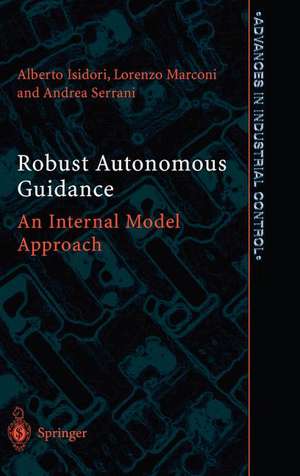
Robust Autonomous Guidance: Advances in Industrial Control
Autor Alberto Isidori, Lorenzo Marconi, Andrea Serranien Limba Engleză Hardback – oct 2003
From a review of the principles of internal-model-based feedback control design, this book moves on to expound recent enhancements to such designs and then to their implementation in systems operating under conditions of great uncertainty.
The case studies presented involve control systems coping with a high degree of nonlinear behaviour. The key issues addressed in each are the design of an adaptive internal model for the specific tracking task and of stabilizing control capable of steering the tracking error to zero while keeping all internal states bounded for any arbitrarily large but bounded envelope of initial data and uncertain parameters. Nested saturated controls form the basis of novel tools for asymptotic analysis and design.
Din seria Advances in Industrial Control
- 15%
 Preț: 670.62 lei
 - 18%
 Preț: 986.31 lei
 - 18%
 Preț: 757.72 lei
 - 18%
 Preț: 1155.07 lei
 - 18%
 Preț: 996.30 lei
 - 18%
 Preț: 931.50 lei
 - 18%
 Preț: 864.31 lei
 - 18%
 Preț: 790.01 lei
 - 18%
 Preț: 755.41 lei
 - 18%
 Preț: 1458.15 lei
 - 18%
 Preț: 758.73 lei
 - 15%
 Preț: 663.00 lei
 - 15%
 Preț: 663.48 lei
 - 15%
 Preț: 664.95 lei
 - 18%
 Preț: 925.33 lei
 - 18%
 Preț: 775.66 lei
 - 18%
 Preț: 951.24 lei
 - 18%
 Preț: 987.51 lei
 - 15%
 Preț: 666.44 lei
 - 15%
 Preț: 664.72 lei
 - 18%
 Preț: 983.57 lei
 - 15%
 Preț: 663.58 lei
 - 18%
 Preț: 1436.95 lei
 - 18%
 Preț: 980.03 lei
 - 18%
 Preț: 984.66 lei
 - 18%
 Preț: 982.24 lei
 - 18%
 Preț: 985.21 lei
 - 18%
 Preț: 1148.21 lei
 - 15%
 Preț: 669.91 lei
 - 15%
 Preț: 663.58 lei
 - 18%
 Preț: 979.63 lei
 - 18%
 Preț: 982.74 lei
 - 18%
 Preț: 1153.23 lei
 - 15%
 Preț: 664.01 lei
 - 18%
 Preț: 982.58 lei
 - 18%
 Preț: 980.78 lei
 - 15%
 Preț: 660.75 lei
 - 15%
 Preț: 663.58 lei
 - 20%
 Preț: 669.73 lei
 - 18%
 Preț: 1148.59 lei
 - 20%
 Preț: 1029.39 lei
 - 15%
 Preț: 667.27 lei
 - 24%
 Preț: 1082.44 lei
 - 18%
 Preț: 978.15 lei
 - 18%
 Preț: 1342.56 lei
 - 15%
 Preț: 676.08 lei
 - 15%
 Preț: 666.52 lei
 - 20%
 Preț: 620.99 lei
 - 18%
 Preț: 1080.75 lei
Preț: 1145.88 lei
Preț vechi: 1397.41 lei
-18%
Puncte Express: 1719
Carte tipărită la comandă
Livrare economică 26 noiembrie-10 decembrie
Livrare prin curier în România Termenul estimat este afișat lângă disponibilitate.
Transport gratuit pentru acest produs Plată online sau ramburs, în funcție de opțiunile comenzii.
Retur gratuit în 14 zile Comandă securizată și suport în română.
Specificații
ISBN-13: 9781852336950
ISBN-10: 1852336951
Pagini: 248
Ilustrații: XVI, 229 p.
Dimensiuni: 160 x 241 x 19 mm
Greutate: 0.49 kg
Ediția:2003
Editura: Springer
Colecția Advances in Industrial Control
Seria Advances in Industrial Control
Locul publicării:London, United Kingdom
ISBN-10: 1852336951
Pagini: 248
Ilustrații: XVI, 229 p.
Dimensiuni: 160 x 241 x 19 mm
Greutate: 0.49 kg
Ediția:2003
Editura: Springer
Colecția Advances in Industrial Control
Seria Advances in Industrial Control
Locul publicării:London, United Kingdom
V-ar putea interesa
-
 Arduino Robot BonanzaGordon McComb-38%Preț: 210.57 lei339.85 lei
 -
 Robotics: A Very Short IntroductionAlan Winfield-20%Preț: 57.12 lei71.12 lei
 -
 The Technological SingularityMurray Shanahan-21%Preț: 97.48 lei122.92 lei
 -
 Optimal ControlFrank L Lewis-9%Preț: 992.25 lei1090.39 lei
 -
 Output Regulation of Uncertain Nonlinear SystemsChristopher I. Byrnes-15%Preț: 657.71 lei773.77 lei
 -
 Practical Field RoboticsSturges-8%Preț: 636.53 lei691.87 lei
 -
 Trends in ControlAlberto IsidoriPreț: 399.70 lei
 -
 Human-Robot Interaction in Social RoboticsTakayuki Kanda-18%Preț: 1611.04 lei1964.69 lei
 -
 Parallel Robots: Mechanics and ControlHamid D. Taghirad-20%Preț: 1784.20 lei2230.26 lei
 -
 Process Control: Problems, Techniques and ApplicationsSamuel P. Werther-27%Preț: 1165.46 lei1585.77 lei
 -
 Control of Complex SystemsKarl J. Aström-18%Preț: 990.48 lei1207.90 lei
 -
 Nonlinear Control in the Year 2000Alberto IsidoriPreț: 426.50 lei
 -
 ProzeßautomatisierungGerhard-Helge SchildtPreț: 218.93 lei
 -
 Lectures in Feedback Design for Multivariable SystemsAlberto Isidori-15%Preț: 679.75 lei799.71 lei
 -
 Spatial Representation and Motion PlanningAngel P. Del PobilPreț: 373.86 lei
 -
 Reasoning with Uncertainty in RoboticsLeo DorstPreț: 397.70 lei
 -
 -15%Preț: 615.35 lei723.94 lei
 -
 Advances in Control Theory and ApplicationsClaudio Bonivento-18%Preț: 929.64 lei1133.70 lei
 -
 Analysis and Design of Nonlinear Control SystemsAlessandro Astolfi-18%Preț: 1278.69 lei1559.37 lei
 -
 -18%Preț: 907.25 lei1106.39 lei
 -
 Evolutionary Swarm RoboticsVito Trianni-18%Preț: 975.20 lei1189.28 lei
 -
 European Robotics Symposium 2008Herman Bruyninckx-18%Preț: 989.52 lei1206.74 lei
 -
 -18%Preț: 912.09 lei1112.30 lei
Public țintă
ResearchCuprins
1. Fundamentals of Internal-model-based Control Theory.- 2. Attitude Regulation of a LEO Rigid Satellite.- 3. VTOL Landing: Design of the Internal Model.- 4. VTOL Landing: Design of the Stabilizer.- 5. Robust Nonlinear Motion Control of a Helicopter.- A. Attitude Parameterization.- A.1 Rotation Matrices.- A.2 Quaternions.- B. Input-to-state Stability and Small Gain Theorems.- B.1 Comparison Functions.- B.2 Input-to-state Stability: Definitions and Criteria.- B.3 The Small Gain Theorem.- C. Stabilization of an Uncertain Chain of Integrators by Satu rated Feedback.- C.1 Saturation Functions.- C.2 Robust Stabilization of a Chain of Integrators by Saturated Feedback.- References.
Recenzii
The book is well organized and well written. Each chapter starts with an introductory section and each case study concludes with simulation results. The book is an excellent combination of theory and real-world applications. Each application not only demonstrates the power of the theoretical results but also is important on its own behalf.
This book is a valuable addition to references for academic researchers and industrial engineers working in the field of nonlinear control systems design, in particular, for aerospace guidance systems. The book can also serve as a useful reference for graduate courses in nonlinear control systems.
IEEE Control Systems Magazine (October 2004) (Reviewer: Qian Wang)
This book is a valuable addition to references for academic researchers and industrial engineers working in the field of nonlinear control systems design, in particular, for aerospace guidance systems. The book can also serve as a useful reference for graduate courses in nonlinear control systems.
IEEE Control Systems Magazine (October 2004) (Reviewer: Qian Wang)
Textul de pe ultima copertă
A typical plant control system will be subject to the undesirable influence of exogenous commands and disturbances. In order to track and reject these Professor Isidori and his co-authors have designed a feedback control system based on embedding a model of these disturbances within the controller itself - the so-called "internal model".
Beginning with a review of the fundamental principles of internal-model-based feedback control design, Robust Autonomous Guidance moves on to expound recent enhancements to such designs and then to their implementation in systems operating under conditions of great uncertainty.
The three case studies presented: attitude control of a low-Earth-orbit satellite and the landing of fixed- and rotary-winged aircraft on a ship involve control systems coping with a high degree of nonlinear behaviour. The key issues addressed in each case study are the design of an adaptive internal model for the specific tracking task and of stabilizing control capable of steering the tracking error to zero while keeping all internal states bounded for any arbitrarily large but bounded envelope of initial data and uncertain parameters. Nested saturated controls form the basis of novel tools for asymptotic analysis and design.
Robust Autonomous Guidance will be of great interest to academic and industrial researchers working with nonlinear control systems and to engineers involved in the design of aerospatial guidance systems. It will also be a useful reference for graduate students working with non-linear systems.
Advances in Industrial Control aims to report and encourage the transfer of technology in control engineering. The rapid development of control technology has an impact on all areas of the control discipline. The series offers an opportunity for researchers to present an extended exposition of new work in all aspects of industrial control.
Beginning with a review of the fundamental principles of internal-model-based feedback control design, Robust Autonomous Guidance moves on to expound recent enhancements to such designs and then to their implementation in systems operating under conditions of great uncertainty.
The three case studies presented: attitude control of a low-Earth-orbit satellite and the landing of fixed- and rotary-winged aircraft on a ship involve control systems coping with a high degree of nonlinear behaviour. The key issues addressed in each case study are the design of an adaptive internal model for the specific tracking task and of stabilizing control capable of steering the tracking error to zero while keeping all internal states bounded for any arbitrarily large but bounded envelope of initial data and uncertain parameters. Nested saturated controls form the basis of novel tools for asymptotic analysis and design.
Robust Autonomous Guidance will be of great interest to academic and industrial researchers working with nonlinear control systems and to engineers involved in the design of aerospatial guidance systems. It will also be a useful reference for graduate students working with non-linear systems.
Advances in Industrial Control aims to report and encourage the transfer of technology in control engineering. The rapid development of control technology has an impact on all areas of the control discipline. The series offers an opportunity for researchers to present an extended exposition of new work in all aspects of industrial control.
Caracteristici
Shows the reader how to apply nonlinear design techniques to three important and widely used case studies Demonstrates how nonlinear control can be adapted to take account of the severe uncertainties and complex nonlinear dynamics typical of applications in the real world Nonlinear control is notoriously awkward - the material in this book will mean a considerable saving in time and effort for the industrial reader in implementing robust nonlinear control systems Includes supplementary material: sn.pub/extras
Notă biografică
Alberto Isidori was born in Rapallo, Italy. He graduated in electrical engineering from the University of Rome in 1965. In 1969 he obtained a degree equivalent to a doctorate in automatic control from the University of Rome.
Since 1975, he has been Professor of Automatic Control at the University of Rome "La Sapienza". Since 1989, he has also held a position of rofessor (on a half-time basis) at the Department of Systems Science and Mathematics, Washington University, St. Louis, Missouri. He has held visiting positions at several academic institutions, including the University of Illinois (Urbana, Il.), the University of California (Berkeley, Ca.) and the ETH (Zurich, Switzerland).
His research interests are primarily focused on mathematical control theory and control engineering.
In 1979, Alberto Isidori initiated a research program aimed at the extension of so-called "geometric theory" of multivariable linear systems, pioneered in the early 1970s by various authors,to linear systems. Linear algebra and linear geometric methods were replaced in nonlinear systems by the methods of differential geometry, whose usefulness in the study of controllability, observability, and minimality of nonlinear systems had been demonstrated in the early 70s. The main intuition of Isidori was to use differential geometric methods in the synthesis of feedback laws for nonlinear systems, more or less in the same way as linear geometric methods were used in the synthesis of feedback laws for linear systems. The result of this seminal work was the development of systematic methods addressing outstanding design problems like feedback linearization, noninteracting control, disturbance decoupling, and model matching.
From 1985 to 1990 Isidori's research concentrated on the development of the "nonlinear analogue" of the notion of the "zero" of a transfer function. Taking as a point of departure the "geometric" interpretation of this notion, the concept of nonlinear zero dynamics was introduced, studied, and applied. As a result, it was shown that most of the features of the notion of zeros of the transfer function of a linear system are actually manifestations of more general principles. Remarkable examples of application of this theory consisted in the study and the solution of the nonlinear equivalent of the so-called "servomechanism problem" of linear system theory and in the characterization of the conditions for feedback equivalence to a nonlinear passive system.
Since the 90s, Isidori has focused his research interests on problems of disturbance attenuation and robust stabilization of nonlinear systems.
Professional Activities
-President of the European Union Control Association (1995-1997).
-Member of the IFAC Council (1993-1996).
-President-elect of IFAC (three-year term to begin following IFAC World Congress in Seoul 2008)
-On the Editorial Board of: European Journal of Control (since 1995), Automatica (since 1990), IEEE Transactions on Automatic Control (since 1990), International Journal of Control (since 1990), International Journal of Robust and Nonlinear Control (since 1991), Journal of Mathematical Systems, Estimation and Control (since 1991), Mathematics of Control, Signals and Systems (1987-89), Applied Stochastic Models and Data Analysis (since 1985), Systems and Control Letters (1981-88).
Awards and Honors
-Georgio Quazza Medal of IFAC, for ?pionering and fundamental contributions to the theory of nonlinear control,? 1996.
-Fellow of the Institute of Electrical and Electronic Engineers, for ?fundamental contributions to nonlinear control theory?, 1987.
-Outstanding Paper Award for papers published on IEEE Transactions on Automatic Control, in 1981 and in 1990.
-Outstanding Paper Award a paper published on Automatica in1991.
Selected PublicationsNonlinear Control Systems (3rd