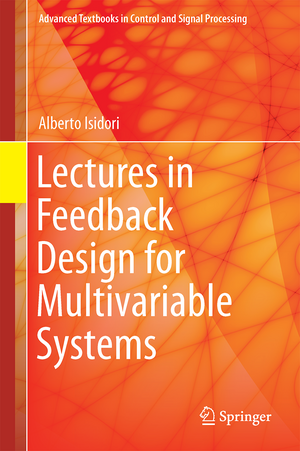
Lectures in Feedback Design for Multivariable Systems: Advanced Textbooks in Control and Signal Processing
Autor Alberto Isidorien Limba Engleză Hardback – 28 aug 2016
Recomandăm Lectures in Feedback Design for Multivariable Systems ca o resursă avansată de studiu, care necesită cunoștințe prealabile solide în teoria sistemelor liniare și a controlului. Lucrarea este concepută pentru a ghida cititorul prin complexitatea sistemelor multivariabile, punând un accent deosebit pe robustețe în fața incertitudinilor de modelare. Putem afirma că rigoarea matematică a expunerii este echilibrată de o structură pedagogică clară, care facilitează tranziția de la concepte fundamentale la rezultate de cercetare recente. Organizarea volumului reflectă o progresie logică: prima parte fundamentează teoria sistemelor liniare, explorând stabilizarea sistemelor cu fază minimă și aplicațiile teoremei câștigului mic, în timp ce a doua parte extinde aceste concepte către domeniul neliniar. Cititorul care a aplicat ideile din Multivariable Feedback Control de Sigurd Skogestad va găsi aici o aprofundare teoretică superioară, în special în ceea ce privește tratamentul coordonat al sistemelor neliniare MIMO, un domeniu în care Alberto Isidori aduce contribuții originale. În contextul operei autorului, această carte servește drept o sinteză modernă ce completează titluri clasice precum Nonlinear Control Systems. Dacă lucrările anterioare se concentrau pe abordarea geometrică, prezentul volum pune în lumină metodele de design pentru stabilizarea și reglarea ieșirii, integrând observatori neliniari și principiul separării. Exemplele de calcul incluse nu sunt doar ilustrative, ci oferă inginerilor din domenii precum robotica sau sistemele energetice unelte concrete pentru rezolvarea problemelor de tracking și respingere a perturbărilor externe.
Din seria Advanced Textbooks in Control and Signal Processing
- 13%
 Preț: 506.25 lei
 - 15%
 Preț: 505.54 lei
 -
 Preț: 378.95 lei
 - 15%
 Preț: 483.16 lei
 -
 Preț: 379.31 lei
 - 15%
 Preț: 563.23 lei
 -
 Preț: 402.55 lei
 - 15%
 Preț: 629.25 lei
 -
 Preț: 397.45 lei
 -
 Preț: 384.90 lei
 - 15%
 Preț: 488.46 lei
 - 19%
 Preț: 632.80 lei
 -
 Preț: 405.14 lei
 - 15%
 Preț: 549.47 lei
 - 15%
 Preț: 524.67 lei
 - 15%
 Preț: 679.65 lei
 - 15%
 Preț: 596.77 lei
 -
 Preț: 414.11 lei
 - 23%
 Preț: 708.91 lei
 - 19%
 Preț: 536.34 lei
 - 15%
 Preț: 611.08 lei
 - 25%
 Preț: 735.42 lei
Preț: 679.75 lei
Preț vechi: 799.71 lei
-15%
Carte disponibilă
Livrare economică 16-30 noiembrie
Specificații
ISBN-10: 3319420305
Pagini: 426
Ilustrații: 15 schwarz-weiße und 15 farbige Abbildungen, Bibliographie
Dimensiuni: 160 x 241 x 27 mm
Greutate: 0.83 kg
Ediția:1st ed. 2017
Editura: Springer
Seria Advanced Textbooks in Control and Signal Processing
Locul publicării:Cham, Switzerland
V-ar putea interesa
-
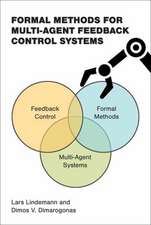 Formal Methods for Multi-Agent Feedback Control SystemsDimos V. Dimarogonas-20%Preț: 610.14 lei762.68 lei
 -
 -23%Preț: 175.25 lei227.99 lei
 -
 Linear System Theory: The State Space ApproachLofti A. ZadehPreț: 207.90 lei
 -
 Optimal Control and EstimationRobert F. Stengel-19%Preț: 214.50 lei264.50 lei
 -
 Linear Multivariable Control SystemsShankar P Bhattacharyya-11%Preț: 667.91 lei750.46 lei
 -
 Nonlinear SystemsHassan Khalil-11%Preț: 671.99 lei755.04 lei
 -
 Nonlinear Control, Global EditionHassan Khalil-11%Preț: 661.72 lei743.50 lei
 -
 MechatronicsW. Bolton-11%Preț: 667.57 lei750.07 lei
 -
 -11%Preț: 676.58 lei760.19 lei
 -
 -11%Preț: 674.61 lei758.00 lei
 -
 Linear Parameter-Varying ControlOlivier Sename-23%Preț: 718.87 lei933.60 lei
 -
 Feedback Control Systems Analysis and DesignMehdi Rahmani-AndebiliPreț: 473.12 lei
 -
 Robust and Adaptive ControlEugene LavretskyPreț: 542.07 lei
 -
 Nonlinear Systems and ControlsJürgen Adamy-23%Preț: 790.25 lei1026.31 lei
 -
 -18%Preț: 920.78 lei1122.90 lei
De ce să citești această carte
Această carte este esențială pentru studenții la masterat sau doctorat și pentru inginerii care proiectează sisteme de control pentru robotică sau mecatronică. Cititorul câștigă o înțelegere profundă a modului în care se pot proiecta legi de feedback robuste pentru sisteme complexe, trecând de la teorie la aplicații practice prin exemple detaliate care abordează direct incertitudinile de model și perturbările externe.
Despre autor
Alberto Isidori este o figură proeminentă în domeniul automaticii la nivel mondial. Absolvent de inginerie electrică la Universitatea din Roma în 1965, acesta și-a consolidat cariera ca profesor de control automat la Universitatea „La Sapienza” și la Washington University din St. Louis. Recunoscut pentru rigoarea sa științifică, Isidori a publicat lucrări fundamentale care au definit controlul neliniar modern. Expertiza sa vastă, acumulată în decenii de cercetare și predare în instituții academice de prestigiu, se reflectă în modul sistematic și coerent în care prezintă designul sistemelor de feedback în acest volum publicat de Springer.
Descriere scurtă
Divided into two parts, the first covers relevant aspects of linear-systems theory, the second, nonlinear theory. In order to deepen readers’ understanding, simpler single-input–single-output systems generally precede treatment of more complex multi-input–multi-output (MIMO) systems and linear systems precede nonlinear systems. This approach is used throughout, including in the final chapters, which explain the latest advanced ideas governing the stabilization, regulation, and tracking of nonlinear MIMO systems. Two major design problems are considered, both in the presence of model uncertainties: asymptotic stabilization with a “guaranteed region of attraction” of a given equilibrium point and asymptotic rejection of the effect of exogenous (disturbance) inputs on selected regulated outputs.
Much of the introductory instructional material in this book has been developed for teaching students, while the final coverage of nonlinear MIMO systems offers readers a first coordinated treatment of completely novel results. The worked examples presented provide the instructor with ready-to-use material to help students to understand the mathematical theory.
Readers should be familiar with the fundamentals of linear-systems and control theory. This book is a valuable resource for students following postgraduate programs in systems and control, as well as engineers working on the control of robotic, mechatronic and power systems.