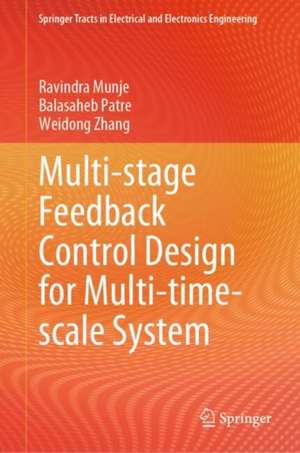
Multi-stage Feedback Control Design for Multi-time-scale System: Springer Tracts in Electrical and Electronics Engineering
Autor Ravindra Munje, Balasaheb Patre, Weidong Zhangen Limba Engleză Hardback – 24 aug 2024
Remarcăm, în analiza performanței sistemelor complexe, că abordarea unui reactor nuclear prin metode de control standard se lovește adesea de fenomenul matricelor slab condiționate din cauza valorilor proprii dispersate. Multi-stage Feedback Control Design for Multi-time-scale System răspunde acestei provocări tehnice printr-o metodologie de proiectare în etape, demonstrată riguros prin simularea controlului distribuției puterii într-un Advanced Heavy Water Reactor (AHWR). Suntem de părere că inovația majoră a acestei lucrări rezidă în gestionarea sistemelor cu scale de timp multiple (lente, rapide și foarte rapide), unde eșantionarea cu o singură rată fie pierde informații critice, fie supraîncarcă procesorul. Dacă Multi-Stage and Multi-Time Scale Feedback Control of Linear Systems with Applications to Fuel Cells de Verica Radisavljević-Gajić v-a oferit cadrul teoretic al subsistemelor liniare, volumul de față, semnat de Ravindra Munje, Balasaheb Patre și Weidong Zhang, oferă instrumentele practice pentru implementarea în domeniul discret prin scheme de eșantionare multi-rate. Structura cărții este concepută progresiv: începe cu fundamentele designului în trei etape pentru sisteme continue, trece prin proiectarea observatorilor pentru feedback-ul de ieșire și culminează cu strategii avansate pentru timpul discret. Această abordare continuă temele explorate anterior de Ravindra Munje în lucrarea Investigation of Spatial Control Strategies with Application to Advanced Heavy Water Reactor, rafinând strategiile de control spațial prin reducerea complexității de calcul și îmbunătățirea robusteții buclei închise.
Din seria Springer Tracts in Electrical and Electronics Engineering
- 19%
 Preț: 590.64 lei
 - 20%
 Preț: 1078.28 lei
 - 24%
 Preț: 908.37 lei
 - 20%
 Preț: 1072.62 lei
 - 20%
 Preț: 646.45 lei
 - 24%
 Preț: 1011.75 lei
 - 24%
 Preț: 784.60 lei
 - 18%
 Preț: 1043.99 lei
 - 5%
 Preț: 1258.13 lei
 - 20%
 Preț: 785.58 lei
 - 18%
 Preț: 1160.05 lei
 - 18%
 Preț: 1155.03 lei
 - 18%
 Preț: 921.29 lei
 - 18%
 Preț: 1044.45 lei
 - 18%
 Preț: 1276.80 lei
 - 18%
 Preț: 1067.35 lei
 - 18%
 Preț: 781.46 lei
 - 24%
 Preț: 945.41 lei
 - 24%
 Preț: 888.12 lei
 -
 Preț: 330.90 lei
 - 24%
 Preț: 833.88 lei
 - 24%
 Preț: 824.11 lei
 -
 Preț: 448.88 lei
 - 20%
 Preț: 1203.62 lei
 - 24%
 Preț: 1081.52 lei
 - 18%
 Preț: 1265.16 lei
 - 18%
 Preț: 805.90 lei
 - 18%
 Preț: 1150.93 lei
 - 18%
 Preț: 1606.78 lei
Preț: 920.78 lei
Preț vechi: 1122.90 lei
-18%
Carte disponibilă
Livrare economică 13-27 noiembrie
Specificații
ISBN-10: 9819745918
Pagini: 152
Ilustrații: XX, 180 p. 20 illus.
Dimensiuni: 160 x 241 x 14 mm
Greutate: 0.35 kg
Ediția:2024
Editura: Springer
Colecția Springer Tracts in Electrical and Electronics Engineering
Seria Springer Tracts in Electrical and Electronics Engineering
Locul publicării:Singapore, Singapore
V-ar putea interesa
-
 Formal Methods for Multi-Agent Feedback Control SystemsDimos V. Dimarogonas-20%Preț: 610.14 lei762.68 lei
 -
 Signals and Systems Using MATLAB®Aydin Akan-31%Preț: 676.23 lei981.55 lei
 -
 -23%Preț: 175.25 lei227.99 lei
 -
 Linear Multivariable Control SystemsShankar P Bhattacharyya-11%Preț: 667.91 lei750.46 lei
 -
 -11%Preț: 676.58 lei760.19 lei
 -
 -11%Preț: 674.61 lei758.00 lei
 -
 -23%Preț: 1294.93 lei1681.72 lei
 -
 Multi-Stage and Multi-Time Scale Feedback Control of Linear Systems with Applications to Fuel CellsVerica Radisavljevi¿-Gaji¿-15%Preț: 667.41 lei785.19 lei
 -
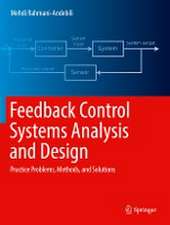 Feedback Control Systems Analysis and DesignMehdi Rahmani-AndebiliPreț: 473.12 lei
 -
 An Introduction to Optimal Control TheoryOnésimo Hernández-LermaPreț: 479.91 lei
 -
 Sliding-Mode Control and Variable-Structure SystemsTiago Roux Oliveira-18%Preț: 1457.64 lei1777.61 lei
 -
 Robust and Adaptive ControlEugene LavretskyPreț: 542.07 lei
 -
 Signals and Systems with MATLAB® and Simulink®Farzin AsadiPreț: 431.01 lei
 -
 Lectures in Feedback Design for Multivariable SystemsAlberto Isidori-15%Preț: 679.75 lei799.71 lei
 -
 Advanced Control Methods for Industrial ProcessesPablo A. López-Pérez-23%Preț: 698.89 lei907.65 lei
 -
 -18%Preț: 1449.74 lei1767.97 lei
 -
 Control Applications in Modern Power SystemsShailendra Kumar-18%Preț: 1064.06 lei1297.63 lei
De ce să citești această carte
Această carte este esențială pentru inginerii de sistem și cercetătorii care lucrează cu infrastructuri critice, precum centralele electrice. Cititorul câștigă metode concrete pentru a proiecta controlere eficiente care economisesc resurse computaționale, evitând în același timp instabilitatea numerică specifică sistemelor cu dinamici variate. Este un ghid tehnic ce face trecerea de la teoria matricială la aplicații industriale reale, oferind soluții pentru optimizarea timpului de răspuns și a preciziei observatorilor.
Despre autor
Ravindra Munje, împreună cu coautorii Balasaheb Patre și Weidong Zhang, reprezintă o echipă de experți în inginerie electrică și sisteme de control, cu o vastă experiență în modelarea reactoarelor nucleare și a sistemelor energetice de mare putere. Ravindra Munje este recunoscut pentru cercetările sale privind strategiile de control spațial aplicate la Advanced Heavy Water Reactors (AHWR), concentrându-se pe transformarea modelelor matematice complexe în algoritmi de control aplicabili. Contribuțiile lor în cadrul seriei Springer Tracts in Electrical and Electronics Engineering subliniază angajamentul pentru reducerea complexității computaționale în ingineria modernă.
Descriere scurtă
This book also discusses the design of multi-stage feedback controllers in discrete time. The design of state feedback control for a multi-time-scale system with a lower sampling rate fails to capture information in the fastest (very fast) and fast states. While sampling at a higher rate increases computation time. Thus, the use of single-rate sampling for such systems is unsuitable. Therefore, multi-rate state feedback controllers are designed for the multi-time-scale system, in which slow, fast, and very fast states are sampled at different sampling rates. As slow, fast and very fast states are the decoupled and internal states of the original system, these are estimated by the sequential multi-stage observers. Applications of these multirate designs to the numerical examples are demonstrated and simulations are compared with single-rate sampling methods. The methods suggested in this book result in considerable savings in online and offline computations, reduction in design complexity, and improvement in robustness and closed-loop performance. This book can be beneficial to mathematicians, scientists, researchers and practicing engineers working in this area.
Cuprins
Notă biografică
Dr. Balasaheb M. Patre completed a Bachelor of Instrumentation Engineering in 1986 and, a Masters of Instrumentation Engineering in 1990, both from SGGS Institute of Engineering and Technology, Vishnupuri, Nanded, and Ph. D. from Indian Institute of Technology (IIT), Bombay in 1998. Currently, he is working as a Professor at the Department of Instrumentation Engineering, SGGS Institute of Engineering and Technology, Vishnupuri, Nanded, Maharashtra. He has published more than 80 International Journal Papers, more than 100 National and International Conference papers, 6 Books, and 5 Book Chapters. He is a reviewer for 45 international (SCI/SCIE indexed) peer-reviewed journals. He has completed sponsored research projects from DST, AICTE, BARC, BRNS, and NRB. He has so far supervised 22 students for Ph. D. and 5 students are currently pursuing Ph. D. under his guidance in the areas of systems and control engineering in general and robust control, nuclear reactor control, sliding mode control and applications, and process control in particular. Dr. Patre is a senior member of IEEE, a Fellow of the Institution of Engineers (India), a Member of IETE (India), and a life member of ISTE.
Dr. Weidong Zhang received his BS, MS, and Ph.D. degrees from Zhejiang University, China, in 1990, 1993, and 1996, respectively, and then worked as a Postdoctoral Fellow at Shanghai Jiaotong University. He joined Shanghai Jiaotong University in 1998 as an Associate Professor and has been a Full Professor since 1999. From 2003 to 2004, he worked at the University of Stuttgart, Germany, as an Alexander von Humboldt Fellow. He is a recipient of the National Science Fund for Distinguished Young Scholars of China. In 2011 he was appointed Chair Professor at Shanghai Jiaotong University. He is currently the Director of the Engineering Research Center of Marine Automation, Municipal Education Commission. His research interests include control theory and its applications in industry and ocean engineering. He is the author of more than 300 refereed papers and 1 book and holds 32 patents.