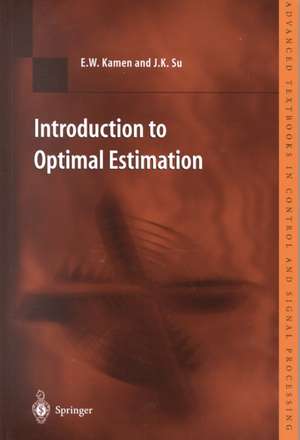
Introduction to Optimal Estimation: Advanced Textbooks in Control and Signal Processing
Autor Edward W. Kamen, Jonathan K. Suen Limba Engleză Paperback – 30 sep 1999
Din seria Advanced Textbooks in Control and Signal Processing
- 15%
 Preț: 679.75 lei
 - 13%
 Preț: 506.25 lei
 - 15%
 Preț: 505.54 lei
 -
 Preț: 378.95 lei
 - 15%
 Preț: 483.16 lei
 -
 Preț: 379.31 lei
 - 15%
 Preț: 563.23 lei
 -
 Preț: 402.55 lei
 - 15%
 Preț: 629.25 lei
 -
 Preț: 384.90 lei
 - 15%
 Preț: 488.46 lei
 - 19%
 Preț: 632.80 lei
 -
 Preț: 405.14 lei
 - 15%
 Preț: 549.47 lei
 - 15%
 Preț: 524.67 lei
 - 15%
 Preț: 679.65 lei
 - 15%
 Preț: 596.77 lei
 -
 Preț: 414.11 lei
 - 23%
 Preț: 708.91 lei
 - 19%
 Preț: 536.34 lei
 - 15%
 Preț: 611.08 lei
 - 25%
 Preț: 735.42 lei
Preț: 397.45 lei
Puncte Express: 596
Carte tipărită la comandă
Livrare economică 07-21 decembrie
Livrare prin curier în România Termenul estimat este afișat lângă disponibilitate.
Transport gratuit de la 400.00 lei Plată online sau ramburs, în funcție de opțiunile comenzii.
Retur gratuit în 14 zile Comandă securizată și suport în română.
Specificații
ISBN-13: 9781852331337
ISBN-10: 185233133X
Pagini: 400
Ilustrații: XIV, 380 p.
Dimensiuni: 155 x 235 x 22 mm
Greutate: 0.6 kg
Ediția:1999
Editura: Springer
Colecția Advanced Textbooks in Control and Signal Processing
Seria Advanced Textbooks in Control and Signal Processing
Locul publicării:London, United Kingdom
ISBN-10: 185233133X
Pagini: 400
Ilustrații: XIV, 380 p.
Dimensiuni: 155 x 235 x 22 mm
Greutate: 0.6 kg
Ediția:1999
Editura: Springer
Colecția Advanced Textbooks in Control and Signal Processing
Seria Advanced Textbooks in Control and Signal Processing
Locul publicării:London, United Kingdom
V-ar putea interesa
-
 -27%Preț: 992.55 lei1359.66 lei
 -
 -27%Preț: 992.27 lei1359.27 lei
 -
 Industrial Controls and ManufacturingEdward W. Kamen-23%Preț: 439.17 lei570.35 lei
 -
 Stability and Robustness of Multivariable Feedback SystemsMichael George Safonov-20%Preț: 197.75 lei247.19 lei
 -
 -15%Preț: 628.02 lei738.84 lei
 -
 Sewer Management SystemsThomas J Day-9%Preț: 999.40 lei1098.25 lei
 -
 -20%Preț: 1538.93 lei1923.66 lei
 -
 -23%Preț: 556.27 lei722.42 lei
 -
 AutomationEduardo Salas-23%Preț: 923.21 lei1198.97 lei
 -
 Control System ApplicationsWilliam S. Levine-18%Preț: 1371.35 lei1672.38 lei
 -
 Optimal Control SystemsD. Subbaram Naidu-18%Preț: 1195.51 lei1457.94 lei
 -
 Introduction to Feedback Control TheoryHitay Ozbay-18%Preț: 1042.50 lei1271.34 lei
 -
 -18%Preț: 1080.09 lei1317.18 lei
 -
 -20%Preț: 709.78 lei887.22 lei
 -
 Techno-Societal 2018Prashant M. Pawar-24%Preț: 1751.84 lei2305.05 lei
 -
 -15%Preț: 616.03 lei724.74 lei
 -
 FeedbackTom MoirPreț: 511.62 lei
 -
 -24%Preț: 891.21 lei1172.64 lei
 -
 -15%Preț: 614.11 lei722.48 lei
 -
 Advances in Physical Agents IILuis M. Bergasa-18%Preț: 952.65 lei1161.77 lei
 -
 Interval Reachability AnalysisPierre-Jean Meyer-15%Preț: 407.37 lei479.25 lei
 -
 Hanns Peter Jörgl: Repetitorium Regelungstechnik. Band 2Hanns Peter Jörgl-9%Preț: 630.55 lei692.91 lei
 -
 Synthese und Analyse digitaler SchaltungenGerd Scarbata-9%Preț: 644.37 lei708.09 lei
 -
 Modellbasierte prädiktive RegelungRainer Dittmar-8%Preț: 410.41 lei446.10 lei
 -
 Privacy in Dynamical SystemsFarhad Farokhi-15%Preț: 546.70 lei643.17 lei
 -
 -18%Preț: 852.80 lei1040.00 lei
Public țintă
Professional/practitionerCuprins
1 Introduction.- 1.1 Signal Estimation.- 1.2 State Estimation.- 1.3 Least Squares Estimation.- Problems.- 2 Random Signals and Systems with Random Inputs.- 2.1 Random Variables.- 2.2 Random Discrete-Time Signals.- 2.3 Discrete-Time Systems with Random Inputs.- Problems.- 3 Optimal Estimation.- 3.1 Formulating the Problem.- 3.2 Maximum Likelihood and Maximum a posteriori Estimation.- 3.3 Minimum Mean-Square Error Estimation.- 3.4 Linear MMSE Estimation.- 3.5 Comparison of Estimation Methods.- Problems.- 4 The Wiener Filter.- 4.1 Linear Time-Invariant MMSE Filters.- 4.2 The FIR Wiener Filter.- 4.3 The Noncausal Wiener Filter.- 4.4 Toward the Causal Wiener Filter.- 4.5 Derivation of the Causal Wiener Filter.- 4.6 Summary of Wiener Filters.- Problems.- 5 Recursive Estimation and the Kaiman Filter.- 5.1 Estimation with Growing Memory.- 5.2 Estimation of a Constant Signal.- 5.3 The Recursive Estimation Problem.- 5.4 The Signal/Measurement Model.- 5.5 Derivation of the Kaiman Filter.- 5.6 Summary of Kaiman Filter Equations.- 5.7 Kaiman Filter Properties.- 5.8 The Steady-state Kaiman Filter.- 5.9 The SSKF as an Unbiased Estimator.- 5.10 Summary.- Problems.- 6 Further Development of the Kaiman Filter.- 6.1 The Innovations.- 6.2 Derivation of the Kaiman Filter from the Innovations.- 6.3 Time-varying State Model and Nonstationary Noises.- 6.4 Modeling Errors.- 6.5 Multistep Kaiman Prediction.- 6.6 Kaiman Smoothing.- Problems.- 7 Kaiman Filter Applications.- 7.1 Target Tracking.- 7.2 Colored Process Noise.- 7.3 Correlated Noises.- 7.4 Colored Measurement Noise.- 7.5 Target Tracking with Polar Measurements.- 7.6 System Identification.- Problems.- 8 Nonlinear Estimation.- 8.1 The Extended Kalman Filter.- 8.2 An Alternate Measurement Update.- 8.3 Nonlinear System Identification UsingNeural Networks.- 8.4 Frequency Demodulation.- 8.5 Target Tracking Using the EKF.- 8.6 Multiple Target Tracking.- Problems.- A The State Representation.- A.1 Discrete-Time Case.- A.2 Construction of State Models.- A.3 Dynamical Properties.- A.4 Discretization of Noise Covariance Matrices.- B The z-transform.- B.1 Region of Convergence.- B.2 z-transform Pairs and Properties.- B.3 The Inverse z-transform.- C Stability of the Kaiman Filter.- C.1 Observability.- C.2 Controllability.- C.3 Types of Stability.- C.4 Positive-Definiteness of P(n).- C.5 An Upper Bound for P(n).- C.6 A Lower Bound for P(n).- C.7 A Useful Control Lemma.- C.8 A Kaiman Filter Stability Theorem.- C.9 Bounds for P(n).- D The Steady-State Kaiman Filter.- D.2 A Stabilizability Lemma.- D.3 Preservation of Ordering.- D.5 Existence and Stability.- E Modeling Errors.- E.1 Inaccurate Initial Conditions.- E.2 Nonlinearities and Neglected States.- References.
Textul de pe ultima copertă
This book, developed from a set of lecture notes by Professor Kamen, and since expanded and refined by both authors, is an introductory yet comprehensive study of its field. It contains examples that use MATLAB® and many of the problems discussed require the use of MATLAB®. The primary objective is to provide students with an extensive coverage of Wiener and Kalman filtering along with the development of least squares estimation, maximum likelihood estimation and a posteriori estimation, based on discrete-time measurements. In the study of these estimation techniques there is strong emphasis on how they interrelate and fit together to form a systematic development of optimal estimation. Also included in the text is a chapter on nonlinear filtering, focusing on the extended Kalman filter and a recently-developed nonlinear estimator based on a block-form version of the Levenberg-Marquadt Algorithm.
Caracteristici
A strong technical reference book for both students and engineers Authors are well-respected in their field