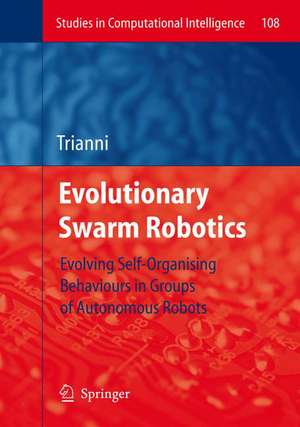
Evolutionary Swarm Robotics: Studies in Computational Intelligence, cartea 108
Autor Vito Triannien Limba Engleză Hardback – 30 mai 2008
ER techniques should be used in order to obtain robust and efficient group behaviours based on self-organisation. From a more theoretical point of view, the second important contribution brought forth by the author's experiments concerns the understanding of the basic principles underlying self-organising behaviours and collective intelligence. In this experimental work, the evolved behaviours are analysed in order to uncover the mechanisms that have led to a certain organisation.
In summary, this book tries to mediate between two apparently opposed perspectives: engineering and cognitive science. The experiments presented and the results obtained contribute to the assessment of ER not only as a design tool, but also as a methodology for modelling and understanding intelligent adaptive behaviours.
Din seria Studies in Computational Intelligence
- 18%
 Preț: 924.22 lei
 - 20%
 Preț: 1229.71 lei
 - 5%
 Preț: 1058.46 lei
 - 20%
 Preț: 1030.18 lei
 - 18%
 Preț: 849.88 lei
 - 15%
 Preț: 626.20 lei
 - 20%
 Preț: 562.99 lei
 - 24%
 Preț: 891.41 lei
 - 20%
 Preț: 317.05 lei
 - 20%
 Preț: 1105.37 lei
 - 20%
 Preț: 1230.68 lei
 - 20%
 Preț: 671.27 lei
 - 18%
 Preț: 980.46 lei
 - 18%
 Preț: 980.87 lei
 - 15%
 Preț: 665.10 lei
 - 18%
 Preț: 982.36 lei
 - 20%
 Preț: 1090.62 lei
 - 20%
 Preț: 1395.65 lei
 - 20%
 Preț: 1244.59 lei
 - 15%
 Preț: 661.64 lei
 - 15%
 Preț: 658.54 lei
 - 15%
 Preț: 655.95 lei
 - 15%
 Preț: 664.69 lei
 - 20%
 Preț: 1014.94 lei
 - 20%
 Preț: 1066.64 lei
 - 18%
 Preț: 1280.90 lei
 - 18%
 Preț: 950.43 lei
 - 15%
 Preț: 663.45 lei
 - 18%
 Preț: 1381.17 lei
 - 15%
 Preț: 656.62 lei
 - 18%
 Preț: 979.20 lei
 - 18%
 Preț: 980.03 lei
Preț: 975.20 lei
Preț vechi: 1189.28 lei
-18%
Puncte Express: 1463
Carte tipărită la comandă
Livrare economică 03-17 decembrie
Livrare prin curier în România Termenul estimat este afișat lângă disponibilitate.
Transport gratuit pentru acest produs Plată online sau ramburs, în funcție de opțiunile comenzii.
Retur gratuit în 14 zile Comandă securizată și suport în română.
Specificații
ISBN-13: 9783540776116
ISBN-10: 3540776117
Pagini: 208
Ilustrații: XVI, 192 p.
Dimensiuni: 160 x 241 x 16 mm
Greutate: 0.43 kg
Ediția:2008
Editura: Springer
Colecția Studies in Computational Intelligence
Seria Studies in Computational Intelligence
Locul publicării:Berlin, Heidelberg, Germany
ISBN-10: 3540776117
Pagini: 208
Ilustrații: XVI, 192 p.
Dimensiuni: 160 x 241 x 16 mm
Greutate: 0.43 kg
Ediția:2008
Editura: Springer
Colecția Studies in Computational Intelligence
Seria Studies in Computational Intelligence
Locul publicării:Berlin, Heidelberg, Germany
V-ar putea interesa
-
 Brushless Servomotors: Fundamentals and ApplicationsYasuhiko Dote-20%Preț: 326.71 lei409.92 lei
 -
 Computational Principles of Mobile RoboticsGregory Dudek-20%Preț: 350.17 lei437.35 lei
 -
 Biologically Inspired RoboticsYunhui Liu-18%Preț: 1162.67 lei1417.89 lei
 -
 Make a Mind-Controlled Arduino RobotTero Karvinen-20%Preț: 48.06 lei60.08 lei
 -
 Encyclopedia of Electronic Components Volume 1Charles PlattPreț: 147.62 lei
 -
 -18%Preț: 2624.58 lei3200.72 lei
 -
 The Unofficial Lego Mindstorms Nxt 2.0 Inventor's GuideDavid J. PerduePreț: 156.37 lei
 -
 The LEGO Technic Idea Book: Simple MachinesYoshihito Isogawa-19%Preț: 133.26 lei163.69 lei
 -
 The LEGO Technic Idea Book: Wheeled WondersYoshihito Isogawa-19%Preț: 110.64 lei136.05 lei
 -
 Military Robots and Drones: A Reference HandbookPaul J. Springer-44%Preț: 272.01 lei485.48 lei
 -
 Control TheoryJames Ron Leigh-18%Preț: 818.65 lei998.35 lei
 -
 Experimental RoboticsM. Ani Hsieh-18%Preț: 1018.07 lei1241.55 lei
 -
 Logistik-Wörterbuch. Dictionary of LogisticsVanessa Scott-Sabic-18%Preț: 838.28 lei1022.30 lei
 -
 Cooperative ControlVijay Kumar-15%Preț: 644.30 lei758.00 lei
 -
 -18%Preț: 907.25 lei1106.39 lei
 -
 Handbook of Collective Robotics: Fundamentals and ChallengesSerge Kernbach-20%Preț: 1541.98 lei1927.47 lei
 -
 SIMULTANEOUS LOCALIZATION AND MAPPINGWang Zhan-20%Preț: 600.33 lei750.42 lei
 -
 Field RoboticsPhilippe Bidaud-18%Preț: 2099.84 lei2560.78 lei
Public țintă
ResearchCuprins
The Evolution of Self-Organization.- Embodied Cognitive Science.- Multi-Robot Systems, Swarm Robotics and Self-Organisation.- Evolutionary Robotics for Self-Organising Behaviours.- Experiments with Simulated and Real Robots.- A Self-Organising Artefact: The Swarm-bot.- Coordinated Motion.- Hole Avoidance.- Self-Organising Synchronisation.- Future Directions.- Emergent Collective Decisions through Self-Organisation.- Decision-Making Mechanisms through the Perception of Time.- From Solitary to Collective Behaviours: Decision Making and Cooperation.- Conclusions.
Recenzii
From the reviews:
“This book is aimed at engineering and cognitive science researchers interested in evolutionary robotics techniques for the design of self-organizing group behaviors.” (IEEE Control Systems Magazine, Vol. 30, June, 2010)
“This book is aimed at engineering and cognitive science researchers interested in evolutionary robotics techniques for the design of self-organizing group behaviors.” (IEEE Control Systems Magazine, Vol. 30, June, 2010)
Textul de pe ultima copertă
In this book the use of ER techniques for the design of self-organising group behaviours, for both simulated and real robots is introduced. This research has a twofold value. From an engineering perspective, an automatic methodology for synthesising complex behaviours in a robotic system is described.
ER techniques should be used in order to obtain robust and efficient group behaviours based on self-organisation. From a more theoretical point of view, the second important contribution brought forth by the author's experiments concerns the understanding of the basic principles underlying self-organising behaviours and collective intelligence. In this experimental work, the evolved behaviours are analysed in order to uncover the mechanisms that have led to a certain organisation.
In summary, this book tries to mediate between two apparently opposed perspectives: engineering and cognitive science. The experiments presented and the results obtained contribute to the assessment of ER not only as a design tool, but also as a methodology for modelling and understanding intelligent adaptive behaviours.
ER techniques should be used in order to obtain robust and efficient group behaviours based on self-organisation. From a more theoretical point of view, the second important contribution brought forth by the author's experiments concerns the understanding of the basic principles underlying self-organising behaviours and collective intelligence. In this experimental work, the evolved behaviours are analysed in order to uncover the mechanisms that have led to a certain organisation.
In summary, this book tries to mediate between two apparently opposed perspectives: engineering and cognitive science. The experiments presented and the results obtained contribute to the assessment of ER not only as a design tool, but also as a methodology for modelling and understanding intelligent adaptive behaviours.
Caracteristici
Presents the concept and recent results in evolutionary swarm robotics