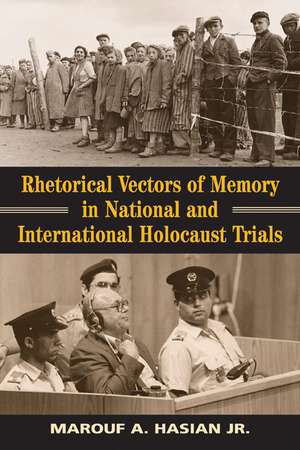
Rhetorical Vectors of Memory in National and International Holocaust Trials: Rhetoric & Public Affairs
Autor Marouf A. Hasian Jr.en Limba Engleză Hardback – 9 noi 2006
During the past several decades, the twentieth century Holocaust has become a defining event in many histories. This newfound respect for the Judeocide has been cathartic for both individuals and communities, in that it provides evidence that audiences around the world are rethinking the significance of the World War II narratives of bystanders, perpetrators, and victims. Given the complexities of these issues, scholars who are interested in studying Holocaust memory make choices about the questions on which they focus, the artifacts they select for analysis, and the perspectives they want to present.
Hasian reviews how national and international courts have used Holocaust trials as forums for debates about individuated justice, historical record keeping, and pedagogical memory work. He concludes that the trials involving Auschwitz, Demjanjuk, Eichmann, Finta, Nuremberg, Irving, Kastner, Keegstra, Sawoniuk, and Zündel are highly problematic. The author provides a rhetorical analysis of holocaust trials as a way of looking into the question of what role court proceedings play in the creation of Holocaust collective memories.
Hasian reviews how national and international courts have used Holocaust trials as forums for debates about individuated justice, historical record keeping, and pedagogical memory work. He concludes that the trials involving Auschwitz, Demjanjuk, Eichmann, Finta, Nuremberg, Irving, Kastner, Keegstra, Sawoniuk, and Zündel are highly problematic. The author provides a rhetorical analysis of holocaust trials as a way of looking into the question of what role court proceedings play in the creation of Holocaust collective memories.
Din seria Rhetoric & Public Affairs
-
 Preț: 285.75 lei
 -
 Preț: 177.41 lei
 -
 Preț: 174.57 lei
 -
 Preț: 228.55 lei
 - 13%
 Preț: 354.73 lei
 -
 Preț: 188.76 lei
 -
 Preț: 169.51 lei
 -
 Preț: 155.61 lei
 -
 Preț: 314.44 lei
 -
 Preț: 157.89 lei
 - 13%
 Preț: 422.90 lei
 -
 Preț: 128.90 lei
 -
 Preț: 319.38 lei
 -
 Preț: 131.83 lei
 - 13%
 Preț: 455.92 lei
 -
 Preț: 373.98 lei
 - 13%
 Preț: 354.13 lei
 - 13%
 Preț: 339.97 lei
 - 13%
 Preț: 340.48 lei
 - 13%
 Preț: 340.98 lei
 - 13%
 Preț: 343.09 lei
 -
 Preț: 270.77 lei
 -
 Preț: 278.08 lei
 - 13%
 Preț: 340.98 lei
 -
 Preț: 255.22 lei
 -
 Preț: 214.36 lei
 -
 Preț: 339.67 lei
 -
 Preț: 265.46 lei
 - 5%
 Preț: 143.27 lei
 -
 Preț: 417.97 lei
 -
 Preț: 307.90 lei
 - 13%
 Preț: 342.09 lei
Preț: 341.49 lei
Preț vechi: 392.52 lei
-13% Nou
Puncte Express: 512
Preț estimativ în valută:
60.45€ • 70.38$ • 52.79£
60.45€ • 70.38$ • 52.79£
Carte indisponibilă temporar
Doresc să fiu notificat când acest titlu va fi disponibil:
Se trimite...
Preluare comenzi: 021 569.72.76
Specificații
ISBN-13: 9780870137846
ISBN-10: 0870137840
Pagini: 236
Dimensiuni: 152 x 229 x 23 mm
Greutate: 0.59 kg
Editura: Michigan State University Press
Colecția Michigan State University Press
Seria Rhetoric & Public Affairs
ISBN-10: 0870137840
Pagini: 236
Dimensiuni: 152 x 229 x 23 mm
Greutate: 0.59 kg
Editura: Michigan State University Press
Colecția Michigan State University Press
Seria Rhetoric & Public Affairs
Cuprins
ContentsAcknowledgments 00Chapter One. The Role of Legal Trials in the Preservation of Select Holocaust Histories and Memories 00Chapter Two. The Nuremberg Trial of the Major War Criminals and Early Legal Remembrances of the Holocaust 00Chapter Three. The Difficulties of ¿Mastering the Past¿: Contemporary and Modern Vectors of Memories and the Auschwitz Trial 00Chapter Four. Israeli Judicial Proceedings and Changing Remembrances of the Holocaust 00Chapter Five. Canada¿s Experiences with Holocaust Trials 00Chapter Six. Understanding England¿s Holocaust Memories 00Chapter Seven. The Future of Legal Involvement in Holocaust Memories 00Selected Bibliography 000Index 000
Descriere
During the past several decades, the twentieth century Holocaust has become a defining event in many histories. Hasian reviews how national and international courts have used Holocaust trials as forums for debates about individuated justice, historical record keeping, and pedagogical memory work.