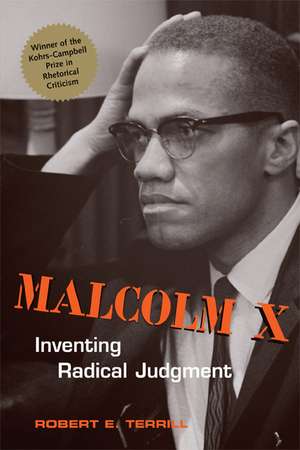
Malcolm X: Inventing Radical Judgment: Rhetoric & Public Affairs
Autor Robert E. Terrillen Limba Engleză Paperback – 11 apr 2007
Few figures haunt the collective American psyche like Malcolm X. Hoodlum, convict, convert, prophet, nationalist, and martyr, Malcolm’s life spans the Civil Rights era like an index of America’s racial anxiety. Dozens of books and hundreds of articles have analyzed his life, his work, and the various ways that his image has been appropriated by American culture. Not much has been done, however, to analyze his speeches. This would be a glaring omission in the body of scholarship about almost any public figure, but is especially troubling with regard to Malcolm X. His legacy does not consist of marches preserved on newsreels, legislation passed by Congress, or holidays observed by the state; his legacy consists almost exclusively of his words.
Malcolm X, like any orator, did not fashion his discourse in a vacuum but worked within and modified modes fashioned by his predecessors. Malcolm X: Inventing Radical Judgment begins by exploring the interpretive strategies presented in key texts from the history of African American protest, establishing a spectrum against which Malcolm’s oratory can be assessed. The texts of speeches that Malcolm delivered while he was a minister for the Nation of Islam and the texts of speeches and statements he made after he left the Nation are analyzed carefully to discern the strategies of interpretation and judgment that he enacted and fostered in his audiences. Finally, this radical judgment, presented in and through Malcolm’s public discourse, is re-contextualized by using three disparate theoretical approaches. The purpose of this triangulation is not to contain the rhetoric of Malcolm X within the limitations of these vocabularies, but rather to show that the changing potential of Malcolm’s rhetoric lies, in part, in its iconoclastic refusal to be constrained by definitive boundaries.
Malcolm X, like any orator, did not fashion his discourse in a vacuum but worked within and modified modes fashioned by his predecessors. Malcolm X: Inventing Radical Judgment begins by exploring the interpretive strategies presented in key texts from the history of African American protest, establishing a spectrum against which Malcolm’s oratory can be assessed. The texts of speeches that Malcolm delivered while he was a minister for the Nation of Islam and the texts of speeches and statements he made after he left the Nation are analyzed carefully to discern the strategies of interpretation and judgment that he enacted and fostered in his audiences. Finally, this radical judgment, presented in and through Malcolm’s public discourse, is re-contextualized by using three disparate theoretical approaches. The purpose of this triangulation is not to contain the rhetoric of Malcolm X within the limitations of these vocabularies, but rather to show that the changing potential of Malcolm’s rhetoric lies, in part, in its iconoclastic refusal to be constrained by definitive boundaries.
Din seria Rhetoric & Public Affairs
-
 Preț: 285.75 lei
 -
 Preț: 177.41 lei
 -
 Preț: 174.57 lei
 -
 Preț: 228.55 lei
 - 13%
 Preț: 354.73 lei
 -
 Preț: 188.76 lei
 -
 Preț: 169.51 lei
 - 13%
 Preț: 341.49 lei
 -
 Preț: 155.61 lei
 -
 Preț: 314.44 lei
 -
 Preț: 157.89 lei
 - 13%
 Preț: 422.90 lei
 -
 Preț: 319.38 lei
 -
 Preț: 131.83 lei
 - 13%
 Preț: 455.92 lei
 -
 Preț: 373.98 lei
 - 13%
 Preț: 354.13 lei
 - 13%
 Preț: 339.97 lei
 - 13%
 Preț: 340.48 lei
 - 13%
 Preț: 340.98 lei
 - 13%
 Preț: 343.09 lei
 -
 Preț: 270.77 lei
 -
 Preț: 278.08 lei
 - 13%
 Preț: 340.98 lei
 -
 Preț: 255.22 lei
 -
 Preț: 214.36 lei
 -
 Preț: 339.67 lei
 -
 Preț: 265.46 lei
 -
 Preț: 417.97 lei
 -
 Preț: 307.90 lei
 - 13%
 Preț: 342.09 lei
Preț: 128.90 lei
Nou
Puncte Express: 193
Preț estimativ în valută:
22.81€ • 26.75$ • 20.03£
22.81€ • 26.75$ • 20.03£
Carte indisponibilă temporar
Doresc să fiu notificat când acest titlu va fi disponibil:
Se trimite...
Preluare comenzi: 021 569.72.76
Specificații
ISBN-13: 9780870138034
ISBN-10: 0870138030
Pagini: 255
Dimensiuni: 152 x 229 x 18 mm
Greutate: 0.48 kg
Editura: Michigan State University Press
Colecția Michigan State University Press
Seria Rhetoric & Public Affairs
ISBN-10: 0870138030
Pagini: 255
Dimensiuni: 152 x 229 x 18 mm
Greutate: 0.48 kg
Editura: Michigan State University Press
Colecția Michigan State University Press
Seria Rhetoric & Public Affairs
Notă biografică
Clarke Rountree is Professor of Communication Arts at the University of Alabama, Huntsville. Rountree was awarded the prestigious 2008- 2009 Kohrs-Campbell Prize in Rhetorical Criticism by Michigan State University Press. The Kohrs-Campbell Award is presented with a $10,000 cash prize and a plaque.
Cuprins
ContentsPreface iChapter One: Malcolm's Medium 1Meeting Malcolm 4Malcolm's Words 8Malcolm's Audience 12Malcolm Studies 17Studying Malcolm 24Conclusion 37Chapter Two: Prophetic Precedence 49Frederick Douglass: African-American Jeremiah 53W. E. B. Du Bois: Nationalist Prophet 66David Walker: Apocalyptic Appeal 79Nat Turner: Black Messiah 94Chapter Three: The Limits of Prophecy 118Marcus Garvey 121Noble Drew Ali 130The Nation of Islam 137Black Man's History 142Ronald Stokes 164Michigan State 167Limits of Prophecy 179Chapter Four: Radical Judgment 203The Split and The March 206The Chickens Coming Home to Roost 216The Ballot or the Bullet 222Letters from Mecca 241Return and Interlude 248The Final Speech 261Emancipatory Interpretation 276Chapter Five: Context and Assessment 294The NOI after Malcolm X 295Triangulation 301Summary and Implications 337NotesSelected Bibliography 365Index
Descriere
Few figures haunt the collective American psyche like Malcolm X. Hoodlum, convict, convert, prophet, nationalist, and martyr, Malcolm’s life spans the Civil Rights era like an index of America’s racial anxiety. Dozens of books and hundreds of articles have analyzed his life, his work, and the various ways that his image has been appropriated by American culture. Not much has been done, however, to analyze his speeches. This would be a glaring omission in the body of scholarship about almost any public figure, but is especially troubling with regard to Malcolm X. His legacy does not consist of marches preserved on newsreels, legislation passed by Congress, or holidays observed by the state; his legacy consists almost exclusively of his words.