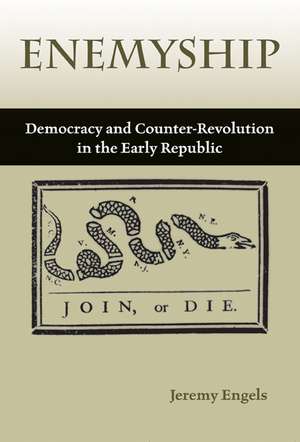
Enemyship: Democracy and Counter-Revolution in the Early Republic: Rhetoric & Public Affairs
Autor Jeremy Engelsen Limba Engleză Hardback – noi 2010
The Declaration of Independence is usually celebrated as a radical document that inspired revolution in the English colonies, in France, and elsewhere. In Enemyship, however, Jeremy Engels views the Declaration as a rhetorical strategy that outlined wildly effective arguments justifying revolution against a colonial authority—and then threatened political stability once independence was finally achieved.
Enemyship examines what happened during the latter years of the Revolutionary War and in the immediate post-Revolutionary period, when the rhetorics and energies of revolution began to seem problematic to many wealthy and powerful Americans.
To mitigate this threat, says Engles, the founders of the United States deployed the rhetorics of what he calls "enemyship," calling upon Americans to unite in opposition to their shared national enemies.
Enemyship examines what happened during the latter years of the Revolutionary War and in the immediate post-Revolutionary period, when the rhetorics and energies of revolution began to seem problematic to many wealthy and powerful Americans.
To mitigate this threat, says Engles, the founders of the United States deployed the rhetorics of what he calls "enemyship," calling upon Americans to unite in opposition to their shared national enemies.
Din seria Rhetoric & Public Affairs
-
 Preț: 285.51 lei
 -
 Preț: 177.23 lei
 -
 Preț: 174.40 lei
 -
 Preț: 227.52 lei
 - 13%
 Preț: 354.36 lei
 -
 Preț: 188.53 lei
 -
 Preț: 169.32 lei
 - 13%
 Preț: 341.13 lei
 -
 Preț: 155.44 lei
 -
 Preț: 314.10 lei
 -
 Preț: 157.72 lei
 - 13%
 Preț: 422.44 lei
 -
 Preț: 128.76 lei
 -
 Preț: 131.69 lei
 - 13%
 Preț: 455.43 lei
 -
 Preț: 373.58 lei
 - 13%
 Preț: 353.76 lei
 - 13%
 Preț: 339.60 lei
 - 13%
 Preț: 342.72 lei
 - 13%
 Preț: 390.83 lei
 -
 Preț: 270.47 lei
 -
 Preț: 277.78 lei
 - 13%
 Preț: 340.64 lei
 -
 Preț: 254.93 lei
 -
 Preț: 214.12 lei
 -
 Preț: 443.32 lei
 -
 Preț: 348.74 lei
 - 5%
 Preț: 184.28 lei
 - 11%
 Preț: 479.62 lei
 -
 Preț: 394.26 lei
 - 13%
 Preț: 341.72 lei
Preț: 340.64 lei
Preț vechi: 391.53 lei
-13%
Puncte Express: 511
Preț estimativ în valută:
60.27€ • 70.07$ • 52.24£
60.27€ • 70.07$ • 52.24£
Carte indisponibilă temporar
Doresc să fiu notificat când acest titlu va fi disponibil:
Se trimite...
Preluare comenzi: 021 569.72.76
Specificații
ISBN-13: 9780870139802
ISBN-10: 0870139800
Pagini: 316
Dimensiuni: 152 x 229 x 25 mm
Greutate: 0.57 kg
Editura: Michigan State University Press
Colecția Michigan State University Press
Seria Rhetoric & Public Affairs
ISBN-10: 0870139800
Pagini: 316
Dimensiuni: 152 x 229 x 25 mm
Greutate: 0.57 kg
Editura: Michigan State University Press
Colecția Michigan State University Press
Seria Rhetoric & Public Affairs
Notă biografică
Jeremy Engels is an Assistant Professor in the Department of Communication Arts and Sciences at Penn State University.
Cuprins
Contents
Acknowledgments
introduction
chapter one/ How Enemyship Became Common Sense
chapter two/ The Dilemmas of American Nationalism
chapter three/ The Army of the Constitution
chapter four/ The Contract of Blood
conclusion/ Hobbes’s Gamble and Franklin’s Warning
Descriere
The Declaration of Independence is usually celebrated as a radical document that inspired revolution in the English colonies, in France, and elsewhere. In Enemyship, however, Jeremy Engels views the Declaration as a rhetorical strategy that outlined wildly effective arguments justifying revolution against a colonial authority—and then threatened political stability once independence was finally achieved.