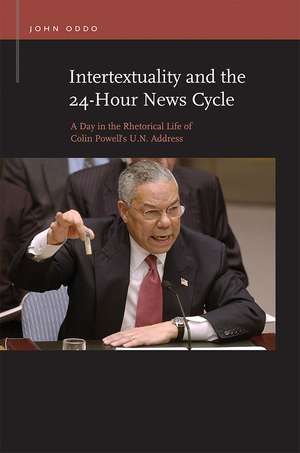
Intertextuality and the 24-Hour News Cycle: A Day in the Rhetorical Life of Colin Powell's U.N. Address: Rhetoric & Public Affairs
Autor John Oddoen Limba Engleză Paperback – aug 2014
On a cold Wednesday morning in February 2003 Colin Powell argued before the United Nations Security Council that Iraq harbored weapons of mass destruction. Before the speech, nearly 90 percent of Americans reported that Powell’s speech would help them determine their view about invading Iraq. In the days after the speech, a strong majority of Americans reported that they found Powell’s evidence convincing enough to justify war. But most American adults did not watch Powell’s speech. Instead, they learned about it from journalists—and to a large extent formed their opinions about war with Iraq based on news coverage of his address. In Intertextuality and the 24-Hour News Cycle John Oddo investigates the “rhetorical life” of Colin Powell’s address as it was extended across several media reports. Focusing on one day of pre- and postspeech news coverage, Oddo examines how journalists influenced Powell’s presentation— precontextualizing and recontextualizing his speech, and prepositioning and repositioning audiences to respond to it. The book surveys a variety of news media (television, newspaper, and Internet) and systematically integrates several methodological approaches (critical, rhetorical, discourse-analytic, and multimodal). This revealing text shows the decisive role that journalists played in shaping American attitudes about Powell, his presentation, and the desirability of war in Iraq.
Din seria Rhetoric & Public Affairs
-
 Preț: 285.75 lei
 -
 Preț: 177.41 lei
 -
 Preț: 174.57 lei
 -
 Preț: 228.55 lei
 - 13%
 Preț: 354.73 lei
 -
 Preț: 188.76 lei
 -
 Preț: 169.51 lei
 - 13%
 Preț: 341.49 lei
 -
 Preț: 155.61 lei
 -
 Preț: 314.44 lei
 -
 Preț: 157.89 lei
 - 13%
 Preț: 422.90 lei
 -
 Preț: 128.90 lei
 -
 Preț: 319.38 lei
 -
 Preț: 131.83 lei
 - 13%
 Preț: 455.92 lei
 -
 Preț: 373.98 lei
 - 13%
 Preț: 354.13 lei
 - 13%
 Preț: 339.97 lei
 - 13%
 Preț: 340.48 lei
 - 13%
 Preț: 340.98 lei
 - 13%
 Preț: 343.09 lei
 -
 Preț: 270.77 lei
 -
 Preț: 278.08 lei
 - 13%
 Preț: 340.98 lei
 -
 Preț: 214.36 lei
 -
 Preț: 339.67 lei
 -
 Preț: 265.46 lei
 - 5%
 Preț: 143.27 lei
 -
 Preț: 417.97 lei
 -
 Preț: 307.90 lei
 - 13%
 Preț: 342.09 lei
Preț: 255.22 lei
Nou
Puncte Express: 383
Preț estimativ în valută:
45.18€ • 52.60$ • 39.45£
45.18€ • 52.60$ • 39.45£
Carte indisponibilă temporar
Doresc să fiu notificat când acest titlu va fi disponibil:
Se trimite...
Preluare comenzi: 021 569.72.76
Specificații
ISBN-13: 9781611861402
ISBN-10: 1611861403
Pagini: 350
Ilustrații: 36
Dimensiuni: 152 x 229 x 28 mm
Greutate: 0.59 kg
Ediția:1
Editura: Michigan State University Press
Colecția Michigan State University Press
Seria Rhetoric & Public Affairs
ISBN-10: 1611861403
Pagini: 350
Ilustrații: 36
Dimensiuni: 152 x 229 x 28 mm
Greutate: 0.59 kg
Ediția:1
Editura: Michigan State University Press
Colecția Michigan State University Press
Seria Rhetoric & Public Affairs
Notă biografică
John Oddo is Assistant Professor in the Rhetoric program at Carnegie Mellon University, where he teaches courses in the history of rhetoric, rhetorical style, and intertexuality.
Cuprins
Contents
List of Tables
Acknowledgments
Notational Scheme
Introduction. The Rhetorical Life of Colin Powell’s U.N. Speech
Chapter One. The Campaign for War in Iraq: Contextualizing Powell’s Speech in Political and Media Discourse
Chapter Two. The Chief Prosecutor and the Iraqi Regime: Intertextual Ethos and Transitive Chains of Authority
Chapter Three. Undercutting Saddam’s Denials: Precontextualization and Audience Alignment
Chapter Four. America’s Best Intelligence: Recontextualization and Rhetorical Transformation
Chapter Five. Political Discourse, the Press, and the Public Good
Appendix A. Data Corpus
Appendix B. Synoptic Views of Discourse
Appendix C. Intertextual Precedents for Powell’s Arguments
Appendix D. Attitudinal Discourse in Linguistic and Multimodal Texts
Appendix E. Attitudes about Powell and Iraq
Appendix F. Conventions of Precontextualizationin Mainstream Journalism
Appendix G. The Engagement System, Temporality, and Presence
Appendix H. Coding Categories for Audience Repositioning
Appendix I. A Four- Phased Analytic Approach
Notes
Bibliography
Index
Recenzii
Using an eclectic blend of rhetorical analysis and multimodal critical discourse analysis, Oddo’s study is both unique and exemplary in its finegrained, methodical dissection of the twenty-four hours of television coverage surrounding this historic event. Indeed, it should serve as a model for any researcher interested in analyzing mediated public discourse.
—Thomas Huckin, Professor of English and Linguistics, University of Utah
—Thomas Huckin, Professor of English and Linguistics, University of Utah
Descriere
Most American adults never saw Colin Powell’s speech on weapons of mass destruction in Iraq. Instead, they learned about it from journalists—and to a large extent formed their opinions about war with Iraq based on news coverage of the address. Focusing on one day of pre- and post-speech news coverage, Oddo examines how journalists influenced Powell’s presentation—precontextualizing and recontextualizing his speech, and prepositioning and repositioning audiences to respond to it