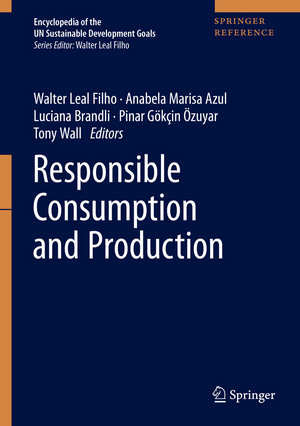
Responsible Consumption and Production: Encyclopedia of the UN Sustainable Development Goals
Editat de Walter Leal Filho, Anabela Marisa Azul, Luciana Brandli, Pinar Gökcin Özuyar, Tony Wallen Limba Engleză Hardback – 4 mar 2020
Recomandăm acest volum ca referință profesională și academică de nivel master și doctorat, fiind un pilon fundamental pentru cercetarea în domeniul sustenabilității. Responsible Consumption and Production este prima ediție (2020) a unui efort enciclopedic masiv, dedicat integral Obiectivului de Dezvoltare Durabilă 12 al ONU. Într-un context global marcat de epuizarea biodiversității și schimbări climatice, lucrarea propune o cartografiere riguroasă a soluțiilor integrate pentru tranziția către modele de producție circulare.
Remarcăm structura enciclopedică ce permite o navigare facilă prin concepte complexe, de la managementul eficient al resurselor naturale la reducerea drastică a risipei alimentare și gestionarea substanțelor chimice pe parcursul întregului ciclu de viață. Volumul extinde cadrul propus de SDG12 – Sustainable Consumption and Production – A Revolutionary Challenge for the 21st Century prin profunzimea datelor tehnice și prin abordarea sistemică a achizițiilor publice sustenabile și a turismului responsabil. Spre deosebire de alte lucrări, această enciclopedie pune un accent deosebit pe necesitatea ca țările dezvoltate să preia inițiativa, oferind totodată suport tehnologic regiunilor în curs de dezvoltare.
Această lucrare consolidează viziunea autorului Walter Leal Filho expusă în Handbook of Sustainability Science in the Future, trecând de la analiza problemelor globale la definirea unor parametri concreți de monitorizare a impactului. Progresia conținutului, de la politici macro la bune practici corporative, transformă cele 1000 de pagini într-un instrument de lucru esențial pentru decidenți și cercetători.
Din seria Encyclopedia of the UN Sustainable Development Goals
- 18%
 Preț: 4264.23 lei
 - 18%
 Preț: 3468.84 lei
 - 18%
 Preț: 3507.98 lei
 - 18%
 Preț: 4315.24 lei
 - 18%
 Preț: 4252.10 lei
 - 18%
 Preț: 3490.78 lei
 - 18%
 Preț: 3497.63 lei
 - 18%
 Preț: 3504.41 lei
 - 18%
 Preț: 3503.87 lei
 - 18%
 Preț: 3537.06 lei
 - 18%
 Preț: 3532.51 lei
 - 18%
 Preț: 3541.60 lei
 - 18%
 Preț: 3532.51 lei
 - 24%
 Preț: 3446.97 lei
 - 24%
 Preț: 3435.62 lei
 - 35%
 Preț: 3214.89 lei
Preț: 4267.25 lei
Preț vechi: 5203.96 lei
-18%
Carte disponibilă
Livrare economică 08-22 iunie
Specificații
ISBN-10: 3319957252
Pagini: 1000
Ilustrații: XXIII, 862 p. 120 illus., 93 illus. in color.
Dimensiuni: 178 x 254 mm
Greutate: 2.31 kg
Ediția:1st ed. 2020
Editura: Springer International Publishing
Colecția Springer
Seria Encyclopedia of the UN Sustainable Development Goals
Locul publicării:Cham, Switzerland
V-ar putea interesa
-
 Sustainability in the Twenty-First CenturyMohan Munasinghe-14%Preț: 691.37 lei803.92 lei
 -
 Globalization, Culture, and DevelopmentM. Pyykkönen-18%Preț: 918.77 lei1120.45 lei
 -
 Preț: 202.44 lei
 -
 -15%Preț: 618.31 lei727.43 lei
 -
 Practicing SustainabilityGuru MadhavanPreț: 269.57 lei
 -
 -18%Preț: 703.05 lei857.39 lei
 -
 Power and Capacity in Urban Climate GovernancePeter Eckersley-23%Preț: 585.92 lei760.94 lei
 -
 Limits of ConsumptionGauri Shankar Gupta-30%Preț: 77.40 lei111.10 lei
 -
 The New ArcticBirgitta Evengård-15%Preț: 628.90 lei739.89 lei
 -
 Slavoj ¿i¿ekTony WallPreț: 362.86 lei
 -
 Preț: 443.18 lei
 -
 Sustainability Science: Field Methods and ExercisesMiguel Esteban-15%Preț: 617.05 lei725.94 lei
 -
 No PovertyWalter Leal Filho-18%Preț: 3507.98 lei4278.02 lei
 -
 Decent Work and Economic GrowthWalter Leal Filho-24%Preț: 3446.97 lei4535.48 lei
 -
 Industry, Innovation and InfrastructureWalter Leal Filho-18%Preț: 3532.51 lei4307.94 lei
 -
 Peace, Justice and Strong InstitutionsWalter Leal Filho-24%Preț: 3435.62 lei4520.54 lei
 -
 Partnerships for the GoalsWalter Leal Filho-18%Preț: 3541.60 lei4319.02 lei
 -
 Sustainable Development at Universities: New HorizonsWalter Leal Filho-23%Preț: 1033.88 lei1342.69 lei
 -
 E-Learning and Education for SustainabilityUlisses Miranda Azeiteiro-19%Preț: 513.12 lei633.48 lei
 -
 Enabling Responsible LivingUlf Schrader-19%Preț: 539.10 lei665.56 lei
 -
 Preț: 423.39 lei
 -
 Systemische BionikE. W. Udo KüppersPreț: 117.85 lei
 -
 -15%Preț: 614.41 lei722.83 lei
 -
 Mechanism Design for SustainabilityZongwei Luo-37%Preț: 558.49 lei886.47 lei
De ce să citești această carte
Această enciclopedie este indispensabilă pentru specialiștii în politici publice, managerii de sustenabilitate și cercetătorii care au nevoie de o bază teoretică și practică solidă privind ODD 12. Cititorul câștigă acces la o terminologie standardizată la nivel internațional și la strategii validate pentru reducerea amprentei ecologice, fiind un ghid complet pentru implementarea Agendei 2030 în orice organizație.
Despre autor
Walter Leal Filho este o figură centrală în educația ecologică internațională, predând la Universitatea Tehnică din Hamburg. Expertiza sa vastă este reflectată în coordonarea seriei Encyclopedia of the UN Sustainable Development Goals, cea mai cuprinzătoare resursă editorială dedicată obiectivelor ONU. Prin activitatea sa ca editor al European Environmental Education Newsletter și prin lucrări precum Sustainable Agriculture and Food Security, Filho a demonstrat o capacitate remarcabilă de a integra știința mediului cu politici economice viabile, fiind un promotor activ al soluțiilor sustenabile în țările în curs de dezvoltare.
Descriere scurtă
The Encyclopedia of the UN Sustainable Development Goals comprehensively addresses the SDGs in an integrated way. It encompasses 17 volumes, each one devoted to one of the 17 SDGs. This volume addresses SDG 12, namely "Ensure sustainable consumption and production patterns" and contains the description of a range of terms, which allows a better understanding and fosters knowledge.
- Implement the 10-Year Framework of Programmes on Sustainable Consumption and Production Patterns, all countries taking action, with developed countries taking the lead, taking into account the development and capabilities of developing countries
- Achieve the sustainable management and efficient use of natural resources
- Halve per capita global food waste at the retail and consumer levels and reduce food losses along production and supply chains, including post-harvest losses
- Achieve the environmentally sound management of chemicals and all wastes throughout their life cycle, in accordance with agreed international frameworks, and significantly reduce their release to air, water and soil in order to minimize their adverse impacts on human health and the environment
- Substantially reduce waste generation through prevention, reduction, recycling and reuse
- Encourage companies, especially large and transnational companies, to adopt sustainable practices and to integrate sustainability information into their reporting cycle
- Promote public procurement practices that are sustainable, in accordance with national policies and priorities
- Ensure that people everywhere have the relevant information and awareness for sustainable development and lifestyles in harmony with nature
- Support developing countries to strengthen their scientific and technological capacity to move towards more sustainable patterns of consumption and production
- Develop and implement tools to monitor sustainable development impacts for sustainable tourism that creates jobs and promotes local culture and products
- Rationalize inefficient fossil-fuel subsidies that encourage wasteful consumption by removing market distortions, in accordance with national circumstances, including by restructuring taxation and phasing out those harmful subsidies, where they exist, to reflect their environmental impacts, taking fully into account the specific needs and conditions of developing countries and minimizing the possible adverse impacts on their development in a manner that protects the poor and the affected communities
Cuprins
Notă biografică
Anabela Marisa Azul is a Researcher at the Center for Neuroscience and Cell Biology (CNC) and the Institute for Interdisciplinary Research of the University of Coimbra (UC, Portugal). She holds a Ph.D. in Biological Sciences, specializing in Ecology (2002, UC), and pursued her investigation on biology and ecology of fungi to pinpoint the role of mycorrhizal symbiosis for sustainability of Mediterranean forests under different land use scenarios at the Centre for Functional Ecology (CFE-UC), where she became an Associate Researcher (from 2009 to 2014). At CFE-UC, Marisa Azul developed a holistic approach that combined innovation in food production with sustainable development and public scientific awareness to multiple actors. At CNC, from 2014 on, Marisa Azul focuses her investigation on basic research and participatory research dynamics to pinpoint links between metabolism, health/disease, and sustainability. She has broad academic experience as a researcher working in participatory research and interdisciplinary that link biomedical and life/environmental sciences, social sciences, science education, science communication, and artistic forms. Her research interests also lie in bringing together the academy and social/economical players. She has been successful in attracting national and international funding, coordinating projects, and mentoring young researchers on the topics mentioned. She has co-authored over 40 scientific publications and book chapters, co-edited 4 books on Climate Change Management Series and 1 onWorld Sustainability Series published by Springer, co-authored 4 books for children and 2 comics, and co-produced 1 animation.