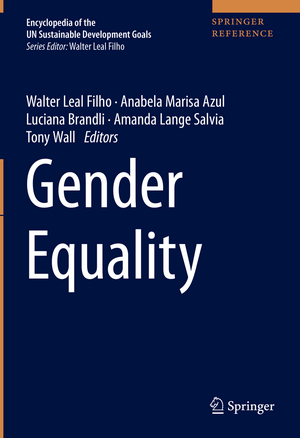
Gender Equality: Encyclopedia of the UN Sustainable Development Goals
Editat de Walter Leal Filho, Anabela Marisa Azul, Luciana Brandli, Amanda Lange Salvia, Tony Wallen Limba Engleză Hardback – 10 ian 2021
Aplicabilitatea practică a volumului Gender Equality rezidă în capacitatea sa de a transforma directivele teoretice ale Agendei 2030 a ONU în repere concrete pentru politici publice și cercetare academică. Găsim în această lucrare o analiză masivă, de peste 1300 de pagini, dedicată exclusiv Obiectivului de Dezvoltare Durabilă 5, considerat un pilon central pentru sustenabilitatea globală. Suntem de părere că forța acestui volum stă în abordarea enciclopedică, ce nu se limitează la aspecte sociologice, ci integrează dimensiuni economice și tehnologice ale egalității de gen.
Notăm cu interes structura riguroasă a cărții, care progresează de la fundamentele accesului la educație și împuternicirea economică, până la provocări contemporane precum intersecția dintre inteligența artificială și opresiune. Cuprinsul relevă o acoperire geografică și tematică vastă, incluzând analize despre sănătatea reproductivă în Asia de Sud, politici de acțiune afirmativă și mecanisme de protecție legală precum Convenția de la Istanbul. Această lucrare extinde cadrul propus de Reduced Inequalities cu date noi din perioada de implementare a obiectivelor post-2016, oferind o perspectivă mult mai granulată asupra disparităților care persistă la nivel global.
În contextul operei editorului Walter Leal Filho, acest volum continuă direcția stabilită în Handbook of Sustainability Science in the Future, unde autorul explora impactul creșterii populației asupra resurselor. Dacă lucrările sale anterioare, precum Clean Water and Sanitation, se concentrau pe resurse fizice, Gender Equality adresează capitalul uman și structurile sociale necesare pentru a susține progresul tehnic. Stilul este unul academic, precis, eliminând ambiguitățile prin definirea clară a termenilor și a indicatorilor de performanță utilizați de ONU.
Din seria Encyclopedia of the UN Sustainable Development Goals
- 18%
 Preț: 4591.07 lei
 - 18%
 Preț: 3756.28 lei
 - 18%
 Preț: 3769.74 lei
 - 18%
 Preț: 4602.86 lei
 - 18%
 Preț: 4594.03 lei
 - 18%
 Preț: 4601.11 lei
 - 18%
 Preț: 3751.27 lei
 - 18%
 Preț: 3758.64 lei
 - 18%
 Preț: 3765.92 lei
 - 18%
 Preț: 3765.33 lei
 - 18%
 Preț: 3537.06 lei
 - 18%
 Preț: 3541.60 lei
 - 18%
 Preț: 3532.51 lei
 - 24%
 Preț: 3613.89 lei
 - 24%
 Preț: 4149.86 lei
 - 24%
 Preț: 3602.05 lei
Preț: 3532.51 lei
Preț vechi: 4307.94 lei
-18%
Carte disponibilă
Livrare economică 16-30 noiembrie
Specificații
ISBN-10: 3319956868
Pagini: 1340
Ilustrații: XXIX, 1290 p. 46 illus., 40 illus. in color. In 2 volumes, not available separately.
Dimensiuni: 178 x 254 mm
Greutate: 3.81 kg
Ediția:2021
Editura: Springer International Publishing
Colecția Springer
Seria Encyclopedia of the UN Sustainable Development Goals
Locul publicării:Cham, Switzerland
V-ar putea interesa
-
 -18%Preț: 1415.98 lei1726.80 lei
 -
 Development Management of Transforming EconomiesFabiana Sciarelli-15%Preț: 716.52 lei842.96 lei
 -
 America's Most Sustainable Cities and RegionsJohn W. DayPreț: 263.33 lei
 -
 -27%Preț: 1521.27 lei2074.57 lei
 -
 Sustainable Cities: Urban Planning Challenges and PolicyKimberly Etingoff-18%Preț: 924.04 lei1126.88 lei
 -
 SDG1 - No PovertyKatarzyna Cichos-11%Preț: 436.51 lei490.45 lei
 -
 -18%Preț: 937.13 lei1142.83 lei
 -
 Slavoj ¿i¿ekTony WallPreț: 362.86 lei
 -
 -24%Preț: 692.53 lei911.22 lei
 -
 Technology, Society and SustainabilityLech W. Zacher-24%Preț: 916.52 lei1205.94 lei
 -
 The Human Face of Water SecurityDavid Devlaeminck-23%Preț: 642.57 lei834.50 lei
 -
 Sustainable Development and Renovation in Architecture, Urbanism and EngineeringPilar Mercader-Moyano-18%Preț: 981.66 lei1197.15 lei
 -
 Handbook of Sustainability Science and ResearchWalter Leal Filho-24%Preț: 2173.52 lei2859.90 lei
 -
 Handbook of Lifelong Learning for Sustainable DevelopmentWalter Leal Filho-24%Preț: 1337.68 lei1760.10 lei
 -
 Handbook of Sustainability and Social Science ResearchWalter Leal Filho-24%Preț: 1773.00 lei2332.90 lei
 -
 Zero HungerWalter Leal Filho-18%Preț: 3756.28 lei4580.84 lei
 -
 Quality EducationWalter Leal Filho-18%Preț: 4601.11 lei5611.11 lei
 -
 Industry, Innovation and InfrastructureWalter Leal Filho-18%Preț: 3532.51 lei4307.94 lei
 -
 Reduced InequalitiesWalter Leal Filho-18%Preț: 3751.27 lei4574.71 lei
 -
 Climate ActionWalter Leal Filho-24%Preț: 4149.86 lei5460.35 lei
 -
 Peace, Justice and Strong InstitutionsWalter Leal Filho-24%Preț: 3602.05 lei4739.53 lei
 -
 Partnerships for the GoalsWalter Leal Filho-18%Preț: 3541.60 lei4319.02 lei
 -
 Life on LandWalter Leal Filho-18%Preț: 3765.92 lei4592.58 lei
 -
 Sustainable Landscape Planning in Selected Urban RegionsMakoto Yokohari-24%Preț: 936.93 lei1232.80 lei
 -
 An Ecosystem Approach to Sustainable AgricultureCarl F. Jordan-15%Preț: 617.66 lei726.66 lei
 -
 Global Change, Energy Issues and Regulation PoliciesJean Bernard Saulnier-15%Preț: 644.90 lei758.71 lei
 -
 The Economy of Green CitiesRichard Simpson-15%Preț: 654.33 lei769.81 lei
 -
 -18%Preț: 926.81 lei1130.25 lei
De ce să citești această carte
Această enciclopedie este esențială pentru specialiștii în politici publice, cercetători și activiști care au nevoie de o bază de date factuală și teoretică pentru implementarea egalității de gen. Cititorul câștigă o înțelegere profundă a mecanismelor prin care discriminarea poate fi combătută prin legislație și tehnologie. Este un instrument de referință care transformă obiectivele politice în strategii de acțiune măsurabile.
Despre autor
Walter Leal Filho este un expert recunoscut în domeniul educației pentru mediu și sustenabilitate, predând la Universitatea Tehnică din Hamburg. Rolul său de editor în cadrul seriei Encyclopedia of the UN Sustainable Development Goals reflectă vasta sa experiență în coordonarea proiectelor internaționale și a publicațiilor academice de anvergură, precum European Environmental Education Newsletter. Prin munca sa, acesta integrează perspectivele științifice cu nevoile de dezvoltare socială, fiind o figură centrală în documentarea eforturilor globale pentru atingerea țintelor Agendei 2030.
Descriere scurtă
The Encyclopedia of the UN Sustainable Development Goals comprehensively addresses the SDGs in an integrated way. It encompasses 17 volumes, each devoted to one of the 17 SDGs. This volume addresses SDG 5, namely "Achieve gender equality and empower all women and girls" and contains the description of a range of terms, which allows a better understanding and fosters knowledge. This SDG is considered by many as a pivotal goal since the significant role of women in achieving sustainable development has always been acknowledged in several official UN declarations. Yet gender disparity is still rampant under various guises in various countries. Women’s rights need to be strongly safeguarded through legislation to ensure equal opportunities.
Concretely, the defined targets are:
- End all forms of discrimination against all women and girls everywhere
- Eliminate all forms of violence against all women and girls in the public and private spheres, including trafficking and sexual and other types of exploitation
- Eliminate all harmful practices, such as child, early and forced marriage and female genital mutilation
- Recognize and value unpaid care and domestic work through the provision of public services, infrastructure and social protection policies and the promotion of shared responsibility within the household and the family as nationally appropriate
- Ensure women’s full and effective participation and equal opportunities for leadership at all levels of decision-making in political, economic and public life
- Ensure universal access to sexual and reproductive health and reproductive rights as agreed in accordance with the Programme of Action of the International Conference on Population and Development and the Beijing Platform for Action and the outcome documents of their review conferences
- Undertake reforms to give women equal rights to economic resources, as well as access to ownership and control over land and other forms of property, financial services, inheritance and natural resources, in accordance with national laws
- Enhance the use of enabling technology, in particular information and communications technology, to promote the empowerment of women
- Adopt and strengthensound policies and enforceable legislation for the promotion of gender equality and the empowerment of all women and girls at all levels
Cuprins
Notă biografică
Anabela Marisa Azul is a Researcher at the Center for Neuroscience and Cell Biology (CNC) and the Institute for Interdisciplinary Research of the University of Coimbra (UC, Portugal). She holds a Ph.D. in Biological Sciences, specializing in Ecology (2002, UC), and pursued her investigation on biology and ecology of fungi to pinpoint the role of mycorrhizal symbiosis for sustainability of Mediterranean forests under different land use scenarios at the Centre for Functional Ecology (CFE-UC), where she became an Associate Researcher (from 2009 to 2014). At CFE-UC, Marisa Azul developed a holistic approach that combined innovation in food production with sustainable development and public scientific awareness to multiple actors. At CNC, from 2014 on, Marisa Azul focuses her investigation on basic research and participatory research dynamics to pinpoint links between metabolism, health/disease, and sustainability. She has broad academic experience as a researcher working in participatory research and interdisciplinary that link biomedical and life/environmental sciences, social sciences, science education, science communication, and artistic forms. Her research interests also lie in bringing together the academy and social/economical players. She has been successful in attracting national and international funding, coordinating projects, and mentoring young researchers on the topics mentioned. She has co-authored over 40 scientific publications and book chapters, co-edited 4 books on Climate Change Management Series and 1 onWorld Sustainability Series published by Springer, co-authored 4 books for children and 2 comics, and co-produced 1 animation.