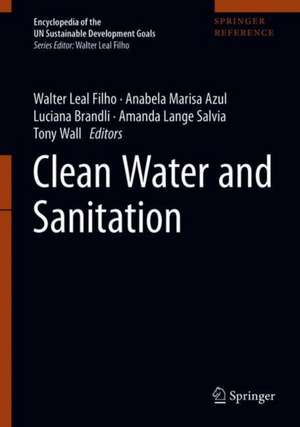
Clean Water and Sanitation: Encyclopedia of the UN Sustainable Development Goals
Editat de Walter Leal Filho, Anabela Marisa Azul, Luciana Brandli, Amanda Lange Salvia, Tony Wallen Limba Engleză Hardback – 11 iun 2022
Observăm că implementarea soluțiilor integrate pentru gestionarea resurselor de apă a devenit o prioritate critică în contextul Agendei 2030. Volumul Clean Water and Sanitation propune o trecere aplicată de la obiectivele teoretice ale ONU la strategii de execuție, abordând direct țintele SDG 6: acces universal la apă potabilă, îmbunătățirea calității prin reducerea poluării și eficiența utilizării apei în toate sectoarele. Ne-a atras atenția rigoarea cu care editorii, sub coordonarea lui Walter Leal Filho, au structurat cele 1000 de pagini, trecând de la distribuția globală a apei la soluții tehnice precum filtrele ceramice pentru uz casnic. Această enciclopedie completează perspectiva oferită de SDG6 – Clean Water and Sanitation – Balancing the Water Cycle for Sustainable Life on Earth, adăugând o dimensiune tehnică și administrativă mult mai vastă, bazată pe date din teren. În timp ce alte lucrări se concentrează pe politici generale, acest volum analizează mecanisme specifice, cum ar fi monitorizarea prin 'citizen science' în Dublin sau co-managementul resurselor în Camerun. Structura progresivă a cărții facilitează înțelegerea legăturii dintre sănătatea ecosistemelor acvatice (munți, râuri, acvifere) și bunăstarea umană. În contextul operei sale, Walter Leal Filho continuă direcția începută în Handbook of Sustainability Science in the Future, unde analiza impactul creșterii populației asupra resurselor planetei. Dacă în Good Health and Well-Being accentul era pus pe indicatorii de sănătate, aici autorul prioritizează infrastructura și guvernarea apei ca fundament pentru toate celelalte obiective de dezvoltare. Este o resursă academică ce transformă viziunea politică în metodologie de lucru, esențială pentru a înțelege cum poate fi susținută viața într-o lume cu resurse finite.
Din seria Encyclopedia of the UN Sustainable Development Goals
- 18%
 Preț: 4591.07 lei
 - 18%
 Preț: 3756.28 lei
 - 18%
 Preț: 3769.74 lei
 - 18%
 Preț: 4602.86 lei
 - 18%
 Preț: 4594.03 lei
 - 18%
 Preț: 4601.11 lei
 - 18%
 Preț: 3751.27 lei
 - 18%
 Preț: 3765.92 lei
 - 18%
 Preț: 3765.33 lei
 - 18%
 Preț: 3537.06 lei
 - 18%
 Preț: 3532.51 lei
 - 18%
 Preț: 3541.60 lei
 - 18%
 Preț: 3532.51 lei
 - 24%
 Preț: 3613.89 lei
 - 24%
 Preț: 4149.86 lei
 - 24%
 Preț: 3602.05 lei
Preț: 3758.64 lei
Preț vechi: 4583.70 lei
-18%
Carte disponibilă
Livrare economică 16-30 noiembrie
Specificații
ISBN-10: 3319958453
Pagini: 1048
Ilustrații: XXIX, 1018 p. 225 illus., 203 illus. in color.
Dimensiuni: 183 x 260 x 58 mm
Greutate: 2.3 kg
Ediția:1st edition 2022
Editura: Springer
Colecția Encyclopedia of the UN Sustainable Development Goals
Seria Encyclopedia of the UN Sustainable Development Goals
Locul publicării:Cham, Switzerland
V-ar putea interesa
-
 Research MethodsPeter Stokes-26%Preț: 171.47 lei230.72 lei
 -
 Leadership Assessment for Talent DevelopmentJohn Knights-14%Preț: 1008.51 lei1172.69 lei
 -
 The Academic Language of Climate ChangeEvangelos Manolas-19%Preț: 572.85 lei707.23 lei
 -
 Sustainability and the HumanitiesWalter Leal Filho-18%Preț: 769.59 lei938.52 lei
 -
 Climate Change and the Role of EducationWalter Leal Filho-18%Preț: 1368.46 lei1668.85 lei
 -
 African Handbook of Climate Change AdaptationNicholas Oguge-18%Preț: 5280.88 lei6440.10 lei
 -
 -18%Preț: 6182.46 lei7539.59 lei
 -
 Climate Vulnerability and Resilience in the Global SouthG. M. Monirul Alam-18%Preț: 940.53 lei1146.99 lei
 -
 Climate Change in the Mediterranean and Middle Eastern RegionWalter Leal Filho-18%Preț: 997.76 lei1216.77 lei
 -
 -18%Preț: 1455.52 lei1775.02 lei
 -
 Handbook of Climate Change Across the Food Supply ChainWalter Leal Filho-18%Preț: 1052.55 lei1283.59 lei
 -
 Sustainable Agriculture and Food SecurityWalter Leal Filho-18%Preț: 999.42 lei1218.80 lei
 -
 -18%Preț: 1052.98 lei1284.11 lei
 -
 Handbook of Human and Planetary HealthWalter Leal Filho-5%Preț: 758.60 lei798.52 lei
 -
 -18%Preț: 993.52 lei1211.61 lei
 -
 -18%Preț: 1004.09 lei1224.51 lei
 -
 Climate Change Research at UniversitiesWalter Leal Filho-18%Preț: 933.89 lei1138.88 lei
 -
 Rainwater-Smart Agriculture in Arid and Semi-Arid AreasWalter Leal Filho-18%Preț: 921.36 lei1123.61 lei
 -
 World Trends in Environmental EducationUlisses Azeiteiro-23%Preț: 566.42 lei735.61 lei
 -
 Sustainability at Universities: Opportunities, Challenges, and TrendsWalter Leal Filho-19%Preț: 596.39 lei736.29 lei
 -
 Contributions to the UN Decade of Education for Sustainable DevelopmentFernando J. Gonçalves-19%Preț: 600.85 lei741.80 lei
 -
 Sustainable Development at Universities: New HorizonsWalter Leal Filho-23%Preț: 1118.40 lei1452.47 lei
 -
 E-Learning and Education for SustainabilityUlisses Miranda Azeiteiro-19%Preț: 552.01 lei681.50 lei
 -
 Higher Education Institutions in a Global Warming WorldUlisses Azeiteiro-15%Preț: 615.82 lei724.49 lei
De ce să citești această carte
Recomandăm acest volum specialiștilor în politici publice, inginerilor de mediu și cercetătorilor care au nevoie de o bază de date exhaustivă despre SDG 6. Cititorul câștigă o înțelegere profundă a tehnologiilor de tratare, a sistemelor de guvernare și a metodelor de cooperare internațională. Este o investiție într-o lucrare de referință Springer care sintetizează soluții globale pentru criza apei, oferind modele replicabile pentru comunitățile vulnerabile.
Despre autor
Walter Leal Filho este un expert recunoscut internațional în educație pentru mediu și dezvoltare durabilă, predând la Hamburg Technical University. Activitatea sa editorială este impresionantă, coordonând proiecte de anvergură precum seria dedicată Obiectivelor de Dezvoltare Durabilă ale ONU. Prin lucrări precum Sustainable Agriculture and Food Security sau Competence Building in Sustainable Development, Filho s-a impus ca o voce autoritară în analiza modului în care societatea umană se poate adapta schimbărilor climatice. Expertiza sa integrează cercetarea academică cu implementarea proiectelor practice la nivel global.
Descriere scurtă
The Encyclopedia of the UN Sustainable Development Goals comprehensively addresses the SDGs in an integrated way. It encompasses 17 volumes, each devoted to one of the 17 SDGs. This volume is dedicated to SDG 6 "Ensure availability and sustainable management of water andsanitation for all". Water and sanitation are fundamental to human well-being. Integrated water resources management is essential to ensure availability and sustainable management of water and sanitation for all and to the realization of Sustainable Development.
Concretely, the defined targets are:
- Achieve universal and equitable access to safe and affordable drinking water for all
- Achieve access to adequate and equitable sanitation and hygiene for all and end open defecation, paying special attention to the needs of women and girls and those in vulnerable situations
- Improve water quality by reducing pollution, eliminating dumping and minimizing release of hazardous chemicals and materials, halving the proportion of untreated wastewater and substantially increasing recycling and safe reuse globally
- Substantially increase water-use efficiency across all sectors and ensure sustainable withdrawals and supply of freshwater to address water scarcity and substantially reduce the number of people suffering from water scarcity
- Implement integrated water resources management at all levels, including through transboundary cooperation as appropriate
- Protect and restore water-related ecosystems, including mountains, forests, wetlands, rivers, aquifers and lakes
- Expand international cooperation and capacity-building support to developing countries in water- and sanitation-related activities and programmes, including water harvesting, desalination, water efficiency, wastewater treatment, recycling and reuse technologies
- Support and strengthen the participation of local communities in improving Uwater and sanitation management
Cuprins
Notă biografică
Anabela Marisa Azul is a Researcher at the Center for Neuroscience and Cell Biology (CNC) and the Institute for Interdisciplinary Research of the University of Coimbra (UC, Portugal). She holds a Ph.D. in Biological Sciences, specializing in Ecology (2002, UC), and pursued her investigation on biology and ecology of fungi to pinpoint the role of mycorrhizal symbiosis for sustainability of Mediterranean forests under different land use scenarios at the Centre for Functional Ecology (CFE-UC), where she became an Associate Researcher (from 2009 to 2014). At CFE-UC, Marisa Azul developed a holistic approach that combined innovation in food production with sustainable development and public scientific awareness to multiple actors. At CNC, from 2014 on, Marisa Azul focuses her investigation on basic research and participatory research dynamics to pinpoint links between metabolism, health/disease, and sustainability. She has broad academic experience as a researcher working in participatory research and interdisciplinary that link biomedical and life/environmental sciences, social sciences, science education, science communication, and artistic forms. Her research interests also lie in bringing together the academy and social/economical players. She has been successful in attracting national and international funding, coordinating projects, and mentoring young researchers on the topics mentioned. She has co-authored over 40 scientific publications and book chapters, co-edited 4 books on Climate Change Management Series and 1 onWorld Sustainability Series published by Springer, co-authored 4 books for children and 2 comics, and co-produced 1 animation.