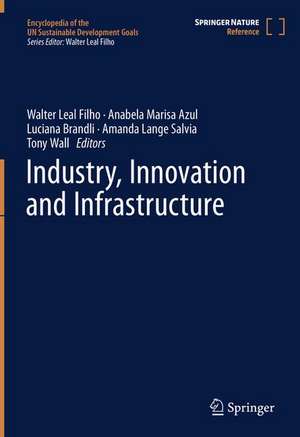
Industry, Innovation and Infrastructure: Encyclopedia of the UN Sustainable Development Goals
Editat de Walter Leal Filho, Anabela Marisa Azul, Luciana Brandli, Amanda Lange Salvia, Tony Wallen Limba Engleză Hardback – 5 mai 2021
Descoperim în acest volum o abordare aplicată a provocărilor industriale contemporane, începând cu studii de caz concrete precum implementarea principiilor sustenabile în agroindustria trestiei de zahăr sau co-crearea infrastructurii în Namibia. Găsim aici o analiză riguroasă a modului în care inovația poate contracara degradarea biodiversității și schimbările climatice, oferind soluții pentru o industrializare incluzivă. Structura cărții este enciclopedică, organizată pentru a ghida cititorul de la concepte fundamentale, precum accesibilitatea ca precondiție a dezvoltării, până la impactul tehnologiilor de frontieră, incluzând inteligența artificială și vehiculele autonome.
Suntem de părere că acest volum, parte din Encyclopedia of the UN Sustainable Development Goals, reușește să sintetizeze complexitatea Obiectivului de Dezvoltare Durabilă 9 prin articole ce vizează eficientizarea resurselor și adoptarea proceselor industriale ecologice. Comparabil cu Sustainable Cities and Communities în rigurozitate, acest titlu este actualizat pentru dinamica accelerată a inovației tehnologice și necesitatea infrastructurii reziliente în fața fenomenelor meteorologice extreme. Industry, Innovation and Infrastructure continuă direcția academică stabilită de Walter Leal Filho în lucrări precum Handbook of Sustainability Science in the Future, trecând de la prognoza globală la mecanismele tehnice și politice necesare pentru a atinge țintele Agendei 2030. Textul explorează critic lanțurile de aprovizionare în construcții și responsabilitatea socială corporativă, oferind o viziune integrată asupra creșterii economice care nu sacrifică protecția mediului.
Din seria Encyclopedia of the UN Sustainable Development Goals
- 18%
 Preț: 4441.08 lei
 - 18%
 Preț: 3468.84 lei
 - 18%
 Preț: 3507.98 lei
 - 18%
 Preț: 4315.24 lei
 - 18%
 Preț: 4325.19 lei
 - 18%
 Preț: 4252.10 lei
 - 18%
 Preț: 3629.10 lei
 - 18%
 Preț: 3636.22 lei
 - 18%
 Preț: 3504.41 lei
 - 18%
 Preț: 3642.70 lei
 - 18%
 Preț: 3537.06 lei
 - 18%
 Preț: 3532.51 lei
 - 18%
 Preț: 3541.60 lei
 - 24%
 Preț: 3446.97 lei
 - 24%
 Preț: 3435.62 lei
 - 35%
 Preț: 3214.89 lei
Preț: 3532.51 lei
Preț vechi: 4307.94 lei
-18%
Carte disponibilă
Livrare economică 28 octombrie-11 noiembrie
Specificații
ISBN-10: 3319958720
Pagini: 1000
Ilustrații: XXVIII, 1265 p. 166 illus., 118 illus. in color. In 2 volumes, not available separately.
Dimensiuni: 178 x 254 mm
Greutate: 3.81 kg
Ediția:2021
Editura: Springer International Publishing
Colecția Springer
Seria Encyclopedia of the UN Sustainable Development Goals
Locul publicării:Cham, Switzerland
V-ar putea interesa
-
 Sustainability in European Transport PolicyMatthew HumphreysPreț: 442.04 lei
 -
 Sustainable Development in PracticeAzapagic-8%Preț: 549.07 lei596.81 lei
 -
 Grow Small, Think BeautifulStephan HardingPreț: 159.05 lei
 -
 Preț: 132.01 lei
 -
 SDG1 - No PovertyKatarzyna Cichos-11%Preț: 436.51 lei490.45 lei
 -
 Planning Sustainable TransportBarry Hutton-15%Preț: 480.92 lei565.79 lei
 -
 Greater Kenyir LandscapesMohd Tajuddin Abdullah-23%Preț: 766.98 lei996.08 lei
 -
 Urban Planning and Water-related Disaster ManagementGuangwei Huang-19%Preț: 537.14 lei663.14 lei
 -
 Technologies for DevelopmentSilvia HostettlerPreț: 421.54 lei
 -
 -23%Preț: 793.74 lei1030.83 lei
 -
 Designing Sustainable Technologies, Products and PoliciesEnrico BenettoPreț: 455.17 lei
 -
 Sustainable Development Research in the Asia-Pacific RegionWalter Leal Filho-18%Preț: 743.82 lei907.10 lei
 -
 Handbook of Climate ServicesWalter Leal Filho-18%Preț: 1099.04 lei1340.29 lei
 -
 Climate Change, Hazards and Adaptation OptionsWalter Leal Filho-18%Preț: 1153.17 lei1406.30 lei
 -
 Managing Climate Change Adaptation in the Pacific RegionWalter Leal Filho-18%Preț: 875.39 lei1067.55 lei
 -
 -18%Preț: 861.38 lei1050.47 lei
 -
 Climate Vulnerability and Resilience in the Global SouthG. M. Monirul Alam-18%Preț: 940.53 lei1146.99 lei
 -
 Handbook of Human and Planetary HealthWalter Leal Filho-5%Preț: 735.61 lei774.32 lei
 -
 -18%Preț: 962.53 lei1173.81 lei
 -
 SDGs in the Americas and Caribbean RegionWalter Leal Filho-24%Preț: 3878.08 lei5102.75 lei
 -
 Slavoj ¿i¿ekTony WallPreț: 362.86 lei
 -
 Drivers of Climate Change in Urban IndiaLutz Meyer-Ohlendorf-15%Preț: 626.46 lei737.02 lei
 -
 100 Pioneers in Efficient Resource ManagementMario Schmidt-19%Preț: 718.61 lei887.18 lei
 -
 Biofuels and SustainabilityKazuhiko TakeuchiPreț: 417.66 lei
 -
 Metaphorical ManagementKlaus EllePreț: 525.50 lei
 -
 Quantification of Sustainability Indicators in the Food SectorSubramanian Senthilkannan MuthuPreț: 362.15 lei
De ce să citești această carte
Această lucrare este esențială pentru cercetători, decidenți politici și profesioniști din inginerie sau economie care doresc să înțeleagă implementarea practică a ODD 9. Cititorul câștigă o perspectivă globală asupra modernizării infrastructurii și a rolului inovației în atingerea sustenabilității. Este un instrument de referință care transformă obiectivele teoretice ale ONU în strategii aplicabile pentru o industrie rezilientă și tehnologii curate.
Despre autor
Walter Leal Filho este un expert recunoscut în domeniul educației de mediu și sustenabilității, predând la Hamburg Technical University. Coordonează numeroase proiecte internaționale de cercetare și este editorul European Environmental Education Newsletter. În calitatea sa de editor principal al seriei Encyclopedia of the UN Sustainable Development Goals, acesta și-a dedicat cariera integrării științei sustenabilității în politici publice, publicând lucrări fundamentale precum Competence Building in Sustainable Development și Sustainable Agriculture and Food Security. Expertiza sa reflectă o viziune multidisciplinară asupra sănătății planetare și umane.
Descriere scurtă
The Encyclopedia of the UN Sustainable Development Goals comprehensively addresses the SDGs in an integrated way. It encompasses 17 volumes, each one devoted to one of the 17 SDGs. This volume addresses SDG 9, namely “Build resilient infrastructure, promote inclusive and sustainable industrialization and foster innovation” and contains the description of a range of terms, to allow a better understanding and foster knowledge about it. This book presents a set of papers on the state of the art of knowledge and practices about three important aspects of sustainable development, infrastructure, industrialization and innovation. It focuses on the support of cleaner technologies, enhanced scientific research, domestic technology development and universal internet access.
- Develop quality, reliable, sustainable and resilient infrastructure, including regional and transborder infrastructure, to support economic development and human well-being, with a focus on affordable and equitable access for all
- Promote inclusive and sustainable industrialization and, by 2030, significantly raise industry’s share of employment and gross domestic product, in line with national circumstances, and double its share in least developed countries
- Increase the access of small-scale industrial and other enterprises, in particular in developing countries, to financial services, including affordable credit, and their integration into value chains and markets
- Upgrade infrastructure and retrofit industries to make them sustainable, with increased resource-use efficiency and greater adoption of clean and environmentally sound technologies and industrial processes, with all countries taking action in accordance with their respective capabilities
- Enhance scientific research, upgrade the technological capabilities of industrial sectors in all countries, in particular developing countries, including encouraging innovation and substantially increasing the number of research and development workers per 1 million people and public and private research and development spending
- Facilitate sustainable and resilient infrastructure development in developing countries through enhanced financial, technological and technical support to African countries, least developed countries, landlocked developing countries and small island developing states
- Support domestic technology development, research and innovation in developing countries, including by ensuring a conducive policy environment for, inter alia, industrial diversification and value addition to commodities
- Significantly increase access to information and communications technology and strive to provide universal and affordable access to the Internet in least developed countries
Cuprins
Notă biografică
Anabela Marisa Azul is a Researcher at the Center for Neuroscience and Cell Biology (CNC) and the Institute for Interdisciplinary Research of the University of Coimbra (UC, Portugal). She holds a Ph.D. in Biological Sciences, specializing in Ecology (2002, UC), and pursued her investigation on biology and ecology of fungi to pinpoint the role of mycorrhizal symbiosis for sustainability of Mediterranean forests under different land use scenarios at the Centre for Functional Ecology (CFE-UC), where she became an Associate Researcher (from 2009 to 2014). At CFE-UC, Marisa Azul developed a holistic approach that combined innovation in food production with sustainable development and public scientific awareness to multiple actors. At CNC, from 2014 on, Marisa Azul focuses her investigation on basic research and participatory research dynamics to pinpoint links between metabolism, health/disease, and sustainability. She has broad academic experience as a researcher working in participatory research and interdisciplinary that link biomedical and life/environmental sciences, social sciences, science education, science communication, and artistic forms. Her research interests also lie in bringing together the academy and social/economical players. She has been successful in attracting national and international funding, coordinating projects, and mentoring young researchers on the topics mentioned. She has co-authored over 40 scientific publications and book chapters, co-edited 4 books on Climate Change Management Series and 1 onWorld Sustainability Series published by Springer, co-authored 4 books for children and 2 comics, and co-produced 1 animation.