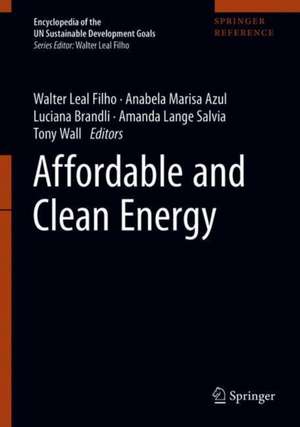
Affordable and Clean Energy: Encyclopedia of the UN Sustainable Development Goals
Editat de Walter Leal Filho, Anabela Marisa Azul, Luciana Brandli, Amanda Lange Salvia, Tony Wallen Limba Engleză Hardback – 10 ian 2021
În literatura academică actuală, deși există numeroase studii fragmentate despre resursele regenerabile, lipsea o lucrare de referință care să integreze dimensiunile economice, sociale și de mediu ale accesului la energie într-o viziune unitară. Găsim în acest volum, Affordable and Clean Energy, răspunsul enciclopedic la această lacună, lucrarea fiind o componentă esențială a seriei Encyclopedia of the UN Sustainable Development Goals. Ne-a atras atenția modul în care editorii coordonați de Walter Leal Filho reușesc să lege accesul la energie de obiective fundamentale precum sănătatea, educația și eradicarea sărăciei.
Cititorii familiarizați cu SDG7 – Ensure Access to Affordable, Reliable, Sustainable, and Modern Energy de Godwell Nhamo vor aprecia aici profunzimea tehnică și amplitudinea datelor, acest volum trecând dincolo de ghidul concis pentru a oferi o analiză de tip 'state-of-the-art'. Reținem structura riguroasă a celor 1000 de pagini, care progresează de la accesul la energie la nivelul gospodăriilor și perspectivele de incluziune, până la provocările politicilor de biogaz și reformele structurale ale sectorului electric. Această abordare este o continuare firească a operei lui Walter Leal Filho, care în lucrări precum Handbook of Sustainability Science in the Future a explorat impactul creșterii populației asupra resurselor globale, iar în Clean Water and Sanitation a analizat efectele industrializării asupra sănătății. Affordable and Clean Energy se distinge prin focalizarea pe soluții integrate de management, inovație și infrastructură, oferind un cadru solid pentru înțelegerea tranziției energetice globale.
Din seria Encyclopedia of the UN Sustainable Development Goals
- 18%
 Preț: 4264.23 lei
 - 18%
 Preț: 3468.84 lei
 - 18%
 Preț: 3507.98 lei
 - 18%
 Preț: 4253.60 lei
 - 18%
 Preț: 4267.25 lei
 - 18%
 Preț: 4252.10 lei
 - 18%
 Preț: 3490.78 lei
 - 18%
 Preț: 3497.63 lei
 - 18%
 Preț: 3504.41 lei
 - 18%
 Preț: 3503.87 lei
 - 18%
 Preț: 3532.51 lei
 - 18%
 Preț: 3541.60 lei
 - 18%
 Preț: 3532.51 lei
 - 24%
 Preț: 3446.97 lei
 - 24%
 Preț: 3435.62 lei
 - 35%
 Preț: 3214.89 lei
Preț: 3537.06 lei
Preț vechi: 4313.49 lei
-18%
Carte disponibilă
Livrare economică 18 mai-01 iunie
Specificații
ISBN-10: 3319958631
Pagini: 1000
Ilustrații: XXIX, 1309 p. 280 illus., 258 illus. in color. In 2 volumes, not available separately.
Dimensiuni: 178 x 254 mm
Greutate: 3.95 kg
Ediția:1st ed. 2021
Editura: Springer International Publishing
Colecția Springer
Seria Encyclopedia of the UN Sustainable Development Goals
Locul publicării:Cham, Switzerland
V-ar putea interesa
-
 Rare Earths Industry: Technological, Economic, and Environmental ImplicationsIsmar Borges De Lima-23%Preț: 669.91 lei865.96 lei
 -
 Interwoven CitiesLiam MageePreț: 372.78 lei
 -
 Preț: 485.77 lei
 -
 The Work-Based Learning Student HandbookRuth HelyerPreț: 158.43 lei
 -
 -27%Preț: 1081.85 lei1481.99 lei
 -
 SDG1 – No Poverty – Making the Dream a RealityKatarzyna Cichos-11%Preț: 418.24 lei469.93 lei
 -
 -18%Preț: 5372.72 lei6552.10 lei
 -
 Green Economy ReaderStanislav Shmelev-24%Preț: 712.09 lei936.96 lei
 -
 Sustainable Economic DevelopmentWalter Leal Filho-18%Preț: 1071.47 lei1306.67 lei
 -
 Responsible Consumption and ProductionWalter Leal Filho-18%Preț: 4267.25 lei5203.96 lei
 -
 Life Below WaterWalter Leal Filho-18%Preț: 3503.87 lei4273.01 lei
 -
 Preț: 401.23 lei
 -
 E-Learning and Education for SustainabilityUlisses Miranda Azeiteiro-19%Preț: 513.12 lei633.48 lei
De ce să citești această carte
Această enciclopedie este resursa definitivă pentru cercetători, decidenți politici și studenți interesați de sustenabilitate. Cititorul câștigă o înțelegere profundă a modului în care energia curată influențează economia și protecția mediului. Este un instrument indispensabil pentru cei care lucrează la implementarea Agendei 2030, oferind soluții concrete pentru creșterea eficienței energetice și a ponderii surselor regenerabile în mixul global.
Despre autor
Walter Leal Filho este un expert recunoscut la nivel internațional în educație pentru mediu și dezvoltare durabilă. Acesta predă la Universitatea Tehnică din Hamburg și coordonează numeroase proiecte internaționale de cercetare. În calitate de editor al seriei Encyclopedia of the UN Sustainable Development Goals, acesta a reușit să mobilizeze o comunitate academică vastă pentru a documenta progresul către obiectivele ONU. Opera sa bogată, care include titluri precum Competence Building in Sustainable Development și Handbook of Human and Planetary Health, reflectă un angajament constant față de soluționarea problemelor climatice și îmbunătățirea condițiilor de viață la nivel global.
Descriere scurtă
The Encyclopedia of the UN Sustainable Development Goals comprehensively addresses the SDGs in an integrated way. The Encyclopedia encompasses 17 volumes, each one devoted to one of the 17 SDGs. This volume addresses SDG 7, namely "Ensure access to affordable, reliable, sustainable and modern energy for all” and contains the description of a range of terms, which allow a better understanding and foster knowledge. Energy is crucial for achieving almost all others SDGs, from its role in the eradication of poverty through advancements in health, education, water supply and industrialization, to combating climate change. This book presents a set of papers on the state-of-the-art of knowledge and practices about energy sustainable, in terms of generation and demand energy, considering aspects of innovation, management, sources of energy, performance, society behavior, and infrastructure, among others.
Concretely, the defined targets are:
- Ensure universal access to affordable, reliable and modern energy services
- Increase substantially the share of renewable energy in the global energy mix
- Double the global rate of improvement in energy efficiency
- Enhance international cooperation to facilitate access to clean energy research and technology, including renewable energy, energy efficiency and advanced and cleaner fossil-fuel technology, and promote investment in energy infrastructure and clean energy technology
- Expand infrastructure and upgrade technology for supplying modern and sustainable energy services for all in developing countries, in particular least developed countries, small island developing states and landlocked developing countries, in accordance with their respective programmes of support
Cuprins
Notă biografică
Anabela Marisa Azul is a Researcher at the Center for Neuroscience and Cell Biology (CNC) and the Institute for Interdisciplinary Research of the University of Coimbra (UC, Portugal). She holds a Ph.D. in Biological Sciences, specializing in Ecology (2002, UC), and pursued her investigation on biology and ecology of fungi to pinpoint the role of mycorrhizal symbiosis for sustainability of Mediterranean forests under different land use scenarios at the Centre for Functional Ecology (CFE-UC), where she became an Associate Researcher (from 2009 to 2014). At CFE-UC, Marisa Azul developed a holistic approach that combined innovation in food production with sustainable development and public scientific awareness to multiple actors. At CNC, from 2014 on, Marisa Azul focuses her investigation on basic research and participatory research dynamics to pinpoint links between metabolism, health/disease, and sustainability. She has broad academic experience as a researcher working in participatory research and interdisciplinary that link biomedical and life/environmental sciences, social sciences, science education, science communication, and artistic forms. Her research interests also lie in bringing together the academy and social/economical players. She has been successful in attracting national and international funding, coordinating projects, and mentoring young researchers on the topics mentioned. She has co-authored over 40 scientific publications and book chapters, co-edited 4 books on Climate Change Management Series and 1 onWorld Sustainability Series published by Springer, co-authored 4 books for children and 2 comics, and co-produced 1 animation.