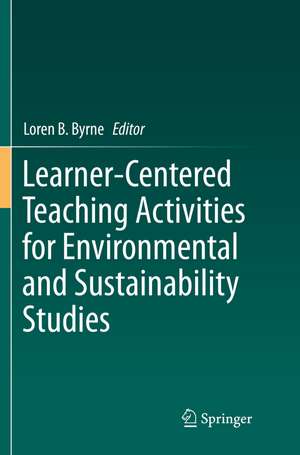
Learner-Centered Teaching Activities for Environmental and Sustainability Studies
Editat de Loren B. Byrneen Limba Engleză Paperback – 25 apr 2018
Considerăm că Learner-Centered Teaching Activities for Environmental and Sustainability Studies reprezintă o resursă indispensabilă pentru cadrele didactice care urmăresc alinierea la standardele moderne de acreditare în educația pentru sustenabilitate. Relevanța acestui volum este imediată pentru educatorii care doresc să implementeze metodologii active, solicitate tot mai frecvent în certificările profesionale din domeniul științelor mediului. Subliniem faptul că textul nu se limitează la teorie, ci oferă soluții pragmatice pentru depășirea constrângerilor de timp și resurse cu care se confruntă instructorii în mediul universitar și preuniversitar. Volumul completează perspectiva oferită de Teaching Environmental Literacy, adăugând un set aplicat de instrumente pedagogice concrete, acolo unde celălalt titlu se concentrează pe definirea obiectivelor de învățare la nivel de disciplină. De asemenea, față de Teaching in the Sciences, lucrarea editată de Loren B. Byrne se specializează strict pe dimensiunile afective și comportamentale ale sustenabilității, utilizând analogii ingenioase. Structura cărții este organizată progresiv: începe cu examinarea pilonilor sustenabilității prin obiecte cotidiene, trece prin modelarea conceptelor de reziliență folosind piese [Lego](brand) și culminează cu exerciții complexe de meta-analiză a literaturii științifice și jocuri de rol despre competiția speciilor. Această progresie permite transformarea studentului dintr-un receptor pasiv într-un participant activ, capabil să „vadă” problemele ecologice din perspective noi și să construiască soluții bazate pe gândire sistemică.
Preț: 460.54 lei
Carte tipărită la comandă
Livrare economică 23 noiembrie-07 decembrie
Specificații
ISBN-10: 3319803743
Pagini: 344
Ilustrații: XX, 322 p. 3 illus.
Dimensiuni: 155 x 235 x 19 mm
Greutate: 0.52 kg
Ediția:Softcover reprint of the original 1st edition 2016
Editura: Springer
Locul publicării:Cham, Switzerland
V-ar putea interesa
-
 METAPHORS FOR ENVIR SUSTAINABILITYBrendon LarsonPreț: 410.91 lei
 -
 Preț: 69.99 lei
 -
 Development for Sustainable AgricultureAkio Hosono-18%Preț: 807.61 lei984.89 lei
 -
 -20%Preț: 624.42 lei780.53 lei
 -
 50 Fantastic Ideas for SustainabilityJune O'Sullivan-42%Preț: 62.90 lei108.68 lei
 -
 Come On!Ernst Ulrich von WeizsäckerPreț: 178.06 lei
 -
 -14%Preț: 5137.90 lei5974.30 lei
 -
 Preț: 166.66 lei
 -
 Economic and Environmental Policy Issues in Indian Textile and Apparel IndustriesBadri Narayanan GopalakrishnanPreț: 361.22 lei
 -
 A Modern Nordic Saga : Politics, Economy and SocietyRyszard M. Czarny-20%Preț: 641.19 lei801.49 lei
 -
 Measuring Progress Towards SustainabilitySubhas K. Sikdar-15%Preț: 619.27 lei728.55 lei
 -
 -15%Preț: 665.41 lei782.84 lei
 -
 -24%Preț: 707.45 lei930.86 lei
 -
 Preț: 116.99 lei
 -
 100 Betriebe für Ressourceneffizienz - Band 1Mario Schmidt-11%Preț: 558.32 lei627.33 lei
 -
 Innovation in der NachhaltigkeitsforschungWalter Leal FilhoPreț: 366.57 lei
 -
 Governance of Urban Sustainability TransitionsDerk Loorbach-24%Preț: 761.65 lei1002.16 lei
 -
 Corrosion Control and Surface FinishingHideyuki Kanematsu-24%Preț: 885.08 lei1164.58 lei
 -
 -20%Preț: 647.42 lei809.28 lei
 -
 Globalized WaterGraciela Schneier-Madanes-18%Preț: 986.35 lei1202.86 lei
 -
 Chemistry: The Key to our Sustainable FutureMinu Gupta Bhowon-18%Preț: 988.65 lei1205.68 lei
 -
 Sustainable Phosphorus ManagementRoland W. ScholzPreț: 411.51 lei
 -
 Special Types of Life Cycle AssessmentMatthias Finkbeiner-24%Preț: 1130.30 lei1487.23 lei
 -
 Aid Effectiveness for Environmental SustainabilityYongfu Huang-18%Preț: 974.85 lei1188.83 lei
De ce să citești această carte
Această carte se adresează profesorilor și practicienilor care doresc să transforme cursurile despre mediu în experiențe interactive. Cititorul câștigă acces la 12 scenarii detaliate de predare care pot fi implementate imediat, fără costuri ridicate. Este soluția ideală pentru a integra rapid activități de tip „hands-on” care dezvoltă gândirea critică și alfabetizarea ecologică a studenților, pregătindu-i pentru provocările reale ale sustenabilității.
Despre autor
Loren B. Byrne este un educator și cercetător recunoscut în domeniul ecologiei și sustenabilității, fiind profesor de biologie și studii de mediu. Interesele sale de cercetare includ ecologia urbană și conservarea solului, însă contribuția sa majoră în acest volum reflectă pasiunea pentru inovație pedagogică. Byrne pledează pentru utilizarea metodelor active în sala de clasă, considerând că educația ecologică eficientă necesită mai mult decât transmiterea de informații; ea necesită implicarea directă a simțurilor și a capacității de reflecție a elevului pentru a produce o schimbare reală de paradigmă.
Descriere scurtă
The broad goal of this volume is to helpadvance environmental education practices that help increase students’environmental literacy. Having a diverse collection of learner-centeredteaching activities is especially useful for helping students develop theirenvironmental literacy because such approaches can help them connect morepersonally with the material thus increasing the chances for altering theaffective and behavioral dimensions of their environmental literacy. Thisvolume differentiates itself from others by providing a unique and diversecollection of classroom activities that can help students develop theirknowledge, skills and personal views about many contemporary environmental andsustainability issues.