
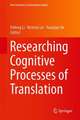
Researching Cognitive Processes of Translation: New Frontiers in Translation Studies
Editat de Defeng Li, Victoria Lai Cheng Lei, Yuanjian Heen Limba Engleză Paperback – 29 dec 2018
| Toate formatele și edițiile | Preț | Express |
|---|---|---|
| Paperback (1) | 503.60 lei 6-8 săpt. | |
| Springer Nature Singapore – 29 dec 2018 | 503.60 lei 6-8 săpt. | |
| Hardback (1) | 672.25 lei 6-8 săpt. | |
| Springer Nature Singapore – 12 noi 2018 | 672.25 lei 6-8 săpt. |
Din seria New Frontiers in Translation Studies
-
 Preț: 383.23 lei
 - 18%
 Preț: 910.58 lei
 -
 Preț: 382.30 lei
 - 15%
 Preț: 559.25 lei
 - 15%
 Preț: 665.98 lei
 - 15%
 Preț: 620.23 lei
 -
 Preț: 405.52 lei
 - 15%
 Preț: 664.73 lei
 -
 Preț: 368.23 lei
 - 18%
 Preț: 965.96 lei
 - 15%
 Preț: 664.41 lei
 - 15%
 Preț: 672.25 lei
 - 24%
 Preț: 693.64 lei
 - 15%
 Preț: 561.29 lei
 - 18%
 Preț: 956.38 lei
 - 18%
 Preț: 701.44 lei
 - 18%
 Preț: 903.90 lei
 - 18%
 Preț: 915.73 lei
 - 18%
 Preț: 756.21 lei
 - 15%
 Preț: 674.15 lei
 - 15%
 Preț: 610.33 lei
 - 24%
 Preț: 806.39 lei
 - 18%
 Preț: 962.00 lei
 - 18%
 Preț: 922.54 lei
 - 15%
 Preț: 561.92 lei
 - 18%
 Preț: 701.44 lei
 - 20%
 Preț: 782.22 lei
 -
 Preț: 373.98 lei
 - 18%
 Preț: 915.43 lei
 - 18%
 Preț: 700.84 lei
 -
 Preț: 377.48 lei
 - 18%
 Preț: 910.58 lei
Preț: 503.60 lei
Preț vechi: 592.46 lei
-15% Nou
Puncte Express: 755
Preț estimativ în valută:
89.10€ • 103.80$ • 77.81£
89.10€ • 103.80$ • 77.81£
Carte tipărită la comandă
Livrare economică 19 ianuarie-02 februarie 26
Preluare comenzi: 021 569.72.76
Specificații
ISBN-13: 9789811347160
ISBN-10: 9811347166
Pagini: 220
Ilustrații: XV, 201 p. 62 illus., 31 illus. in color.
Dimensiuni: 155 x 235 x 12 mm
Greutate: 0.31 kg
Ediția:Softcover reprint of the original 1st ed. 2019
Editura: Springer Nature Singapore
Colecția Springer
Seria New Frontiers in Translation Studies
Locul publicării:Singapore, Singapore
ISBN-10: 9811347166
Pagini: 220
Ilustrații: XV, 201 p. 62 illus., 31 illus. in color.
Dimensiuni: 155 x 235 x 12 mm
Greutate: 0.31 kg
Ediția:Softcover reprint of the original 1st ed. 2019
Editura: Springer Nature Singapore
Colecția Springer
Seria New Frontiers in Translation Studies
Locul publicării:Singapore, Singapore
Cuprins
Part I: Neurocognitive Basis for Translation.- 1. Suggestions for a New Interdisciplinary Linguo-cognitive Theory in Translation Studies.- 2. Translating/Interpreting as Bilingual Processing: The Theoretical Framework.- 3. Translation in the Brain: Preliminary Thoughts About a Brain-imaging Study to Investigate Psychological Processes Involved in Translation.- 4. Explore the Brain Activity During Translation and Interpreting Using Functional Near-infrared Spectroscopy.- 5. On Interpreting.- Part II: Behavioural Perspectives.- 6. Segmentation in Translation: A Look at Expert Behaviour.- 7. Translation Competence as a Cognitive Catalyst for Multiliteracy – Research Findings and Their Implications for L2 Writing and Translation Instruction.- 8. Revisiting Processing Time for Metaphorical Expressions: An Eye-tracking Study on Eye-voice Span during Sight Translation.- Part III: Human-Machine Interface: Translation and Post-editing.- 9. Measuring Difficulty in Translation and Post-editing: AReview.- 10. Outline for a Relevance Theoretical Model of Machine Translation Post-editing.
Recenzii
“The book is a commendable addition to the current repertoire of TPR. The biggest strength lies in its focus on the fundamental importance of solid theoretical foundations for TPR while shedding new light on improving methodological rigor in empirical research endeavors. … the book serves as a timely renewed call for further efforts to address this need.” (Rongbo Fu, The Journal of Specialised Translation, Issue 33, January, 2020)
Notă biografică
Defeng Li is currently a professor of translation studies and director of the Centre for Studies of Translation, Interpreting and Cognition (2014- ), University of Macau, Macau SAR. He was a reader in translation studies and chair of the Centre for Translation Studies at the Centre for Translation Studies SOAS, University of London, United Kingdom (09/2007–12/2013).
His recent research has focused on cognitive approaches to translation and interpreting studies, corpus-assisted translation studies, translation curriculum and material development, translation studies research methods, and second language teaching.
Prof. Li is president of the World Interpreter and Translator Association (WITTA), an international translation studies association.
Textul de pe ultima copertă
This edited volume covers an array of the most relevant topics in translation cognition, taking different approaches and using different research tools. It explores theoretical and methodological issues using case studies and examining their practical and pedagogical implications. It is a valuable resource for translation studies scholars, graduate students and those interested in translation and translation training, enabling them to conceptualize translation cognition, in order to enhance their research methods and designs, manage innovations in their translation training or simply understand their own translation behaviours.
Caracteristici
All chapters contributed by leading scholars Addresses topical issues in cognitive translation studies Covers both theoretical and methodological issues in cognitive translation