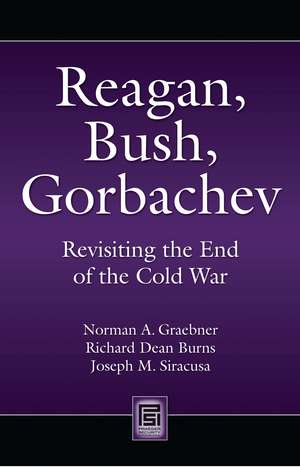
Reagan, Bush, Gorbachev: Revisiting the End of the Cold War: Praeger Security International
Autor Norman a. Graebner, Richard Dean Burns, Joseph M. Siracusaen Limba Engleză Hardback – 29 iun 2008 – vârsta până la 17 ani
Din seria Praeger Security International
- 30%
 Preț: 407.30 lei
 - 34%
 Preț: 382.83 lei
 - 21%
 Preț: 361.02 lei
 - 22%
 Preț: 345.89 lei
 - 29%
 Preț: 413.54 lei
 - 31%
 Preț: 388.13 lei
 - 28%
 Preț: 432.56 lei
 - 21%
 Preț: 345.39 lei
 - 42%
 Preț: 617.10 lei
 - 30%
 Preț: 348.62 lei
 - 21%
 Preț: 363.36 lei
 - 21%
 Preț: 347.50 lei
 - 21%
 Preț: 347.45 lei
 - 30%
 Preț: 395.83 lei
 - 21%
 Preț: 346.12 lei
 - 21%
 Preț: 346.24 lei
 - 21%
 Preț: 346.86 lei
 - 17%
 Preț: 362.86 lei
 - 22%
 Preț: 366.32 lei
 - 17%
 Preț: 361.94 lei
 - 40%
 Preț: 438.46 lei
 - 20%
 Preț: 348.78 lei
 - 30%
 Preț: 406.62 lei
 - 21%
 Preț: 346.52 lei
 - 20%
 Preț: 365.11 lei
 - 37%
 Preț: 295.16 lei
 - 21%
 Preț: 361.82 lei
 - 22%
 Preț: 332.50 lei
 - 21%
 Preț: 273.62 lei
 - 42%
 Preț: 617.29 lei
 - 19%
 Preț: 343.43 lei
 - 20%
 Preț: 325.83 lei
 - 21%
 Preț: 381.17 lei
 - 29%
 Preț: 418.84 lei
 - 20%
 Preț: 326.96 lei
 - 17%
 Preț: 360.61 lei
 - 20%
 Preț: 351.85 lei
 - 27%
 Preț: 365.68 lei
 - 37%
 Preț: 447.93 lei
 - 21%
 Preț: 382.95 lei
 - 32%
 Preț: 274.69 lei
 - 21%
 Preț: 382.42 lei
 - 21%
 Preț: 361.12 lei
 - 17%
 Preț: 326.87 lei
 - 29%
 Preț: 411.30 lei
 - 22%
 Preț: 331.27 lei
 - 20%
 Preț: 341.76 lei
 - 20%
 Preț: 380.06 lei
 - 21%
 Preț: 346.52 lei
 - 22%
 Preț: 378.09 lei
Preț: 455.56 lei
Puncte Express: 683
Carte tipărită la comandă
Livrare economică 18 noiembrie-02 decembrie
Livrare prin curier în România Termenul estimat este afișat lângă disponibilitate.
Transport gratuit pentru acest produs Plată online sau ramburs, în funcție de opțiunile comenzii.
Retur gratuit în 14 zile Comandă securizată și suport în română.
Specificații
ISBN-13: 9780313352416
ISBN-10: 0313352410
Pagini: 188
Dimensiuni: 156 x 235 x 20 mm
Greutate: 0.43 kg
Editura: Bloomsbury Publishing
Colecția Praeger
Seria Praeger Security International
Locul publicării:New York, United States
ISBN-10: 0313352410
Pagini: 188
Dimensiuni: 156 x 235 x 20 mm
Greutate: 0.43 kg
Editura: Bloomsbury Publishing
Colecția Praeger
Seria Praeger Security International
Locul publicării:New York, United States
V-ar putea interesa
-
 The Red LineJohn NicholPreț: 78.54 lei
 -
 Reagan and ThatcherRichard AldousPreț: 114.62 lei
 -
 Iron CurtainAnne Applebaum-26%Preț: 102.25 lei138.04 lei
 -
 Preț: 288.61 lei
 -
 MoonlightJohn Evangelist WalshPreț: 205.42 lei
 -
 An American InsurrectionWilliam DoylePreț: 142.91 lei
 -
 Into the American WoodsJames H MerrellPreț: 175.52 lei
 -
 Preț: 104.61 lei
 -
 Lone Star JusticeRobert M. UtleyPreț: 158.29 lei
 -
 Preț: 122.84 lei
 -
 Founding Fathers Far WestDa JohnsonPreț: 486.58 lei
 -
 Dam BustersJames Holland-18%Preț: 77.86 lei94.81 lei
 -
 Riot and RemembranceJames S. HirschPreț: 117.86 lei
 -
 Boomtown Blues: Colorado Oil Shale, Revised EditionAndrew GullifordPreț: 245.72 lei
 -
 Living Our Language: Ojibwe Tales & Oral HistoriesAnton TreuerPreț: 121.91 lei
 -
 Preț: 253.07 lei
 -
 Preț: 102.61 lei
 -
 Business Research Methods and Statistics Using SPSSRobert P. Burns-8%Preț: 534.75 lei581.25 lei
 -
 1864Charles Bracelen FloodPreț: 118.29 lei
 -
 Clandestine in ChileFrancisco GoldmanPreț: 93.86 lei
 -
 -20%Preț: 209.96 lei261.65 lei
 -
 I am SpainDavid Boyd HaycockPreț: 73.20 lei
Notă biografică
Norman A. Graebner is Randolph P. Compton Professor of History and Public Affairs Emeritus, the University of Virginia and is the recipient of the university's highest honor, the Thomas Jefferson Award. He is an internationally acknowledged authority on United States and American diplomacy. He was a Harold Vyvyan Harmsworth Professor of American History at Oxford University and a Thomas Jefferson Visiting Scholar at Downing College, Cambridge. He is the author, co-author, or editor of more than thirty books and some 130 articles, essays, and book chapters, including Empire on the Pacific: A Study in American Continental Expansion (1955, 1983), Foundations of American Foreign Policy: A Realist Appraisal from Franklin to McKinley (1985), and America as a World Power: A Realist Appraisal from Wilson to Reagan (1984).Richard Dean Burns is Professor Emeritus and former chair of the History Department at California State University, Los Angeles. He has authored and edited more than a dozen books and two dozen articles covering arms control, diplomatic history, international law, and American foreign policy. Most recently, he co-authored The Quest for Missile Defense, 1944-2003 (2004). His other publications include an edited three-volume, Encyclopedia of Arms Control and Disarmament (1993), a co-edited three-volume Encyclopedia of American Foreign Policy, Second Edition (2002), an edited three-volume Chronological History of United States Foreign Relations (2002), and Cold War Chronology, 1917-1992 (2005).Joseph M. Siracusa is Professor of International Diplomacy and Director of Global Studies in the School of Global Studies, Social Science and Planning, at the Royal Melbourne Institute of Technology where he is a specialist in nuclear politics and global security. A native of Chicago and long-time resident of Australia, he is internationally known for his writings on nuclear history, diplomacy, and presidential politics. He is also a frequent political affairs commentator in the Australian media, including ABC Radio National. His books include A History of United States Foreign Policy, Depression to Cold War: A History of America from Herbert Hoover to Ronald Reagan (with David G. Coleman), Presidential Profiles: The Kennedy Years, and Real-World Nuclear Deterrence: The Making of International Strategy (with David G. Coleman).
Cuprins
Preface1 Introduction: The Carter Years2 Ronald Reagan and the Second Cold War3 Reagan Initiatives and Soviet Turmoil4 The Anti-Soviet Crusade Continues5 The Reagan Doctrine6 The Reagan-Gorbachev Dtente7 The Vanishing Cold War8 In RetrospectSelected Bibliography
Descriere
Descriere de la o altă ediție sau format:
This work is a contemporary chronicle of the Cold War and offers an analysis of policy and rhetoric of the United States and Soviet Union during the 1980s. The authors examine the assumptions that drove political decisions and the rhetoric that defined the relationship as the Soviet Union began to implode.
This work demonstrates that while the subsequent unraveling of the Soviet empire was an unintended side effect of Mikhail Gorbachev's reforms, termination of the Cold War was not. Ronald Reagan deserves full credit for recognizing Gorbachev's sincerity and his determination to change the direction of Soviet policies. For this, Reagan felt the full wrath of anticommunist hawks for doing business with a communist leader. But it was Gorbachev who concluded the superpowers had become mesmerized by ideological myths which ruled out any meaningful discussions of a possible accommodation of political issues for more than four decades. The evidence is compelling that Gorbachev himself broke the Cold War's ideological straight jacket that had paralyzed Moscow and Washington's ability to resolve their differences. Though politically weakened, Gorbachev conceded nothing to U.S. military superiority. Never did he negotiate from a position of weakness. In doing so, the last Soviet leader faced even greater political and physical risk. Without Gorbachev the end of the Cold War could have played out very differently and perhaps with great danger.
This work is a contemporary chronicle of the Cold War and offers an analysis of policy and rhetoric of the United States and Soviet Union during the 1980s. The authors examine the assumptions that drove political decisions and the rhetoric that defined the relationship as the Soviet Union began to implode.
This work demonstrates that while the subsequent unraveling of the Soviet empire was an unintended side effect of Mikhail Gorbachev's reforms, termination of the Cold War was not. Ronald Reagan deserves full credit for recognizing Gorbachev's sincerity and his determination to change the direction of Soviet policies. For this, Reagan felt the full wrath of anticommunist hawks for doing business with a communist leader. But it was Gorbachev who concluded the superpowers had become mesmerized by ideological myths which ruled out any meaningful discussions of a possible accommodation of political issues for more than four decades. The evidence is compelling that Gorbachev himself broke the Cold War's ideological straight jacket that had paralyzed Moscow and Washington's ability to resolve their differences. Though politically weakened, Gorbachev conceded nothing to U.S. military superiority. Never did he negotiate from a position of weakness. In doing so, the last Soviet leader faced even greater political and physical risk. Without Gorbachev the end of the Cold War could have played out very differently and perhaps with great danger.