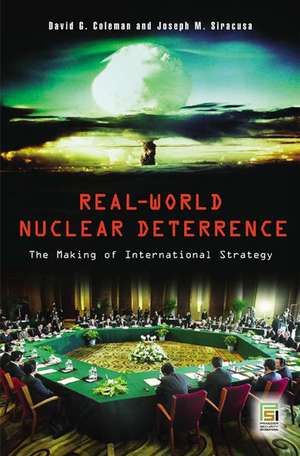
Real-World Nuclear Deterrence: The Making of International Strategy: Praeger Security International
Autor David G. Coleman, Joseph M. Siracusaen Limba Engleză Hardback – 30 iun 2006
By drawing on a wide array of new sources from international archives and the latest in international scholarship, Coleman and Siracusa put some of the most important and enduring problems of nuclear deterrence over the past sixty years into global context. Nuclear deterrence in the real world often operates very differently from how it should according to the prevailing theories, and Coleman and Siracusa take a fresh look at how nuclear weapons policy has been made, finding that it often has had surprisingly little to do with what works and what does not. By studying in depth how governments here and abroad have confronted and dealt with some of the most important issues in nuclear weapons policy, for example, How many nuclear weapons are enough? and What is it that will deter? they find that the making of nuclear weapons policy is a complex, fluid bargaining process subject to the tides of politics, budgets, threat perception, ideology, technology, parochial service rivalries, flawed information, and sometimes just plain wishful thinking.
Din seria Praeger Security International
- 30%
 Preț: 407.30 lei
 - 34%
 Preț: 382.83 lei
 - 21%
 Preț: 361.02 lei
 - 22%
 Preț: 345.89 lei
 - 29%
 Preț: 413.54 lei
 - 31%
 Preț: 388.13 lei
 - 28%
 Preț: 432.56 lei
 - 21%
 Preț: 345.39 lei
 - 42%
 Preț: 617.10 lei
 - 30%
 Preț: 348.62 lei
 - 21%
 Preț: 363.36 lei
 - 21%
 Preț: 347.50 lei
 - 21%
 Preț: 347.45 lei
 - 30%
 Preț: 395.83 lei
 - 21%
 Preț: 346.24 lei
 - 21%
 Preț: 346.86 lei
 - 17%
 Preț: 362.86 lei
 - 22%
 Preț: 366.32 lei
 - 17%
 Preț: 361.94 lei
 - 40%
 Preț: 438.46 lei
 - 20%
 Preț: 348.78 lei
 - 30%
 Preț: 406.62 lei
 - 21%
 Preț: 346.52 lei
 - 20%
 Preț: 365.11 lei
 - 37%
 Preț: 295.16 lei
 - 20%
 Preț: 370.58 lei
 - 22%
 Preț: 332.50 lei
 - 20%
 Preț: 280.33 lei
 - 42%
 Preț: 617.29 lei
 - 19%
 Preț: 343.43 lei
 - 20%
 Preț: 333.71 lei
 - 21%
 Preț: 381.17 lei
 - 29%
 Preț: 418.84 lei
 - 20%
 Preț: 326.96 lei
 - 17%
 Preț: 360.61 lei
 - 20%
 Preț: 351.85 lei
 - 27%
 Preț: 365.68 lei
 - 37%
 Preț: 447.93 lei
 - 21%
 Preț: 382.95 lei
 - 31%
 Preț: 281.46 lei
 - 21%
 Preț: 382.42 lei
 - 21%
 Preț: 361.12 lei
 - 17%
 Preț: 326.87 lei
 - 29%
 Preț: 411.30 lei
 - 22%
 Preț: 331.27 lei
 - 20%
 Preț: 341.76 lei
 - 20%
 Preț: 380.06 lei
 - 21%
 Preț: 346.52 lei
 - 20%
 Preț: 392.24 lei
Preț: 346.12 lei
Preț vechi: 437.01 lei
-21%
Puncte Express: 519
Carte tipărită la comandă
Livrare economică 07-21 decembrie
Livrare prin curier în România Termenul estimat este afișat lângă disponibilitate.
Transport gratuit de la 400.00 lei Plată online sau ramburs, în funcție de opțiunile comenzii.
Retur gratuit în 14 zile Comandă securizată și suport în română.
Specificații
ISBN-13: 9780275980986
ISBN-10: 0275980987
Pagini: 184
Dimensiuni: 156 x 235 x 21 mm
Greutate: 0.45 kg
Editura: Bloomsbury Publishing
Colecția Praeger
Seria Praeger Security International
Locul publicării:New York, United States
ISBN-10: 0275980987
Pagini: 184
Dimensiuni: 156 x 235 x 21 mm
Greutate: 0.45 kg
Editura: Bloomsbury Publishing
Colecția Praeger
Seria Praeger Security International
Locul publicării:New York, United States
V-ar putea interesa
-
 Snake DancePatrick MarnhamPreț: 119.47 lei
 -
 Nuclear Deterrence, Morality and RealismJohn Finnis-27%Preț: 395.59 lei540.39 lei
 -
 Thinking About Nuclear Weapons: Principles, Problems, ProspectsMichael Quinlan-28%Preț: 528.16 lei735.85 lei
 -
 -31%Preț: 710.27 lei1030.72 lei
 -
 -30%Preț: 550.66 lei784.61 lei
 -
 Achieving Nuclear AmbitionsJacques E. C. HymansPreț: 283.72 lei
 -
 TridentFrank McKimPreț: 141.69 lei
 -
 Preț: 398.32 lei
 -
 On Thermonuclear WarHerman KahnPreț: 455.53 lei
Cuprins
Preface
Arming for Peace
Extending Nuclear Umbrellas
Credibility Gap
Bridging the Gap
The Numbers Game
Keeping the Lid On
The Spread of Nuclear Weapons
Bibliography
Index
Arming for Peace
Extending Nuclear Umbrellas
Credibility Gap
Bridging the Gap
The Numbers Game
Keeping the Lid On
The Spread of Nuclear Weapons
Bibliography
Index
Recenzii
David G. Coleman and Joseph M. Siracusa deliver a concise, readable, and thoughtful review of an exceedingly complex issue. In 121 pages of text they discuss the evolution of nuclear strategy in the United States, the Soviet Union, and other countries from the end of World War II to the present..[T]he book is a useful overview of an elusive and vitally important topic.
For Coleman and Siracusa the concept of nuclear deterrence is about more than preventing global thermonuclear war, it is about pursuing and protecting national interests and preventing limited conflicts and thus remains a topic of contemporary relevance, the end of the Cold War notwithstanding. Analyzing the history of nuclear deterrence policy, they discuss such topics as the inadequacy of the belief that the mere possession of nuclear weapons serves as a deterrent; US, British, and Soviet experiments with the concept of extended deterrence, in which nuclear guarantees are made to international allies; efforts to redress the overextension of the last concept with more credible deterrent forces; the question of how many nuclear weapons are enough; and the issue of controlling hostilities between nuclear-armed states.
The book does a good job of taking the reader through the big (and largely Anglo-American) debates on nuclear policy--from containment, through massive retaliation and flexible response, and on to contemporary questions of proliferation..[t]he approach is fresh and lively.
Real-World Nuclear Deterrence: The Making of International Strategy follows the post-Cold War threat of nuclear weapons, surveying the major powers which maintain about 27,000 nuclear weapons to date, and using new sources from international archives and scholarship to consider the latest issues revolving around deterrence strategies. One might anticipate such a book would be geared towards military specialists, but an attention to clear language and historical references lends to lay reader understanding.
For Coleman and Siracusa the concept of nuclear deterrence is about more than preventing global thermonuclear war, it is about pursuing and protecting national interests and preventing limited conflicts and thus remains a topic of contemporary relevance, the end of the Cold War notwithstanding. Analyzing the history of nuclear deterrence policy, they discuss such topics as the inadequacy of the belief that the mere possession of nuclear weapons serves as a deterrent; US, British, and Soviet experiments with the concept of extended deterrence, in which nuclear guarantees are made to international allies; efforts to redress the overextension of the last concept with more credible deterrent forces; the question of how many nuclear weapons are enough; and the issue of controlling hostilities between nuclear-armed states.
The book does a good job of taking the reader through the big (and largely Anglo-American) debates on nuclear policy--from containment, through massive retaliation and flexible response, and on to contemporary questions of proliferation..[t]he approach is fresh and lively.
Real-World Nuclear Deterrence: The Making of International Strategy follows the post-Cold War threat of nuclear weapons, surveying the major powers which maintain about 27,000 nuclear weapons to date, and using new sources from international archives and scholarship to consider the latest issues revolving around deterrence strategies. One might anticipate such a book would be geared towards military specialists, but an attention to clear language and historical references lends to lay reader understanding.