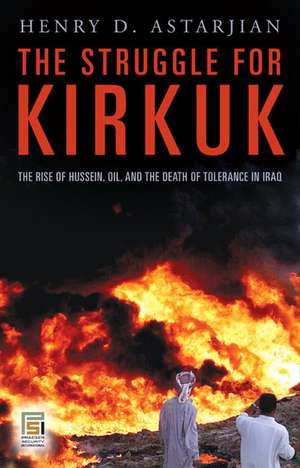
The Struggle for Kirkuk: The Rise of Hussein, Oil, and the Death of Tolerance in Iraq: Praeger Security International
Autor Henry D. Astarjian M.D.en Limba Engleză Hardback – 30 mai 2007
This book is the story of the demographic diversity of this city, its political currents leading to the demise of the Royal regime of Iraq. It is the story of colonial Britains, Kurds, Turkomans, Assyrians, pre-emigration Jews, and post-genocidal Armenians, all living together in peace but with deep-seated animosities. Directly or indirectly they all were involved in surreptitious battles for control over Baba Gurgur, the oil fields of Kirkuk. Henry Astarjian was both a witness to and a victim of most events of this period. The book also explores the influences that the British, through the Iraq Petroleum Company (IPC), had in shaping Iraqi society. This book goes beyond the obvious in detailing the Soviet attempts to gain access to Baba Gurgur through its surrogates, the Communists, and their efforts to recruit the budding youth. It also tells the story of the author's incarceration and torture in a death row cell, at the hands of his childhood friend Adnaan Al-Azzawi, an avowed Communist. The demise of the Hashimite Dynasty in Iraq in 1958, which led to Communist takeover of the country, touched Astarjian's life personally. His incarceration with the Ba'th leaders in Al-Rasheed Military Base, gave him a special look at their psyche and a negative sense for the future of Iraq; that, influenced his decision to leave the country. Finally, the book pursues the psychological effects the Iraqi defeat in Palestine (1948) had on the Iraqi person and the Armed forces. It details the on-the-spot formation of the Iraqi Free Officers movement (whose founders later became the author's prison mates) who, a decade later, waged a coup against the Hashimite regime.
Din seria Praeger Security International
- 31%
 Preț: 388.21 lei
 - 35%
 Preț: 365.05 lei
 - 22%
 Preț: 344.06 lei
 - 22%
 Preț: 345.89 lei
 - 30%
 Preț: 394.17 lei
 - 31%
 Preț: 388.13 lei
 - 28%
 Preț: 432.56 lei
 - 22%
 Preț: 328.84 lei
 - 43%
 Preț: 588.28 lei
 - 31%
 Preț: 332.74 lei
 - 22%
 Preț: 345.89 lei
 - 22%
 Preț: 331.27 lei
 - 22%
 Preț: 331.27 lei
 - 30%
 Preț: 395.83 lei
 - 22%
 Preț: 330.07 lei
 - 22%
 Preț: 330.07 lei
 - 22%
 Preț: 330.67 lei
 - 18%
 Preț: 345.89 lei
 - 22%
 Preț: 366.32 lei
 - 18%
 Preț: 344.66 lei
 - 41%
 Preț: 417.57 lei
 - 22%
 Preț: 332.36 lei
 - 31%
 Preț: 387.57 lei
 - 22%
 Preț: 330.07 lei
 - 22%
 Preț: 348.32 lei
 - 38%
 Preț: 281.30 lei
 - 22%
 Preț: 344.66 lei
 - 22%
 Preț: 332.50 lei
 - 22%
 Preț: 261.64 lei
 - 43%
 Preț: 588.28 lei
 - 19%
 Preț: 343.43 lei
 - 22%
 Preț: 310.51 lei
 - 22%
 Preț: 363.21 lei
 - 30%
 Preț: 399.22 lei
 - 22%
 Preț: 311.52 lei
 - 19%
 Preț: 344.06 lei
 - 21%
 Preț: 335.43 lei
 - 28%
 Preț: 348.68 lei
 - 38%
 Preț: 426.57 lei
 - 22%
 Preț: 365.05 lei
 - 33%
 Preț: 261.94 lei
 - 22%
 Preț: 364.42 lei
 - 18%
 Preț: 311.52 lei
 - 31%
 Preț: 392.03 lei
 - 22%
 Preț: 331.27 lei
 - 22%
 Preț: 325.51 lei
 - 22%
 Preț: 362.32 lei
 - 22%
 Preț: 330.67 lei
 - 22%
 Preț: 365.05 lei
Preț: 344.26 lei
Preț vechi: 442.14 lei
-22%
Puncte Express: 516
Carte tipărită la comandă
Livrare economică 12-26 iunie
Specificații
ISBN-13: 9780275995898
ISBN-10: 0275995895
Pagini: 200
Dimensiuni: 156 x 235 x 22 mm
Greutate: 0.46 kg
Editura: Bloomsbury Publishing
Colecția Praeger
Seria Praeger Security International
Locul publicării:New York, United States
ISBN-10: 0275995895
Pagini: 200
Dimensiuni: 156 x 235 x 22 mm
Greutate: 0.46 kg
Editura: Bloomsbury Publishing
Colecția Praeger
Seria Praeger Security International
Locul publicării:New York, United States
V-ar putea interesa
-
 A Test Of TimeDavid Rohl-19%Preț: 94.97 lei117.88 lei
 -
 An Evil CradlingBrian Keenan-32%Preț: 60.53 lei88.92 lei
 -
 Lords of the HorizonsJason Goodwin-20%Preț: 71.34 lei89.20 lei
 -
 The Fifty Years War: Israel and the ArabsJihan El-TahriPreț: 111.73 lei
 -
 The Ayatollah Begs to DifferHooman MajdPreț: 109.85 lei
 -
 Pity the Nation Lebanon at WarRobert Fisk-19%Preț: 122.57 lei152.11 lei
 -
 The Turks in World HistoryCarter V. Findley-10%Preț: 200.44 lei221.79 lei
 -
 -24%Preț: 370.60 lei485.33 lei
 -
 Tribes, Government, and History in YemenPaul Dresch-14%Preț: 358.79 lei416.15 lei
 -
 The Real Bravo Two ZeroMichael Asher-28%Preț: 63.35 lei88.41 lei
 -
 Cruelty and SilenceKanan MakiyaPreț: 142.96 lei
 -
 The Cambridge Companion to MuhammadJonathan E. BrockoppPreț: 233.40 lei
 -
 Imperial Life in the Emerald CityRajiv Chandrasekaran-28%Preț: 64.35 lei88.98 lei
 -
 The Lion's GraveJon Lee AndersonPreț: 81.35 lei
 -
 The Multiple Identities of the Middle EastBernard LewisPreț: 87.83 lei
 -
 The Yom Kippur WarAbraham RabinovichPreț: 129.45 lei
Cuprins
Preface
Acknowledgments
Introduction
1 Kirkuk
2 Kurds, Turkomans, Arabs, and the Others
3 From Tranquility to Conflict
4 A Communist Offensive
5 Mr. Chapman, A. J. B. Chapman
6 Soviet Plans for Baba Gurgur
7 Communism and the Youth
8 1948
9 The IPC and Us
10 The Dawn of the Kurdish Era
11 The Western Trajectory
12 The Fermenting Coups
13 The Morning of July 14, 1958
14 The Turmoil of the 1940s
15 Kirkuk, the Jerusalem of Iraq
16 Kurdistan
17 A Disastrous Task
18 A Long Journey
19 Room # 11
20 Courts, Kurds, and the Communists
21 Triumphs and Defeats
22 Baghdad
23 The Winds of Change
24 A "U-Turn"
25 More Turmoil
26 "Your Destiny Is Charted for You the Minute You Are Born"
27 A Chitchat
Index
Acknowledgments
Introduction
1 Kirkuk
2 Kurds, Turkomans, Arabs, and the Others
3 From Tranquility to Conflict
4 A Communist Offensive
5 Mr. Chapman, A. J. B. Chapman
6 Soviet Plans for Baba Gurgur
7 Communism and the Youth
8 1948
9 The IPC and Us
10 The Dawn of the Kurdish Era
11 The Western Trajectory
12 The Fermenting Coups
13 The Morning of July 14, 1958
14 The Turmoil of the 1940s
15 Kirkuk, the Jerusalem of Iraq
16 Kurdistan
17 A Disastrous Task
18 A Long Journey
19 Room # 11
20 Courts, Kurds, and the Communists
21 Triumphs and Defeats
22 Baghdad
23 The Winds of Change
24 A "U-Turn"
25 More Turmoil
26 "Your Destiny Is Charted for You the Minute You Are Born"
27 A Chitchat
Index
Recenzii
Among the plethora of recent books on Iraq, this is unique because it offers a provocative view into Iraq's tumultuous past through the eyes of an Iraqi American physician. This is a historical memoir about the struggle over Kirkuk's great oil fields and the crises besetting Iraqi society before the Baath party takeover and rise of Saddam Hussein. Astarjian, the son of Armenian genocide survivors, chronicles Kirkuk's ethnosectarian diversity as Jews, Kurds, Turkmen, Assyrians, Armenians, and Arabs lived together in peace, despite the power plays over the oil fields involving British officials, Soviet agents, and others representing national or ethnic interests. Included are fascinating accounts of the overthrow of the Royal Hashemite regime in 1958, the author's incarceration and torture at the hands of his childhood friend (who had become a communist), and his imprisonment in a Baghdad military prison with Baath party leaders..[t]his is a compelling story about the formative years of modern Iraq, intended to enlighten Americans about the immense challenges and perils facing them in a tragic land. Sadly, it may be too late to make it a must read for US policy makers. Recommended. General readers, lower-division undergraduates through practitioners.
Iraqi-American Astarjian combines memoir with history in describing the oil politics of Kirkuk in Northern Iraq from the 1940s through to the mid 1960s, when he left for America shortly after Saddam Hussein's assassination attempt on Prime Minister Abd-al-Karim Qasim. His description of the political life of Kirkuk during this era gives a small window into the complex forces at work Kurdish versus Arab, Arab versus Turkomen, Communist versus Baathist, etc. and Astarjian is not shy about letting his own anti-communist, anti-Baathist, and other views out into the open.
Iraqi-American Astarjian combines memoir with history in describing the oil politics of Kirkuk in Northern Iraq from the 1940s through to the mid 1960s, when he left for America shortly after Saddam Hussein's assassination attempt on Prime Minister Abd-al-Karim Qasim. His description of the political life of Kirkuk during this era gives a small window into the complex forces at work Kurdish versus Arab, Arab versus Turkomen, Communist versus Baathist, etc. and Astarjian is not shy about letting his own anti-communist, anti-Baathist, and other views out into the open.