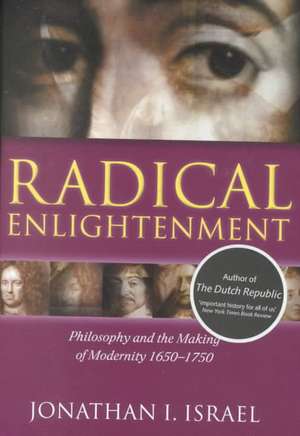
Radical Enlightenment: Philosophy and the Making of Modernity 1650-1750
Autor Jonathan I. Israelen Limba Engleză Hardback – 8 feb 2001
Preț: 1071.47 lei
Preț vechi: 1583.15 lei
-32%
Puncte Express: 1607
Carte tipărită la comandă
Livrare economică 03-09 decembrie
Livrare prin curier în România Termenul estimat este afișat lângă disponibilitate.
Transport gratuit pentru acest produs Plată online sau ramburs, în funcție de opțiunile comenzii.
Retur gratuit în 14 zile Comandă securizată și suport în română.
Specificații
ISBN-13: 9780198206088
ISBN-10: 0198206089
Pagini: 832
Ilustrații: 16 pp plates, 5 halftones, map
Dimensiuni: 166 x 242 x 47 mm
Greutate: 1.27 kg
Editura: OUP OXFORD
Colecția OUP Oxford
Locul publicării:Oxford, United Kingdom
ISBN-10: 0198206089
Pagini: 832
Ilustrații: 16 pp plates, 5 halftones, map
Dimensiuni: 166 x 242 x 47 mm
Greutate: 1.27 kg
Editura: OUP OXFORD
Colecția OUP Oxford
Locul publicării:Oxford, United Kingdom
V-ar putea interesa
-
 The Dutch Republic: Its Rise, Greatness, and Fall 1477-1806Jonathan Israel-19%Preț: 461.59 lei570.25 lei
 -
 Dutch Primacy in World Trade, 1585-1740Jonathan I. Israel-28%Preț: 481.98 lei670.64 lei
 -
 -19%Preț: 358.11 lei439.66 lei
 -
 -20%Preț: 524.71 lei654.27 lei
 -
 The Oxford Handbook of the History of CommunismS. a. Smith-32%Preț: 1024.92 lei1512.65 lei
 -
 -11%Preț: 239.24 lei267.61 lei
 -
 The Gestapo: Power and Terror in the Third ReichCarsten Dams-19%Preț: 139.62 lei172.22 lei
 -
 -18%Preț: 105.84 lei129.50 lei
 -
 -27%Preț: 413.53 lei565.33 lei
 -
 Neptune: The Allied Invasion of Europe and the D-Day LandingsCraig L. Symonds-16%Preț: 163.39 lei194.42 lei
 -
 Robbing the JewsMartin DeanPreț: 309.29 lei
 -
 Revolutionary IdeasJonathan IsraelPreț: 265.16 lei
 -
 Bloody Scottish History: EdinburghGeoff HolderPreț: 112.51 lei
 -
 Voices from the WorkhousePeter Higginbotham-11%Preț: 116.26 lei131.15 lei
 -
 Renaissance Dynasticism & Apanage PoliticsMatthew VesterPreț: 392.03 lei
 -
 Human ActionLudwig Von MisesPreț: 196.65 lei
 -
 Decline and Fall of the Roman Empire: Vols 1-3Edward Gibbon-16%Preț: 402.74 lei479.43 lei
 -
 -16%Preț: 398.25 lei475.89 lei
 -
 The Most Excellent Book of CookeryKen AlbalaPreț: 132.42 lei
 -
 Sigmund Freud - Gesammelte WerkeSigmund FreudPreț: 156.01 lei
 -
 Duino ElegiesDavid Oswald-12%Preț: 189.45 lei215.07 lei
Recenzii
Massive and brilliant book ... Israel displays a profound, and contagious, sympathy for the intellectual movement he describes ... Israel has given us a vast panorama of the unfolding of Enlightenment thought during the crucial century between 1650 and 1750 ... The book is a real tour de force ... magisterial.
A brilliant achievement, piecing together some highly elusive strands of the early enlightenment in a way which not only makes compulsive reading, but is also bound to have a major and permanent impact on enlightenment scholarship as a whole.
This book gives the early radical enlightenment a clarity and power which historians of the early modern period will find impossible to ignore.
As a formidably well-researched history of radical thinking from the mid-seventeenth century through to the French Revolution, and of the scholars who confronted each other at the time in sometimes ferociously bitter disputes, this book has no rival.
In an age of historical miniaturists, it is exhilarating to encounter a scholar who is willing to cover walls and ceilings with a magnificent sprawling historical fresco. Israel has put forward a Grand Historical Thesis of the sort that historians once revelled in, but that has largely gone out of style. He has done so, moreover, with panache and in detail, revealing a command of texts and archival documents, local milieux and international currents, that compels admiration Radical Enlightenment swarms with fascinating material of every sort, so rich and varied that no review can do it justice.
Radical Enlightenment deserves to be widely read because it is an example of ground-breaking, vastly well-informed and thoroughly new history.
Jonathan Israel's ardour, erudition and willingness to challenge widely accepted notions make his book a great achievement - one that entitles him to the gratitude of the entire world of learning.
Magnificent and magisterial, Radical Enlightenment will undoubtedly be one of the truly great historical works of the decade.
Magnificent ... sumptuous in the energy, clarity, and of the breadth of its scholarship ... [A] masterpiece.
Remarkable historical study ... the author succeeds in turning a mountain of evidence into crisp, fresh prose.
That Israel has taken so much learning and compressed it into such an informative and stimulating read is a remarkable achievement ... The book must be considered the standard by which future histories of philosophy will be measured.
We have gained a much more detailed and fine-grained view of the sheer diversity and intellectual creativity not just amongst those who may have been influenced by Spinoza, but also amongst their critics, and those who may be deemed part of either the moderate Enlightenment or even a Counter-Enlightenment.
A brilliant achievement, piecing together some highly elusive strands of the early enlightenment in a way which not only makes compulsive reading, but is also bound to have a major and permanent impact on enlightenment scholarship as a whole.
This book gives the early radical enlightenment a clarity and power which historians of the early modern period will find impossible to ignore.
As a formidably well-researched history of radical thinking from the mid-seventeenth century through to the French Revolution, and of the scholars who confronted each other at the time in sometimes ferociously bitter disputes, this book has no rival.
In an age of historical miniaturists, it is exhilarating to encounter a scholar who is willing to cover walls and ceilings with a magnificent sprawling historical fresco. Israel has put forward a Grand Historical Thesis of the sort that historians once revelled in, but that has largely gone out of style. He has done so, moreover, with panache and in detail, revealing a command of texts and archival documents, local milieux and international currents, that compels admiration Radical Enlightenment swarms with fascinating material of every sort, so rich and varied that no review can do it justice.
Radical Enlightenment deserves to be widely read because it is an example of ground-breaking, vastly well-informed and thoroughly new history.
Jonathan Israel's ardour, erudition and willingness to challenge widely accepted notions make his book a great achievement - one that entitles him to the gratitude of the entire world of learning.
Magnificent and magisterial, Radical Enlightenment will undoubtedly be one of the truly great historical works of the decade.
Magnificent ... sumptuous in the energy, clarity, and of the breadth of its scholarship ... [A] masterpiece.
Remarkable historical study ... the author succeeds in turning a mountain of evidence into crisp, fresh prose.
That Israel has taken so much learning and compressed it into such an informative and stimulating read is a remarkable achievement ... The book must be considered the standard by which future histories of philosophy will be measured.
We have gained a much more detailed and fine-grained view of the sheer diversity and intellectual creativity not just amongst those who may have been influenced by Spinoza, but also amongst their critics, and those who may be deemed part of either the moderate Enlightenment or even a Counter-Enlightenment.
Cuprins
- I. The 'Radical Enlightenment'
- 1: Introduction
- 2: Government and Philosophy
- 3: Society, Institutions, Revolution
- 4: Women, Philosophy, and Sexuality
- 5: Censorship and Culture
- 6: Libraries and Enlightenment
- 7: The Learned Journals
- II. The Rise of Philosophical Radicalism
- 8: Spinoza
- 9: Van den Enden: Philosophy, Democracy, and Egalitarianism
- 10: Radicalism and the People: The Brothers Koerbagh
- 11: Philosophy, the Interpreter of Scripture
- 12: Miracles Denied
- 13: Spinoza's System
- 14: Spinoza, Science, and the Scientists
- 15: Philosophy, Politics, and the Liberation of Man
- 16: Publishing a Banned Philosophy
- 17: The Spread of a Forbidden Movement
- III. Europe and the 'New' Intellectual Controversies 1680-1720
- 18: Bayle and the 'Virtuous Atheist'
- 19: The Bredenburg Disputes
- 20: Fontenelle and the War of the Oracles
- 21: The Death of the Devil
- 22: Leenhof and the 'Universal Philosophical Religion'
- 23: The 'Nature of God' Controversy
- IV. The Intellectual Counter-Offensive
- 24: New Theological Strategies
- 25: The Collapse of Cartesianism
- 26: Leibniz and the Radical Enlightenment
- 27: Anglomania: The 'Triumph' of Newton and Locke
- 28: The Intellectual Drama in Spain and Portugal
- 29: Germany and the Baltic: 'The 'War of the Philosophers'
- V. The Clandestine Progress of the Radical Enlightenment 1680-1750
- 30: Boulainvilliers and the Rise of French
- 31: French Refugee Deists in Exile
- 32: The Spinozistic Novel in French
- 33: English Deism and Europe
- 34: Germany: The Radical Aufklaerung
- 35: The Radical Impact in Italy
- 36: The Clandestine Philosophical Manuscripts
- 37: From La Mettrie to Diderot
- 38: Epilogue: Rousseau, Radicalism, Revolution