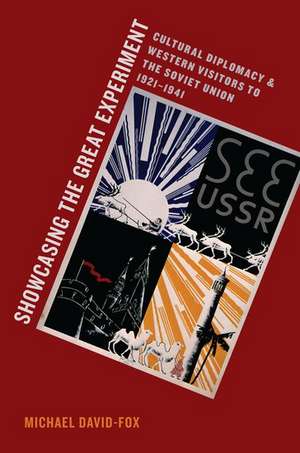
Showcasing the Great Experiment: Cultural Diplomacy and Western Visitors to the Soviet Union, 1921-1941
Autor Michael David-Foxen Limba Engleză Paperback – 6 mar 2014
Preț: 358.11 lei
Preț vechi: 439.66 lei
-19%
Puncte Express: 537
Carte tipărită la comandă
Livrare economică 27 noiembrie-02 decembrie
Livrare prin curier în România Termenul estimat este afișat lângă disponibilitate.
Transport gratuit de la 400.00 lei Plată online sau ramburs, în funcție de opțiunile comenzii.
Retur gratuit în 14 zile Comandă securizată și suport în română.
Specificații
ISBN-13: 9780199376421
ISBN-10: 0199376425
Pagini: 416
Ilustrații: 15 halftones
Dimensiuni: 157 x 231 x 28 mm
Greutate: 0.66 kg
Editura: Oxford University Press
Colecția OUP USA
Locul publicării:New York, United States
ISBN-10: 0199376425
Pagini: 416
Ilustrații: 15 halftones
Dimensiuni: 157 x 231 x 28 mm
Greutate: 0.66 kg
Editura: Oxford University Press
Colecția OUP USA
Locul publicării:New York, United States
V-ar putea interesa
-
 Preț: 151.42 lei
 -
 Intercultural PragmaticsIstvan Kecskes-31%Preț: 741.55 lei1080.82 lei
 -
 Humanity's LawRuti Teitel-20%Preț: 304.40 lei381.47 lei
 -
 The Practice of Public DiplomacyW. RughPreț: 391.23 lei
 -
 Freedom's BattleGary J. BassPreț: 153.36 lei
 -
 Advocacy and Social Work PracticeTom Wilks-21%Preț: 200.11 lei252.11 lei
 -
 Branding Cities: Cosmopolitanism, Parochialism, and Social ChangeStephanie Hemelryk DonaldPreț: 477.89 lei
 -
 Citizens, Politics and Social CommunicationR. Robert HuckfeldtPreț: 304.24 lei
 -
 The Nature and Origins of Mass OpinionJohn R. ZallerPreț: 267.49 lei
 -
 -37%Preț: 250.76 lei398.75 lei
 -
 Political MarketingRobert P. Ormrod-18%Preț: 695.89 lei848.65 lei
 -
 The Ethics of Armed Humanitarian InterventionDon E. ScheidPreț: 221.43 lei
 -
 International Law and International RelationsDavid ArmstrongPreț: 380.80 lei
 -
 International Public Relations and Public DiplomacyGuy J. GolanPreț: 415.54 lei
 -
 Managing the Public's Trust in Non-profit OrganizationsChristopher D.B. BurtPreț: 361.78 lei
Recenzii
The books analytical framework and wealth of new material creates a rich canvas. ... the book provides an important historiographic and theoretical overview of the period, bringing together a wealth of information and revisiting questions of Soviet-Western intellectual exchange that still remain relevant today.
David Fox's marvellous book allows us to see things the way they really were.
David-Fox has produced a deeply researched and original book that invites readers to rethink or revisit some big historiographical questions: continuity and change across the dividing line of 1917, the nature and origins of Stalinism, and the connection between internal and external factors in national development. Of obvious interest to historians of modern Russia, this book will also be read with great benefit by scholars interested in cultural, political, and transnational history.
David Fox's marvellous book allows us to see things the way they really were.
David-Fox has produced a deeply researched and original book that invites readers to rethink or revisit some big historiographical questions: continuity and change across the dividing line of 1917, the nature and origins of Stalinism, and the connection between internal and external factors in national development. Of obvious interest to historians of modern Russia, this book will also be read with great benefit by scholars interested in cultural, political, and transnational history.
Notă biografică
Michael David-Fox is Associate Professor in the Department of History and School of Foreign Service at Georgetown University. He is the author of Revolution of the Mind: Higher Learning among the Bolsheviks, 1918-1929 and a founding editor of Kritika: Explorations in Russian and Eurasian History.