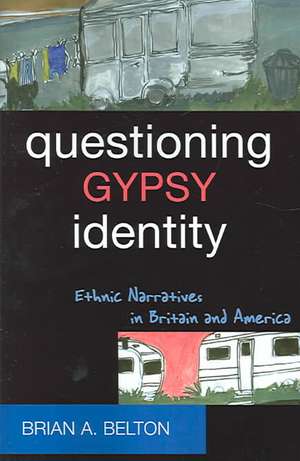
Questioning Gypsy Identity: Ethnic Narratives in Britain and America
Autor Brian A. Beltonen Limba Engleză Paperback – 2 feb 2005
Preț: 277.31 lei
Preț vechi: 362.88 lei
-24%
Puncte Express: 416
Carte tipărită la comandă
Livrare economică 30 noiembrie-14 decembrie
Livrare prin curier în România Termenul estimat este afișat lângă disponibilitate.
Transport gratuit de la 400.00 lei Plată online sau ramburs, în funcție de opțiunile comenzii.
Retur gratuit în 14 zile Comandă securizată și suport în română.
Specificații
ISBN-13: 9780759105331
ISBN-10: 0759105332
Pagini: 212
Dimensiuni: 148 x 226 x 12 mm
Greutate: 0.32 kg
Ediția:New.
Editura: Bloomsbury Publishing
Colecția AltaMira Press
Locul publicării:New York, United States
ISBN-10: 0759105332
Pagini: 212
Dimensiuni: 148 x 226 x 12 mm
Greutate: 0.32 kg
Ediția:New.
Editura: Bloomsbury Publishing
Colecția AltaMira Press
Locul publicării:New York, United States
V-ar putea interesa
-
 The Origin of Our SpeciesChris StringerPreț: 78.32 lei
 -
 -31%Preț: 571.78 lei824.87 lei
 -
 Lucy to Language: The Benchmark PapersR. I. M. Dunbar-31%Preț: 907.34 lei1313.14 lei
 -
 Teeth: A Very Short IntroductionPeter S. Ungar-18%Preț: 59.10 lei72.28 lei
 -
 The Sacred Landscape of the Inca: The Cusco Ceque SystemBrian S. BauerPreț: 287.85 lei
 -
 Human Population GeneticsJohn H. Relethford-23%Preț: 535.99 lei696.08 lei
 -
 The Changing BodyRoderick FloudPreț: 291.73 lei
 -
 The Ethnography of CommunicationMuriel Saville-Troike-8%Preț: 447.04 lei485.91 lei
 -
 The Mirage of ChinaXin LiuPreț: 262.69 lei
 -
 Thin on the GroundSteven E Churchill-9%Preț: 945.92 lei1039.47 lei
 -
 A Companion to Forensic AnthropologyDennis DirkmaatPreț: 428.36 lei
 -
 -23%Preț: 757.54 lei983.83 lei
 -
 Catching Fire: How Cooking Made Us HumanRichard Wrangham-19%Preț: 75.36 lei93.10 lei
Cuprins
Chapter 1 Introduction: A Gypsy Lineage
Chapter 2 The Ethnic Gypsy
Chapter 3 Defining American Gypsies
Chapter 4 Historical Genesis of American Gypsies
Chapter 5 Gypsies in Social Bondage
Chapter 6 Ethnicity as Narrative
Chapter 7 Colonialism and the Gypsies
Chapter 8 Defining Legislation
Chapter 9 Towards a New Paradigm of Gypsy Identity
Chapter 10 Appendix: The Gypsy Lore Society (GLS)
Chapter 11 Bibliography
Chapter 12 Index
Chapter 13 About the Author
Chapter 2 The Ethnic Gypsy
Chapter 3 Defining American Gypsies
Chapter 4 Historical Genesis of American Gypsies
Chapter 5 Gypsies in Social Bondage
Chapter 6 Ethnicity as Narrative
Chapter 7 Colonialism and the Gypsies
Chapter 8 Defining Legislation
Chapter 9 Towards a New Paradigm of Gypsy Identity
Chapter 10 Appendix: The Gypsy Lore Society (GLS)
Chapter 11 Bibliography
Chapter 12 Index
Chapter 13 About the Author
Recenzii
Questioning Gypsy Identity is an extraordinary achievement and a supremely important contribution to our understanding of the construction of ethnic identities. Brian Belton writes with the authority of an insider yet at the same time challenges racial exoticism and cultural cliches that so often define Gypsies. After reading this book, no one will be able to use the word 'gypsy' without careful and reflective thinking.
Fascinating about this book is the eloquent way with which Brian Belton combines family history with academic reflection. By reading his work, one is able to discard old-fashioned ideas about the Rom or Gypsies. The book shatters myths that cloud our view on the lives of Travelers. The author offers an inclusive approach, and does not set Gypsies apart by means of exoticism, giving way to a new vision on their history and position in European and American societies.
This is a fascinating book...offering an in-depth analysis of narrative as a useful method in social science for obtaining and understanding the self-identification of people, how others identify them, and how individuals and the 'generalized other' are mutually influenced. Questioning Gypsy Identity rejects romantic stereotypes of Gypsies, and demonstrates that group identities are social constructions. Brian Belton is a good storyteller, a graceful writer, and a scholar who has prepared a well-documented book.
This is an exciting and overdue book. The theme of ethnic identity is one which has permeated much academic writing over recent years and has been the source of endless theorising and conjecture. Yet too often, debates about Gypsy ethnicity have crudely adopted existing models and theories, without adequately acknowledging the complexity of Gypsy identity. This is where the value of this book lies. Belton systematically reviews existing work in this area and questions the notion of Gypsies as a homogenous group, critically challenging many of the existing theories of Gypsy identity. In particular, he emphasises that ethnicity is primarily a social construct, and one which has important wider implications for Gypsy communities. Belton's focus upon both Britain and America-coupled with a unique insider-outsider perspective-makes this book essential reading for anyone interested in Gypsy ethnicity, or ethnic identity more generally.
This volume focuses on a group woefully underrepresented in the race and ethnicity literature to ask broader questions about how academics have misused the concept of ethnicity by imposing their own caricatures on entire groups of people, resulting in research that is too often misrepresentative. Readers will delight in Brian Belton's seamless shifting between theory, observation, and personal experiences, which give this book the feel of narrative, rather than sterile discourse. It is evident that the questions in Questioning Gypsy Identity come not only from intellectual inquiry, but, perhaps more importantly, from the heart.
Fascinating about this book is the eloquent way with which Brian Belton combines family history with academic reflection. By reading his work, one is able to discard old-fashioned ideas about the Rom or Gypsies. The book shatters myths that cloud our view on the lives of Travelers. The author offers an inclusive approach, and does not set Gypsies apart by means of exoticism, giving way to a new vision on their history and position in European and American societies.
This is a fascinating book...offering an in-depth analysis of narrative as a useful method in social science for obtaining and understanding the self-identification of people, how others identify them, and how individuals and the 'generalized other' are mutually influenced. Questioning Gypsy Identity rejects romantic stereotypes of Gypsies, and demonstrates that group identities are social constructions. Brian Belton is a good storyteller, a graceful writer, and a scholar who has prepared a well-documented book.
This is an exciting and overdue book. The theme of ethnic identity is one which has permeated much academic writing over recent years and has been the source of endless theorising and conjecture. Yet too often, debates about Gypsy ethnicity have crudely adopted existing models and theories, without adequately acknowledging the complexity of Gypsy identity. This is where the value of this book lies. Belton systematically reviews existing work in this area and questions the notion of Gypsies as a homogenous group, critically challenging many of the existing theories of Gypsy identity. In particular, he emphasises that ethnicity is primarily a social construct, and one which has important wider implications for Gypsy communities. Belton's focus upon both Britain and America-coupled with a unique insider-outsider perspective-makes this book essential reading for anyone interested in Gypsy ethnicity, or ethnic identity more generally.
This volume focuses on a group woefully underrepresented in the race and ethnicity literature to ask broader questions about how academics have misused the concept of ethnicity by imposing their own caricatures on entire groups of people, resulting in research that is too often misrepresentative. Readers will delight in Brian Belton's seamless shifting between theory, observation, and personal experiences, which give this book the feel of narrative, rather than sterile discourse. It is evident that the questions in Questioning Gypsy Identity come not only from intellectual inquiry, but, perhaps more importantly, from the heart.