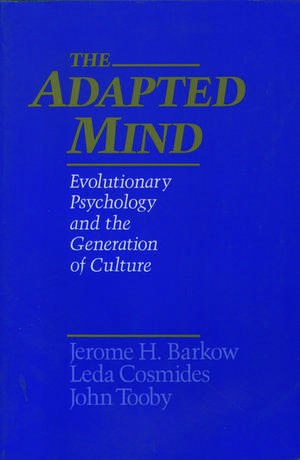
The Adapted Mind: Evolutionary Psychology and the Generation of Culture
Jerome H. Barkow, Leda Cosmides, John Toobyen Limba Engleză Paperback – 11 ian 1996
Preț: 571.78 lei
Preț vechi: 824.87 lei
-31%
Puncte Express: 858
Carte tipărită la comandă
Livrare economică 03-09 decembrie
Livrare prin curier în România Termenul estimat este afișat lângă disponibilitate.
Transport gratuit pentru acest produs Plată online sau ramburs, în funcție de opțiunile comenzii.
Retur gratuit în 14 zile Comandă securizată și suport în română.
Specificații
ISBN-13: 9780195101072
ISBN-10: 0195101073
Pagini: 688
Ilustrații: halftones, line drawings, tables
Dimensiuni: 156 x 234 x 35 mm
Greutate: 0.91 kg
Ediția:Revised
Editura: Oxford University Press
Colecția OUP USA
Locul publicării:New York, United States
ISBN-10: 0195101073
Pagini: 688
Ilustrații: halftones, line drawings, tables
Dimensiuni: 156 x 234 x 35 mm
Greutate: 0.91 kg
Ediția:Revised
Editura: Oxford University Press
Colecția OUP USA
Locul publicării:New York, United States
V-ar putea interesa
-
 The Rise And Fall Of The Third ChimpanzeeJared Diamond-20%Preț: 73.43 lei92.12 lei
 -
 The Thinking Ape: Evolutionary Origins of IntelligenceRichard Byrne-17%Preț: 357.06 lei432.39 lei
 -
 -31%Preț: 679.72 lei985.04 lei
 -
 Lucy to Language: The Benchmark PapersR. I. M. Dunbar-31%Preț: 907.34 lei1313.14 lei
 -
 Teeth: A Very Short IntroductionPeter S. Ungar-18%Preț: 59.10 lei72.28 lei
 -
 The Sacred Landscape of the Inca: The Cusco Ceque SystemBrian S. BauerPreț: 287.85 lei
 -
 After Empire: Melancholia or Convivial Culture?Paul GilroyPreț: 405.99 lei
 -
 Dental Functional MorphologyPeter W. LucasPreț: 463.51 lei
 -
 The Human StoryRobin DunbarPreț: 92.15 lei
 -
 A Brief History of DrugsAntonio EscohotadoPreț: 81.63 lei
 -
 -23%Preț: 757.54 lei983.83 lei
 -
 Catching Fire: How Cooking Made Us HumanRichard Wrangham-19%Preț: 75.36 lei93.10 lei
Cuprins
J. Tooby & L. Cosmides: Introduction; Part I: Theoretical framework: J. Tooby & L. Cosmides: The psychological foundations of culture; D. Symons: On the use and misuse of darwinism in the study of human behavior; Part II: Cooperation: L. Cosmides & J. Tooby: Cognitive adaptations for social exchange; W.C. McGrew & A.T.C. Feistner: Two non-human primate models for the evolution of human food-sharing: chimpanzees and callitrichids; Part III: The psychology of mating and sex: D. Buss: Mate preference mechanisms: consequences for partner choice and intrasexual competition; B. Ellis: The evolution of sexual attraction: evaluative mechanisms in women; M. Wilson & M. Daly: The man who mistook his wife for a chattel; Part IV: Parental care and children: M. Profet: Pregnancy sickness as adaptation: a deterrent to maternal ingestion of teratogens; J. Mann: Nurturance or negligence: maternal psychology and behavioral preference among preterm twins; A. Fernald: Human maternal vocalizations to infants as biologically relevant signals: an evolutionary perspective; M.J. Boulton & P.K. Smith: The social nature of play fighting and play chasing: mechanisms and strategies underlying cooperation and compromise; Part V: Perception and language as adaptations: S. Pinker & P. Bloom: Natural language and natural selection; R.N. Shepherd: The perceptual organization of colors: an adaptation to regularities of the terrestrial world?; I. Silverman & M. Eals: Sex differences in spatial abilities: evolutionary theory and data; Part VI: Environmental aesthetics: G.H. Orians & J.H. Heerwagen: Evolved responses to landscapes; S. Kaplan: Environmental preference in a knowledge-seeking, knowledge-using organism; Part VII: Intrapsychic processes: R.M. Nesse & A.T. Lloyd: The evolution of psychodynamic mechanisms; Part VIII: Understanding evolutionary new cultural forms: J.H. Barkow: Beneath new culture is old psychology: gossip, class, and the environment.
Recenzii
This book is a rare exception, a volume of fresh and original research of momentous significance that is written in such a way that ordinary mortals can immediately join the debate.
... a massive tome that throws considerable light on a number of issues ... The Adapted Mind is a very significant contribution to the field of evolutionary thinking on human psychology and culture. It brings together many well-written and scholarly chapters that do much to articulate the salient issues and give state of the art overviews.
one cannot afford to ignore it
a collection of eighteen papers by twenty-five authors which sum up and illustrate much of the best of our knowledge in the field of evolutionary psychology
... a massive tome that throws considerable light on a number of issues ... The Adapted Mind is a very significant contribution to the field of evolutionary thinking on human psychology and culture. It brings together many well-written and scholarly chapters that do much to articulate the salient issues and give state of the art overviews.
one cannot afford to ignore it
a collection of eighteen papers by twenty-five authors which sum up and illustrate much of the best of our knowledge in the field of evolutionary psychology