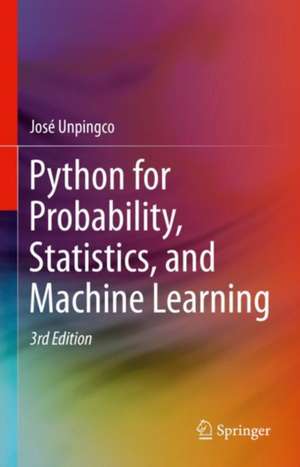
Python for Probability, Statistics, and Machine Learning
Autor José Unpingcoen Limba Engleză Hardback – 5 noi 2022
Using a novel integration of mathematics and Python codes, this book illustrates the fundamental concepts that link probability, statistics, and machine learning, so that the reader can not only employ statistical and machine learning models using modern Python modules, but also understand their relative strengths and weaknesses. To clearly connect theoretical concepts to practical implementations, the author provides many worked-out examples along with "Programming Tips" that encourage the reader to write quality Python code. The entire text, including all the figures and numerical results, is reproducible using the Python codes provided, thus enabling readers to follow along by experimenting with the same code on their own computers.
Modern Python modules like Pandas, Sympy, Scikit-learn, Statsmodels, Scipy, Xarray, Tensorflow, and Keras are used to implement and visualize important machine learning concepts like the bias/variance trade-off, cross-validation, interpretability, and regularization. Many abstract mathematical ideas, such as modes of convergence in probability, are explained and illustrated with concrete numerical examples. This book is suitable for anyone with undergraduate-level experience with probability, statistics, or machine learning and with rudimentary knowledge of Python programming.
Modern Python modules like Pandas, Sympy, Scikit-learn, Statsmodels, Scipy, Xarray, Tensorflow, and Keras are used to implement and visualize important machine learning concepts like the bias/variance trade-off, cross-validation, interpretability, and regularization. Many abstract mathematical ideas, such as modes of convergence in probability, are explained and illustrated with concrete numerical examples. This book is suitable for anyone with undergraduate-level experience with probability, statistics, or machine learning and with rudimentary knowledge of Python programming.
Preț: 598.87 lei
Preț vechi: 704.55 lei
-15%
Puncte Express: 898
Carte disponibilă
Livrare economică 09-23 noiembrie
Livrare express 23-29 octombrie pentru 56.97 lei
Livrare prin curier în România Termenul estimat este afișat lângă disponibilitate.
Transport gratuit pentru acest produs Plată online sau ramburs, în funcție de opțiunile comenzii.
Retur gratuit în 14 zile Comandă securizată și suport în română.
Specificații
ISBN-13: 9783031046476
ISBN-10: 3031046471
Pagini: 528
Ilustrații: XVII, 509 p. 189 illus., 78 illus. in color.
Dimensiuni: 160 x 241 x 32 mm
Greutate: 1 kg
Ediția:Third Edition 2022
Editura: Springer
Locul publicării:Cham, Switzerland
ISBN-10: 3031046471
Pagini: 528
Ilustrații: XVII, 509 p. 189 illus., 78 illus. in color.
Dimensiuni: 160 x 241 x 32 mm
Greutate: 1 kg
Ediția:Third Edition 2022
Editura: Springer
Locul publicării:Cham, Switzerland
V-ar putea interesa
-
 -9%Preț: 324.84 lei357.76 lei
-
 Machine LearningKevin P. Murphy-20%Preț: 731.65 lei918.37 lei
-
 Probabilistic Machine LearningKevin P. Murphy-21%Preț: 854.63 lei1080.57 lei
-
 The Elements of Statistical LearningTrevor Hastie-20%Preț: 546.54 lei683.17 lei
-
 -39%Preț: 394.79 lei646.62 lei
-
 -31%Preț: 607.05 lei885.58 lei
-
 -18%Preț: 719.62 lei877.59 lei
-
 Statistical Analysis with Python For DummiesJoseph SchmullerPreț: 197.44 lei
-
 Machine Learning: An Algorithmic Perspective, Second EditionStephen Marsland-20%Preț: 625.22 lei781.53 lei
-
 Math and Architectures of Deep LearningKrishnendu Chaudhury-20%Preț: 410.21 lei512.76 lei
-
 -34%Preț: 293.68 lei447.85 lei
-
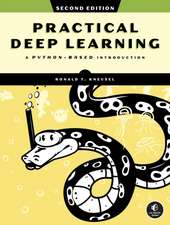 Practical Deep Learning, 2nd Edition: A Python-Based IntroductionRonald T. Kneusel-35%Preț: 333.73 lei515.68 lei
-
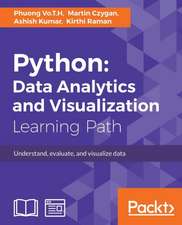 PythonMartin Czygan-23%Preț: 644.95 lei837.61 lei
-
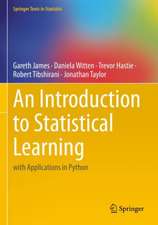 An Introduction to Statistical LearningGareth James-13%Preț: 542.61 lei623.00 lei
-
 Preț: 462.84 lei
-
 Materials Data ScienceStefan Sandfeld-15%Preț: 591.20 lei695.53 lei
-
 Probability and Statistics for Machine LearningCharu C. Aggarwal-20%Preț: 445.19 lei556.49 lei
-
 Statistics for ScientistsUmberto Michelucci-20%Preț: 279.62 lei349.53 lei
-
 Multivariate Analysis and Machine Learning TechniquesSrikrishnan Sundararajan-20%Preț: 560.93 lei701.16 lei
Cuprins
Introduction.- Part 1 Getting Started with Scientific Python.- Installation and Setup.- Numpy.- Matplotlib.- Ipython.- Jupyter Notebook.- Scipy.- Pandas.- Sympy.- Interfacing with Compiled Libraries.- Integrated Development Environments.- Quick Guide to Performance and Parallel Programming.- Other Resources.- Part 2 Probability.- Introduction.- Projection Methods.- Conditional Expectation as Projection.- Conditional Expectation and Mean Squared Error.- Worked Examples of Conditional Expectation and Mean Square Error Optimization.- Useful Distributions.- Information Entropy.- Moment Generating Functions.- Monte Carlo Sampling Methods.- Useful Inequalities.- Part 3 Statistics.- Python Modules for Statistics.- Types of Convergence.- Estimation Using Maximum Likelihood.- Hypothesis Testing and P-Values.- Confidence Intervals.- Linear Regression.- Maximum A-Posteriori.- Robust Statistics.- Bootstrapping.- Gauss Markov.- Nonparametric Methods.- Survival Analysis.- Part 4 Machine Learning.- Introduction.- Python Machine Learning Modules.- Theory of Learning.- Decision Trees.- Boosting Trees.- Logistic Regression.- Generalized Linear Models.- Regularization.- Support Vector Machines.- Dimensionality Reduction.- Clustering.- Ensemble Methods.- Deep Learning.- Notation.- References.- Index.
Notă biografică
Dr. José Unpingco completed his PhD at the University of California, San Diego in 1997 and has since worked in industry as an engineer, consultant, and instructor on a wide-variety of advanced data processing and analysis topics, with deep experience in machine learning and statistics. As the onsite technical director for large-scale Signal and Image Processing for the Department of Defense (DoD), he spearheaded the DoD-wide adoption of scientific Python. He also trained over 600 scientists and engineers to effectively utilize Python for a wide range of scientific topics -- from weather modeling to antenna analysis. Dr. Unpingco is the cofounder and Senior Director for Data Science at a non-profit Medical Research Organization in San Diego, California. He also teaches programming for data analysis at the University of California, San Diego for engineering undergraduate/graduate students. He is author of Python for Signal Processing (Springer 2014) and Python for Probability,Statistics, and Machine Learning (2016)
Textul de pe ultima copertă
Using a novel integration of mathematics and Python codes, this book illustrates the fundamental concepts that link probability, statistics, and machine learning, so that the reader can not only employ statistical and machine learning models using modern Python modules, but also understand their relative strengths and weaknesses. To clearly connect theoretical concepts to practical implementations, the author provides many worked-out examples along with "Programming Tips" that encourage the reader to write quality Python code. The entire text, including all the figures and numerical results, is reproducible using the Python codes provided, thus enabling readers to follow along by experimenting with the same code on their own computers.
Modern Python modules like Pandas, Sympy, Scikit-learn, Statsmodels, Scipy, Xarray, Tensorflow, and Keras are used to implement and visualize important machine learning concepts like the bias/variance trade-off, cross-validation, interpretability, and regularization. Many abstract mathematical ideas, such as modes of convergence in probability, are explained and illustrated with concrete numerical examples. This book is suitable for anyone with undergraduate-level experience with probability, statistics, or machine learning and with rudimentary knowledge of Python programming.
Modern Python modules like Pandas, Sympy, Scikit-learn, Statsmodels, Scipy, Xarray, Tensorflow, and Keras are used to implement and visualize important machine learning concepts like the bias/variance trade-off, cross-validation, interpretability, and regularization. Many abstract mathematical ideas, such as modes of convergence in probability, are explained and illustrated with concrete numerical examples. This book is suitable for anyone with undergraduate-level experience with probability, statistics, or machine learning and with rudimentary knowledge of Python programming.
· Features a novel combination of modern Python implementations and underlying mathematics to illustrate and visualize the foundational ideas of probability, statistics, and machine learning;
· Includes meticulously worked-out numerical examples, all reproducible using the Python code provided in the text, that compute and visualize statistical and machine learning models thus enabling the reader to not only implement these models but understand their inherent trade-offs;
· Utilizes modern Python modules such as Statsmodels, Tensorflow, Keras, Sympy, and Scikit-learn, along with embedded "Programming Tips" to encourage readers to develop quality Python codes that implement and illustrate practical concepts.
Caracteristici
Features fully updated explanation on how to simulate, conceptualize, and visualize random statistical processes Includes newest Python code and connects to key open-source communities and corresponding modules Outlines probability, statistics, and machine learning concepts