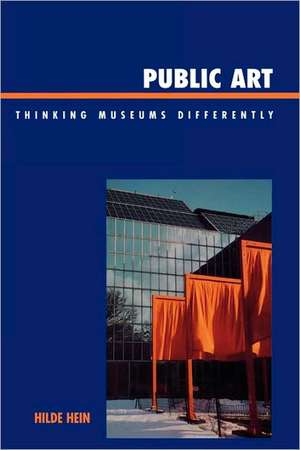
Public Art: Thinking Museums Differently
Autor Hilde Heinen Limba Engleză Paperback – 27 iul 2006
The museum is an agent, not a repository; and like public art, it interacts constructively with passing and transitory publics. As an actor with social clout, the museum has moral impact and responsibilities beyond those of the individuals that comprise its collective identity. The book should be read by museum workers and students, by arts and foundation administrators, critics, educators, aestheticians, institutional historians and theorists, and by anyone interested in the transmission of cultural concepts and values.
Preț: 314.19 lei
Preț vechi: 388.82 lei
-19%
Puncte Express: 471
Carte tipărită la comandă
Livrare economică 21 noiembrie-05 decembrie
Livrare prin curier în România Termenul estimat este afișat lângă disponibilitate.
Transport gratuit de la 400.00 lei Plată online sau ramburs, în funcție de opțiunile comenzii.
Retur gratuit în 14 zile Comandă securizată și suport în română.
Specificații
ISBN-13: 9780759109599
ISBN-10: 0759109591
Pagini: 198
Dimensiuni: 183 x 229 x 14 mm
Greutate: 0.34 kg
Editura: Bloomsbury Publishing
Colecția AltaMira Press
Locul publicării:New York, United States
ISBN-10: 0759109591
Pagini: 198
Dimensiuni: 183 x 229 x 14 mm
Greutate: 0.34 kg
Editura: Bloomsbury Publishing
Colecția AltaMira Press
Locul publicării:New York, United States
V-ar putea interesa
-
 Why the Museum MattersDaniel H. WeissPreț: 98.16 lei
 -
 Thinking About ExhibitionsBruce W. FergusonPreț: 380.12 lei
 -
 Preț: 383.39 lei
 -
 Architecture For CultureBeatrice GrenierPreț: 330.95 lei
 -
 Preț: 226.07 lei
 -
 The Culture Box: Museums as MediaHarley Parker-18%Preț: 160.38 lei194.79 lei
 -
 Preț: 175.25 lei
 -
 Propositions for Museum EducationAnita SinnerPreț: 426.31 lei
 -
 Art Education in Canadian MuseumsAnita SinnerPreț: 332.17 lei
 -
 Culture StrikeLaura RaicovichPreț: 82.88 lei
 -
 Performance in the MuseumPierre SaurissePreț: 256.24 lei
 -
 Decentring the MuseumNina MöntmannPreț: 260.89 lei
 -
 Towards the Ethical Art MuseumGareth HarrisPreț: 161.52 lei
 -
 Now-Tomorrow-FluxClaire BishopPreț: 189.45 lei
 -
 Preț: 257.59 lei
 -
 -19%Preț: 450.34 lei555.98 lei
 -
 Symbolic Machines: Institutional Transformation through ExhibitionsPernille Lystlund MatzenPreț: 260.17 lei
 -
 How to Visit an Art Museum: The Expanded EditionJohan Idema-22%Preț: 95.54 lei122.60 lei
Cuprins
Chapter 1 Introduction
Chapter 2 1. The Experiential Museum
Chapter 3 2. The Private, the Non-private, and the Public
Chapter 4 3. Public Art: History and Meaning
Chapter 5 4. Innovation in Public Art
Chapter 6 5. Fitting Old Museums to a New Paradigm
Chapter 7 6. Why a New Paradigm?
Chapter 8 7. Conclusion
Chapter 2 1. The Experiential Museum
Chapter 3 2. The Private, the Non-private, and the Public
Chapter 4 3. Public Art: History and Meaning
Chapter 5 4. Innovation in Public Art
Chapter 6 5. Fitting Old Museums to a New Paradigm
Chapter 7 6. Why a New Paradigm?
Chapter 8 7. Conclusion
Recenzii
In this wide-ranging study, Hilde Hein looks to the history of public art in order to propose a more dynamic future for the museum. She reveals the ways in which public art's emphasis on experience, process, and the ephemeral provides a deeper understanding of the changes-if not the paradigm shift-already underway in museums.
Hein's exploration of the museum world emphasizes experience and qualifies art as a process, not a thing, hence her concept of the museum as a performance in which objects and people participate. Six chapters discuss The Experiential Museum, Private, Nonprivate, and the Public, History and Meaning of Public Art, Innovation in Public Art, Old Museums and a New Paradigm, and Why a New Paradigm. Although her exposition is soundly based in philosophical arguments, Hein illuminates the discourse with examples like Christo's Gates project and the Baltimore Museum of Visionary Art. The reader finds discussions of contemporary developments like virtual visitors, the uses of electronic technology to extend the accessibility of collections beyondfixed walls. Motivated citizens can freely rearrange their downloaded treasure to create 'collections' of their own design. Nor does Hein (emer., College of the Holy Cross) neglect the significance of the museum site in its effect on the response to collections. Her writing is frequently poetic, as when she explains that objects can inspire the museal gaze which ignites the sense of presence. By emphasizing the impermanence of objects, she helps the reader focus on qualities of museums rarely consider
This eloquent book proposes a new paradigm for the museum, based on a deeply informed understanding of public art and museum practice. By comparing the museum to contemporary public art, Hilde Hein shows how the dynamic experimentalism of the latter can replace the static notion of museums as containers for timeless art. That is an invaluable lesson.
Hein's exploration of the museum world emphasizes experience and qualifies art as a process, not a thing, hence her concept of the museum as a performance in which objects and people participate. Six chapters discuss The Experiential Museum, Private, Nonprivate, and the Public, History and Meaning of Public Art, Innovation in Public Art, Old Museums and a New Paradigm, and Why a New Paradigm. Although her exposition is soundly based in philosophical arguments, Hein illuminates the discourse with examples like Christo's Gates project and the Baltimore Museum of Visionary Art. The reader finds discussions of contemporary developments like virtual visitors, the uses of electronic technology to extend the accessibility of collections beyondfixed walls. Motivated citizens can freely rearrange their downloaded treasure to create 'collections' of their own design. Nor does Hein (emer., College of the Holy Cross) neglect the significance of the museum site in its effect on the response to collections. Her writing is frequently poetic, as when she explains that objects can inspire the museal gaze which ignites the sense of presence. By emphasizing the impermanence of objects, she helps the reader focus on qualities of museums rarely consider
This eloquent book proposes a new paradigm for the museum, based on a deeply informed understanding of public art and museum practice. By comparing the museum to contemporary public art, Hilde Hein shows how the dynamic experimentalism of the latter can replace the static notion of museums as containers for timeless art. That is an invaluable lesson.