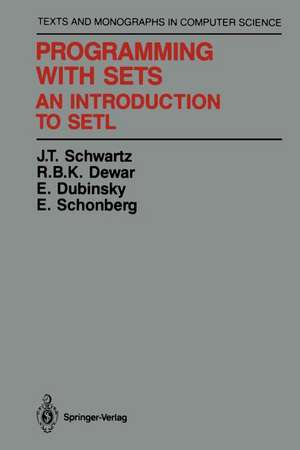
Programming with Sets: Monographs in Computer Science
Autor J. T. Schwartz, R. B. K. Dewar, E. Dubinsky, E. Schonbergen Limba Engleză Paperback – 4 ian 2012
Din seria Monographs in Computer Science
- 20%
 Preț: 515.64 lei
 - 20%
 Preț: 992.50 lei
 - 20%
 Preț: 331.63 lei
 - 20%
 Preț: 360.76 lei
 -
 Preț: 400.17 lei
 - 20%
 Preț: 1327.69 lei
 - 20%
 Preț: 805.66 lei
 - 20%
 Preț: 726.82 lei
 - 20%
 Preț: 1033.14 lei
 - 20%
 Preț: 320.97 lei
 - 20%
 Preț: 739.82 lei
 - 15%
 Preț: 508.69 lei
 - 20%
 Preț: 682.04 lei
 - 18%
 Preț: 991.83 lei
 - 20%
 Preț: 669.76 lei
 -
 Preț: 371.27 lei
 - 20%
 Preț: 998.27 lei
 - 15%
 Preț: 581.54 lei
 - 18%
 Preț: 761.59 lei
 - 20%
 Preț: 331.63 lei
 - 20%
 Preț: 1418.60 lei
 - 20%
 Preț: 998.48 lei
 - 20%
 Preț: 356.14 lei
 - 20%
 Preț: 1500.61 lei
 - 20%
 Preț: 648.42 lei
 - 20%
 Preț: 965.19 lei
 - 20%
 Preț: 1684.31 lei
 - 15%
 Preț: 667.52 lei
 - 20%
 Preț: 643.02 lei
 - 20%
 Preț: 368.49 lei
 - 20%
 Preț: 573.07 lei
 - 20%
 Preț: 317.70 lei
 - 20%
 Preț: 644.60 lei
 - 20%
 Preț: 354.10 lei
 - 20%
 Preț: 336.96 lei
 - 20%
 Preț: 320.55 lei
 - 20%
 Preț: 318.35 lei
 - 20%
 Preț: 351.00 lei
 - 20%
 Preț: 667.13 lei
 - 20%
 Preț: 635.73 lei
 - 20%
 Preț: 1334.51 lei
 - 20%
 Preț: 996.37 lei
 - 20%
 Preț: 430.42 lei
Preț: 682.77 lei
Preț vechi: 853.47 lei
-20%
Puncte Express: 1024
Carte tipărită la comandă
Livrare economică 25 noiembrie-09 decembrie
Livrare prin curier în România Termenul estimat este afișat lângă disponibilitate.
Transport gratuit pentru acest produs Plată online sau ramburs, în funcție de opțiunile comenzii.
Retur gratuit în 14 zile Comandă securizată și suport în română.
Specificații
ISBN-13: 9781461395775
ISBN-10: 1461395771
Pagini: 512
Ilustrații: XV, 493 p.
Dimensiuni: 155 x 235 x 28 mm
Greutate: 0.77 kg
Ediția:Softcover reprint of the original 1st ed. 1986
Editura: Springer
Colecția Monographs in Computer Science
Seria Monographs in Computer Science
Locul publicării:New York, NY, United States
ISBN-10: 1461395771
Pagini: 512
Ilustrații: XV, 493 p.
Dimensiuni: 155 x 235 x 28 mm
Greutate: 0.77 kg
Ediția:Softcover reprint of the original 1st ed. 1986
Editura: Springer
Colecția Monographs in Computer Science
Seria Monographs in Computer Science
Locul publicării:New York, NY, United States
V-ar putea interesa
-
 The C++ Programming LanguageBjarne Stroustrup-20%Preț: 507.21 lei634.02 lei
 -
 Set Theory for ComputingDomenico Cantone-20%Preț: 1002.50 lei1253.12 lei
 -
 Python Programming for BiologyTim J. Stevens-20%Preț: 460.01 lei575.01 lei
 -
 Beginning Programming with C++ For DummiesStephen R. Davis-20%Preț: 173.62 lei217.02 lei
 -
 Pro ASP.NET Web API SecurityBadrinarayanan Lakshmiraghavan-20%Preț: 525.86 lei657.33 lei
 -
 -20%Preț: 230.97 lei288.71 lei
 -
 -20%Preț: 153.00 lei191.25 lei
 -
 SAS Programming and Data Visualization TechniquesPhilip R. Holland-20%Preț: 253.14 lei316.42 lei
 -
 Embedded Software Development with CKai Qian-20%Preț: 574.78 lei718.48 lei
 -
 Functional Programming in ScalaRunar Bjarnason-20%Preț: 340.60 lei425.75 lei
 -
 Python Programming for BeginnersJoseph Joyner-20%Preț: 53.61 lei67.02 lei
 -
 Murachs C# 2012Joel Murach-28%Preț: 359.74 lei496.79 lei
 -
 Programming LanguagesFernando Magno Quintao Pereira-20%Preț: 260.74 lei325.93 lei
 -
 Programming Languages and SystemsJacques Garrigue-20%Preț: 332.81 lei416.02 lei
 -
 Rewriting Logic and Its ApplicationsSantiago Escobar-20%Preț: 322.59 lei403.23 lei
 -
 Software Engineering and Formal MethodsCarlos Canal-20%Preț: 342.29 lei427.86 lei
 -
 The Structure of Nuclear Frechet SpacesE. DubinskyPreț: 266.60 lei
 -
 JIT'99Clemens H. Cap-20%Preț: 407.93 lei509.91 lei
 -
 Softwareentwicklung in C++Klaus Schmaranz-20%Preț: 306.20 lei382.75 lei
Public țintă
ResearchCuprins
1 Programming Concepts.- 1.1 An Informal Overview of SETL.- 1.2 Advice to the Would-Be Programmer.- 1.3 Programming Steps: How to Run Your Program and Read Its Results.- 1.4 How to Type a Program: Character Sets.- 1.5 Appendix: More on How to Read Your Output Listing.- 2 Simple Data Types, Expressions, and Operations.- 2.1 The Main Classes of Data Objects.- 2.2 Simple Types and Their Constants.- 2.3 Variable Identifiers.- 2.4 Expressions and Statements.- 2.5 Operations with Simple Data Types.- 3 Compound Data Types and Operators.- 3.1 Sets and Set Denotations.- 3.2 Tuples.- 3.3 Maps.- 3.4 The Size of Composite Objects: The # Operator.- 3.5 Set Operations and Set Formers.- 3.6 Tuple Operations and Tuple Formers.- 3.7 Tuple Formers; Simple Tuple and String Iterators.- 3.8 Map Operations.- 3.9 Compound Operators.- 3.10 Types and Type-Testing Operators.- 3.11 The? Operator.- 3.12 General Form of the SETL Assignment: The Operators from, frome, and fromb.- 3.13 Operator Precedence Rules.- 3.14 Om and Errors.- 4 Control Structures.- 4.1 The if Statement.- 4.2 The case Statement.- 4.3 Loops.- 4.4 The goto Statement.- 4.5 The stop Statement.- 4.6 The assert Statement.- 4.7 Programming Examples.- 4.8 Reading and Writing Data.- 5 Procedures.- 5.1 Writing and Using Procedures.- 5.2 Name Scopes; Local and Global Variable Names: The var Declaration.- 5.3 Programming Examples 177 5.3.1 The buckets and well problem: a simple artificial intelligence example.- 5.4 Recursive Procedures.- 5.5 Procedures that Modify Their Parameters.- 5.6 Other Procedure-Related Facilities.- 5.7 Rules of Style in the Use of Procedures.- 5.8 String Scanning Primitives.- 5.9 Use of Atoms.- 6 Program Development, Testing, and Debugging.- 6.1 Bugs: How to Minimize Them.- 6.2 Finding Bugs.- 6.3 A Checklist of Common Bugs.- 6.4 Program Testing.- 6.5 Analysis of Program Efficiency.- 6.6 Formal Verification of Programs.- 6.7 Formative Influences on Program Development.- 6.8 References to Material on Alternative Data Structures: References for Additional Material on Algorithms.- 7 Backtracking.- 7.1 Backtracking.- 8 Structuring Large SETL Programs.- 8.1 The const Declaration.- 8.2 Macros.- 8.3 Programming Examples.- 8.4 Programs, Modules, Libraries, and Directories: Structuring Constructs for Large SETL Programs.- 9 Input/Output and Communication with the Environment.- 9.1 Input-Output Facilities.- 9.2 Use of Inclusion Libraries.- 9.3 Listing-Control Commands.- 9.4 Environment Operators and SETL Command Parameters.- 10 The Data Representation Sublanguage.- 10.0 Implementation of the SETL Primitives.- 10.1 The Standard Representation for Tuples.- 10.2 The Standard Representation for Sets.- 10.3 Type Declarations.- 10.4 Basing Declarations.- 10.5 Base Sets Consisting of Atoms Only.- 10.6 Constant Bases.- 10.7 The Packed Representations.- 10.8 Guidelines for the Effective Use of the Data Representation Sublanguage.- 11 The Language in Action: A Gallery of Programming Examples.- 11.1 Eulerian Paths in a Graph.- 11.2 Topological Sorting.- 11.3 The Stable Assignment Problem.- 11.4 A Text Preparation Program.- 11.5 A Simplified Financial Record-Keeping System.- 11.6 A Turing-Machine Simulator.- 11.7 Huffman Coding of Text Files.- 11.8 A Game-Playing Program.- 11.9 Implementation of a Macroprocessor.- Appendix A SETL Reserved Words.- Appendix B Syntax Diagrams.- B.1 Lexical Structure.- B.2 Program Structure.- B.3 Declarative Forms.- B.4 Statement Forms.- B.5 Expressions.