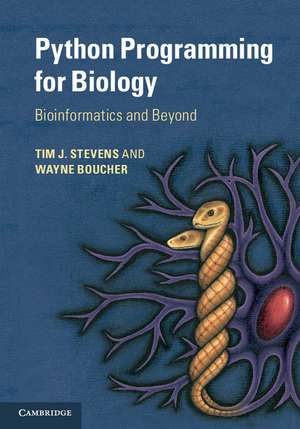
Python Programming for Biology
Autor Tim J. Stevens, Wayne Boucheren Limba Engleză Paperback – 5 noi 2018
Observăm că Python Programming for Biology se poziționează ca o resursă tehnică exhaustivă, acoperind nu doar sintaxa limbajului Python, ci și aplicații avansate de procesare a imaginilor, statistică și machine learning. Într-un domeniu în care datele biologice devin tot mai complexe, această lucrare publicată de Cambridge University Press oferă fundamentul necesar pentru a transforma întrebările de cercetare în soluții computaționale concrete. Remarcăm structura progresivă a celor peste 700 de pagini: autorii încep cu un curs de bază pentru cei fără experiență în programare, trec prin jargonul informatic esențial și ajung la implementări practice de algoritmi bioinformatici. Abordarea autorilor Tim J. Stevens și Wayne Boucher diferă de cea din Computing for Biologists prin gradul de detaliere a instrumentelor de calcul științific. În timp ce volumul lui Ran Libeskind-Hadas se concentrează pe concepte algoritmice fundamentale legate de întrebări biologice specifice, lucrarea de față este mai puțin abstractă și mai mult aplicabilă în fluxurile de lucru zilnice ale unui laborator modern. Merită menționat că textul funcționează și ca un manual de referință pentru limbajul Python, oferind exemple de cod gata de utilizat pentru analiza secvențelor sau interpretarea datelor experimentale. Prezența ilustrațiilor color și a tabelelor tehnice facilitează înțelegerea unor concepte dificile precum analiza statistică a sistemelor biologice complexe. Este o resursă care elimină bariera dintre biologia experimentală și bioinformatica aplicată, oferind cercetătorilor autonomia necesară pentru a-și scrie propriile programe fără a depinde exclusiv de software-uri preinstalate.
Preț: 460.01 lei
Preț vechi: 575.01 lei
-20%
Carte tipărită la comandă
Livrare economică 30 noiembrie-14 decembrie
Specificații
ISBN-10: 0521720095
Pagini: 722
Ilustrații: 91 b/w illus. 11 colour illus. 3 tables
Dimensiuni: 170 x 244 x 39 mm
Greutate: 1.22 kg
Editura: Cambridge University Press
Locul publicării:Cambridge, United Kingdom
V-ar putea interesa
-
 -20%Preț: 473.66 lei592.07 lei
 -
 Understanding BioinformaticsMarketa Zvelebil-27%Preț: 770.52 lei1055.50 lei
 -
 Practical Computing for BiologistsSteven H. D. Haddock-27%Preț: 797.38 lei1092.30 lei
 -
 -18%Preț: 719.62 lei877.59 lei
 -
 Bioinformatics and Functional GenomicsJonathan Pevsner-23%Preț: 833.61 lei1082.62 lei
 -
 R-ticulateMartin Bader-23%Preț: 655.33 lei851.08 lei
 -
 Python Programming in ContextJon Anderson-20%Preț: 864.48 lei1080.60 lei
 -
 Computational Thinking for Life ScientistsBenny ChorPreț: 297.72 lei
 -
 Statistical Analysis with Python For DummiesJoseph SchmullerPreț: 197.44 lei
 -
 The Art of R ProgrammingNorman Matloff-35%Preț: 253.50 lei392.87 lei
 -
 -34%Preț: 293.68 lei447.85 lei
 -
 -37%Preț: 186.29 lei295.65 lei
 -
 Python in Easy StepsMike Mcgrath-20%Preț: 74.68 lei93.35 lei
 -
 BioinformaticsKhalid SayoodPreț: 313.36 lei
 -
 A Guide to Applied Machine Learning for BiologistsMohammad "Sufian" BadarPreț: 390.78 lei
 -
 Fundamentals of Bioinformatics and Computational BiologyGautam B. Singh-15%Preț: 654.92 lei770.50 lei
 -
 Statistics for ScientistsUmberto Michelucci-20%Preț: 275.88 lei344.84 lei
 -
 A Primer on Scientific Programming with PythonHans Petter Langtangen-20%Preț: 651.64 lei814.55 lei
 -
 Multivariate Analysis and Machine Learning TechniquesSrikrishnan Sundararajan-20%Preț: 534.82 lei668.53 lei
De ce să citești această carte
Recomandăm această carte cercetătorilor și studenților din științele vieții care doresc să treacă de la utilizarea unor unelte software limitate la crearea propriilor soluții de analiză. Prin parcurgerea acestui ghid, veți dobândi abilități practice în Python, de la manipularea datelor genomice până la tehnici de machine learning, toate explicate într-un limbaj accesibil, adaptat nevoilor specifice din laborator.
Despre autor
Tim J. Stevens și Wayne Boucher sunt cercetători cu o vastă experiență în domeniul biologiei computaționale, activând în cadrul unor instituții de prestigiu precum Universitatea din Cambridge. Tim J. Stevens este recunoscut pentru contribuțiile sale în dezvoltarea de software pentru rezonanța magnetică nucleară (RMN) și analiza structurilor macromoleculare. Wayne Boucher are un parcurs solid în fizică și matematică aplicată, expertiza sa fiind crucială în dezvoltarea algoritmilor utilizați în analiza datelor biologice complexe. Împreună, aceștia au creat instrumente esențiale pentru comunitatea științifică, experiența lor practică reflectându-se în claritatea și rigoarea tehnică a exemplelor de programare oferite în lucrarea de față.
Descriere scurtă
Cuprins
Recenzii
'Python Programming for Biology is an excellent introduction to the challenges that biologists and biophysicists face. The choice of Python is appropriate; we use it in most research in our laboratories at the interface between biology, biochemistry and bioinformatics. The book takes us through programming principles for a beginner with a biological background, introducing the basics. It has useful tips for improving code and some specific examples, for example in sequence analysis, macromolecular structures, image processing and databases. I was pleased to see that there is a substantive section on machine learning which in the era of 'big data' is becoming central to much of the software developed for biomedical and agri-biotech research.' Tom Blundell, University of Cambridge
'Stevens and Boucher tear down barriers to programming and bioinformatics, for biologists and medics alike … this is the book that I wish I could have read years ago. Serving as both a straightforward tutorial and plain-English reference, the key programming, biology and bioinformatics concepts necessary to build programs for practical, real-world applications are explained in a logical and easy-to-follow order, helping the reader to get from zero to results faster. Unlike many programming books and resources, information is presented in the right amount of detail and jargon is demystified, giving a gentle but thorough and practical introduction to programming with Python, while providing useful tips and encouraging good practices. This introduction is built on with 'from the ground up' explanations of basic, intermediate and advanced computational biology methodologies through Python implementations, resulting in a well-rounded text for programming to solve biological challenges.' Harry Jubb, University of Cambridge
'As an increasingly valuable and important skill, programming can be daunting for those new to it. Python Programming for Biology provides the perfect introduction into the world of coding. Stevens and Boucher gently guide the reader through the basics and into practical examples that will aid the reader into incorporating Python into their research activities. I would not hesitate to recommend it as a valuable teaching aide or to people keen to expand their horizons into bioinformatics.' David Ascher, University of Cambridge
'Python has become a programming and scripting language of utmost importance in scientific computing, in particular in biology. Major, widely used software packages make use of Python, and libraries offering powerful functionalities are available. Many if not most research projects in biology benefit from computational techniques. Although it is incredibly simple to write small scripts in Python, for a novice in programming, the first steps may seem daunting. In contrast to many other books on Python, this book is specifically aimed at an audience that has little or no experience with programming. After a step-by-step introduction to programming in Python, it describes concrete examples from different areas in biology, with code examples from data analysis to modelling. [It] is a highly valuable addition to the literature on Python, and recommended to any biologist who is interested in using computers in his research.' Michael Nilges, Institut Pasteur, France
'[Stevens and Boucher's] understanding of the needs of the target audience for this book (primarily bench scientists with minimal programming experience) is complete. They have accurately customized the book, to meet those specific requirements which are so distinct from those of students aspiring to be specialist programmers. They have achieved this difficult objective without 'dumbing down' the content or omitting any relevant aspect of Python. The book provides an easy and comprehensive introduction for the complete novice as well as offering plenty to engage the more experienced reader. This work is exactly what is required for us to build new training events upon.' David Judge, University of Cambridge