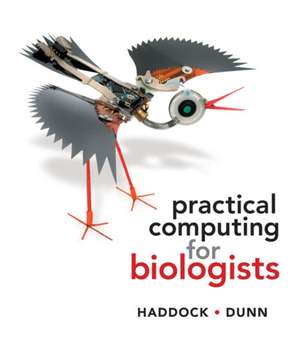
Practical Computing for Biologists
Autor Steven H. D. Haddock, Casey W. Dunnen Limba Engleză Paperback – 5 noi 2010
Considerăm acest volum un instrument indispensabil pentru nivelul de licență și master în științele vieții, fiind conceput special pentru a ajuta cercetătorii să depășească limitările programelor de calcul tabelar. Practical Computing for Biologists abordează o problemă critică în biologia modernă: gestionarea seturilor de date care cresc exponențial. Găsim în această carte o metodologie aplicată, dezvoltată de Steven H. D. Haddock și Casey W. Dunn pe baza propriei experiențe în cercetare, menită să automatizeze procesele repetitive de prelucrare a datelor.
Structura narativă este una pragmatică, ghidând cititorul prin 22 de capitole care acoperă linia de comandă Unix, programarea în Python, utilizarea bazelor de date și editarea grafică. Deși multe tehnici sunt esențiale pentru bioinformatică, aplicabilitatea lor este mult mai largă, vizând orice demers științific ce necesită rigoare computațională. Un element distinctiv al ediției publicate de Oxford University Press este atenția acordată utilizatorilor de sisteme de operare diferite; deși fluxul principal urmărește Mac OS X, instrucțiunile pentru Windows și Linux sunt integrate ergonomic în marginea textului.
Ca alternativă la Managing Your Biological Data with Python pentru cursurile de bioinformatică, acest manual are avantajul unei perspective mai vaste, incluzând nu doar programare, ci și noțiuni de hardware (electronică) și gestionare a serverelor la distanță. Față de UNIX and Perl to the Rescue!, care se concentrează pe Perl, volumul de față prioritizează Python, oferind o curbă de învățare adaptată nevoilor actuale din laboratoarele de cercetare.
Preț: 797.38 lei
Preț vechi: 1092.30 lei
-27%
Carte disponibilă
Livrare economică 05-19 noiembrie
Specificații
ISBN-10: 0878933913
Pagini: 564
Dimensiuni: 230 x 193 x 26 mm
Greutate: 1.2 kg
Editura: Oxford University Press
Colecția OUP USA
Locul publicării:New York, United States
V-ar putea interesa
-
 Computing Skills for BiologistsStefano AllesinaPreț: 508.09 lei
 -
 Bioinformatics and Functional GenomicsJonathan Pevsner-23%Preț: 833.61 lei1082.62 lei
 -
 R-ticulateMartin Bader-23%Preț: 655.33 lei851.08 lei
 -
 Computational Thinking for Life ScientistsBenny ChorPreț: 297.72 lei
 -
 Visualize ThisNathan Yau-20%Preț: 233.34 lei291.67 lei
 -
 Streamlining Your Research Laboratory with PythonMark F Russo-19%Preț: 554.43 lei684.49 lei
 -
 -20%Preț: 134.29 lei167.85 lei
 -
 Data Science Essentials for DummiesLillian Pierson-20%Preț: 76.56 lei95.69 lei
 -
 The Data Hero PlaybookMalcolm HawkerPreț: 202.67 lei
 -
 Excel Quick and EasyDick Kusleika-20%Preț: 81.87 lei102.34 lei
 -
 Linux Command Line and Shell Scripting BibleRichard Blum-20%Preț: 410.86 lei513.56 lei
 -
 Statistical Analysis with Python For DummiesJoseph SchmullerPreț: 197.44 lei
 -
 macOS Tahoe For DummiesHart-DavisPreț: 173.89 lei
 -
 RNA-seq Data Analysis: A Practical ApproachEija Korpelainen-9%Preț: 654.86 lei719.62 lei
 -
 The Art of R ProgrammingNorman Matloff-35%Preț: 253.50 lei392.87 lei
 -
 -34%Preț: 293.51 lei447.85 lei
 -
 Python for Excel Users: Know Excel? You Can Learn PythonTracy Stephens-35%Preț: 238.55 lei369.12 lei
 -
 -35%Preț: 243.51 lei372.78 lei
 -
 Statistics for ScientistsUmberto Michelucci-20%Preț: 275.88 lei344.84 lei
De ce să citești această carte
Recomandăm această carte oricărui biolog care s-a simțit limitat de Excel în procesarea datelor experimentale. Veți câștiga competențe practice în automatizarea analizelor prin Unix și Python, transformând orele de muncă manuală în procese de câteva secunde. Este resursa ideală pentru a trece de la simpla colectare a datelor la o analiză computațională robustă, fără a necesita experiență prealabilă în programare.
Despre autor
Steven H. D. Haddock și Casey W. Dunn sunt cercetători activi care și-au dedicat cariera studierii biodiversității și evoluției marine, utilizând metode computaționale avansate. Steven Haddock este cercetător la MBARI (Monterey Bay Aquarium Research Institute), specializat în bioluminescență și zooplancton, în timp ce Casey Dunn este profesor la Universitatea Yale, recunoscut pentru contribuțiile sale în filogenomică. Experiența lor directă în dezvoltarea de instrumente software pentru propriile laboratoare conferă cărții o notă autentică, soluțiile propuse fiind testate în scenarii reale de cercetare biologică.
Descriere
Recenzii
The book covers a wide range of subjects that truly justifies the title of 'practical computing.' In addition to the usual programming-related topics, it also includes a thorough introduction to the programming environment, approaches to combining different programs together, a description of the basic text manipulation tools such as regular expressions, and even an introduction to dealing with digital art and images. As such the book is great value for the money, being at least three books in one.
My copy of Practical Computing for Biologists arrived last week, and I've been very impressed. It is a well-written, well-paced guide to basic computing skills for scientists and engineers of all stripes (not just biologists). It is beautifully produced: full-color printing and great graphical design make this book a joy to read. If I ever do turn Software Carpentry into a book, I might skip the topics PCB covers and just tell people to go and buy it.
When considering my research and use of time, this book has been the most important book I've read in the last year, and perhaps the last decade. Striking a perfect balance by guiding you through tutorials and nudging your own self-exploration, the book has just enough guided direction to not annoy or overwhelm. It has helped (and is still helping) me to do what I was doing before, but more efficiently.