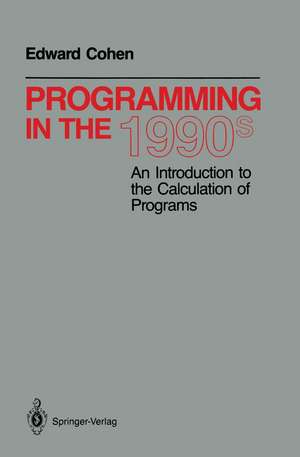
Programming in the 1990s: An Introduction to the Calculation of Programs: Monographs in Computer Science
Autor Edward Cohenen Limba Engleză Paperback – 2 oct 1990
Din seria Monographs in Computer Science
- 20%
 Preț: 515.64 lei
 - 20%
 Preț: 992.50 lei
 - 20%
 Preț: 331.63 lei
 - 20%
 Preț: 360.76 lei
 -
 Preț: 400.17 lei
 - 20%
 Preț: 1327.69 lei
 - 20%
 Preț: 805.66 lei
 - 20%
 Preț: 726.82 lei
 - 20%
 Preț: 1033.14 lei
 - 20%
 Preț: 320.97 lei
 - 20%
 Preț: 739.82 lei
 - 15%
 Preț: 508.69 lei
 - 20%
 Preț: 682.04 lei
 - 18%
 Preț: 991.83 lei
 - 20%
 Preț: 669.76 lei
 -
 Preț: 371.27 lei
 - 20%
 Preț: 998.27 lei
 - 15%
 Preț: 581.54 lei
 - 18%
 Preț: 761.59 lei
 - 20%
 Preț: 331.63 lei
 - 20%
 Preț: 1418.60 lei
 - 20%
 Preț: 998.48 lei
 - 20%
 Preț: 356.14 lei
 - 20%
 Preț: 1500.61 lei
 - 20%
 Preț: 648.42 lei
 - 20%
 Preț: 965.19 lei
 - 20%
 Preț: 1684.31 lei
 - 15%
 Preț: 667.52 lei
 - 20%
 Preț: 643.02 lei
 - 20%
 Preț: 682.77 lei
 - 20%
 Preț: 368.49 lei
 - 20%
 Preț: 573.07 lei
 - 20%
 Preț: 317.70 lei
 - 20%
 Preț: 644.60 lei
 - 20%
 Preț: 354.10 lei
 - 20%
 Preț: 336.96 lei
 - 20%
 Preț: 318.35 lei
 - 20%
 Preț: 351.00 lei
 - 20%
 Preț: 667.13 lei
 - 20%
 Preț: 635.73 lei
 - 20%
 Preț: 1334.51 lei
 - 20%
 Preț: 996.37 lei
 - 20%
 Preț: 430.42 lei
Preț: 320.55 lei
Preț vechi: 400.68 lei
-20%
Puncte Express: 481
Carte tipărită la comandă
Livrare economică 26 noiembrie-10 decembrie
Livrare prin curier în România Termenul estimat este afișat lângă disponibilitate.
Transport gratuit de la 400.00 lei Plată online sau ramburs, în funcție de opțiunile comenzii.
Retur gratuit în 14 zile Comandă securizată și suport în română.
Specificații
ISBN-13: 9780387973821
ISBN-10: 0387973826
Pagini: 265
Ilustrații: XV, 265 p.
Dimensiuni: 155 x 235 x 14 mm
Greutate: 0.44 kg
Ediția:Softcover reprint of the original 1st ed. 1990
Editura: Springer
Colecția Springer
Seria Monographs in Computer Science
Locul publicării:New York, NY, United States
ISBN-10: 0387973826
Pagini: 265
Ilustrații: XV, 265 p.
Dimensiuni: 155 x 235 x 14 mm
Greutate: 0.44 kg
Ediția:Softcover reprint of the original 1st ed. 1990
Editura: Springer
Colecția Springer
Seria Monographs in Computer Science
Locul publicării:New York, NY, United States
V-ar putea interesa
-
 The C++ Programming LanguageBjarne Stroustrup-20%Preț: 507.21 lei634.02 lei
 -
 The Peddler's GrandsonEdward CohenPreț: 84.27 lei
 -
 Python Programming for BiologyTim J. Stevens-20%Preț: 460.01 lei575.01 lei
 -
 The Athenian NationEdward CohenPreț: 431.02 lei
 -
 Ancient Athenian Maritime CourtsEdward CohenPreț: 338.03 lei
 -
 Beginning Programming with C++ For DummiesStephen R. Davis-20%Preț: 173.62 lei217.02 lei
 -
 Pro ASP.NET Web API SecurityBadrinarayanan Lakshmiraghavan-20%Preț: 525.86 lei657.33 lei
 -
 -20%Preț: 230.97 lei288.71 lei
 -
 -20%Preț: 153.00 lei191.25 lei
 -
 Functional Programming in ScalaRunar Bjarnason-20%Preț: 340.60 lei425.75 lei
 -
 Python Programming for BeginnersJoseph Joyner-20%Preț: 53.61 lei67.02 lei
 -
 Murachs C# 2012Joel Murach-28%Preț: 359.74 lei496.79 lei
 -
 Rewriting Logic and Its ApplicationsDorel Lucanu-20%Preț: 317.26 lei396.57 lei
 -
 Programming LanguagesFernando Castor-20%Preț: 317.04 lei396.30 lei
Public țintă
Lower undergraduateCuprins
0 What can we learn from a cake?.- 0.0 Introduction.- 0.1 What can we learn from a cake?.- 1 Preliminary notions, notations, and terminology.- 1.0 Introduction.- 1.1 The shapes of our calculations.- 1.2 Laws and so on.- 1.3 On avoiding parentheses.- 1.4 On carrying out calculations.- 1.5 Three new arithmetic operators.- 1.6 The problem with the three dots.- 1.7 What are the natural numbers?.- 1.8 A bit about function application.- 1.9 What next?.- 2 Predicates A — Boolean operators.- 2.0 Introduction.- 2.1 The equivalence.- 2.2 The disjunction.- 2.3 Intermezzo on some interesting formulae.- 2.4 The conjunction.- 2.5 The implication.- 2.6 The consequence.- 2.7 The negation.- 2.8 The discrepancy.- 2.9 Summary of binding powers.- 2.10 Final comments.- 2.11 Exercises.- 3 Predicates B — Quantified expressions.- 3.0 How to write quantified expressions.- 3.1 Laws for quantified expressions.- 3.2 Universal quantification.- 3.3 Existential quantification.- 3.4 Some arithmetic quantifications.- 3.5 Other quantified expressions.- 3.6 Additional exercises.- 4 Specifications.- 4.0 Introduction.- 4.1 Assigning meaning to our predicates.- 4.2 Towards writing specifications.- 4.3 Examples of specifications.- 4.4 Intermezzo on the array.- 4.5 More examples of specifications.- 4.6 Intermezzo on ascending functions.- 4.7 Even more examples of specifications.- 4.8 Other notations for functional specifications.- 4.9 Comments on specifications.- 5 The shapes of programs.- 5.0 Introduction.- 5.1 The shapes of programs.- 5.2 When is a program correct?.- 5.3 A bit about wp.S.- 5.4 Defining wp.S for all programs S.- 6 Intermezzo on calculations.- 7 Developing loopless programs.- 7.0 Introduction.- 7.1 Calculating expressions in assignments.- 7.2 Developing IFs.- 8 Developing loops — anintroduction.- 9 Loops A — On deleting a conjunct.- 9.0 Introduction.- 9.1 An example — Integer-division.- 9.2 An example — The linear search (and its billions of uses).- 9.3 An example — 3-tuple sort (and avoiding avoidable case-analyses).- 9.4 An example — Integer-division improved (and postponing design decisions).- 10 Loops B — On replacing constants by fresh variables.- 10.0 Introduction.- 10.1 An example — Evaluating a polynomial.- 10.2 An example — The minimum value.- 10.3 An example — Determining the multiple.- 10.4 An example — A table of cubes.- 10.5 An example — The maximum section sum.- 10.6 An example — The binary search (and its numerous applications).- 10.7 An example — Rearranging an array.- 10.8 An example — The bounded linear search.- 11 Mainly on recursion.- 11.0 Introduction.- 11.1 The general solution.- 11.2 An example — The sum of digits.- 11.3 An example — Exponentiation.- 11.4 Introducing four new types.- 11.5 An example — Reversing a sequence (and the importance of good notation).- 11.6 An example — The post-order of a binary tree.- 11.7 An example — The depth of a binary tree.- 11.8 Exercises.- 12 Back to scratch.- 12.0 Introduction.- 12.1 An example — Evaluating a polynomial (and the discovery of nice specifications).- 12.2 An example — Greatest common divisors (and the discovery of useful properties).- 12.3 An example — All shortest paths (and the specification as logical firewall).- 12.4 A final example — Shiloach’s algorithm.- 12.5 Additional exercises.- 13 Where to go from here.- 13.0 On what we have learned.- 13.1 Where to go from here.- 13.2 Be a little discriminating.- 13.3 Inspirations and acknowledgements.- 13.4 Selected references.- 13.5 If you find a nice example….