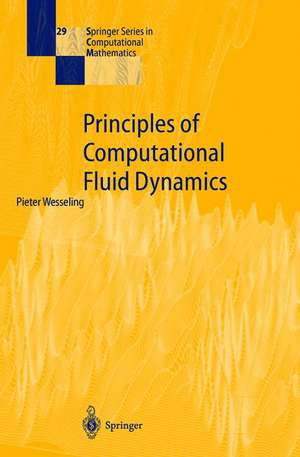
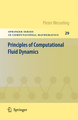
Principles of Computational Fluid Dynamics: Springer Series in Computational Mathematics, cartea 29
Autor Pieter Wesselingen Limba Engleză Hardback – 26 oct 2000
Bazându-ne pe analiza oferită de Mathematical Reviews și pe structura riguroasă a volumului, remarcăm că Principles of Computational Fluid Dynamics reprezintă o resursă academică de referință pentru studiul metodelor numerice în dinamica fluidelor. Publicată inițial în 1999 și reeditată în acest format accesibil în 2001, lucrarea lui Pieter Wesseling se distinge prin abordarea didactică a complexității geometrice și a preciziei uniforme în problemele de perturbare singulară. Subliniem organizarea logică a materialului, care facilitează tranziția de la conceptele fundamentale la aplicații avansate. Volumul debutează cu derivarea ecuațiilor de bază și analiza aspectelor analitice ale ecuațiilor cu derivate parțiale, trecând apoi prin discretizarea volumelor finite și a diferențelor finite pe grile neuniforme. Notăm cu interes includerea unor capitole dedicate ecuațiilor Navier-Stokes și Euler în domenii generale, precum și tratarea unitară a fluxurilor compresibile și incompresibile, o abordare care extinde cadrul metodologic propus de Computational Fluid Dynamics de Naseem Uddin prin accentul pus pe fundamentarea matematică a algoritmilor de iterare. În contextul operei autorului, deși Pieter Wesseling a contribuit și la literatură tehnică în domenii precum Clinical Neuroanatomy, expertiza sa în analiză numerică este aici pe deplin valorificată. Comparativ cu Computational Techniques for Fluid Dynamics 1 de Clive A. J. Fletcher, care se concentrează pe tehnici specifice pentru ingineri, volumul de față oferă o profunzime teoretică mai mare, fiind esențial pentru cercetătorii care urmăresc obținerea unei acurateți ridicate la numere Reynolds mari. Structura cuprinsului indică o progresie de la legi de conservare scalare la soluții numerice complexe, consolidând statutul acestei cărți în cadrul Springer Series in Computational Mathematics.
Din seria Springer Series in Computational Mathematics
- 15%
 Preț: 478.52 lei
 - 18%
 Preț: 1016.67 lei
 - 18%
 Preț: 698.75 lei
 -
 Preț: 389.12 lei
 -
 Preț: 389.18 lei
 - 18%
 Preț: 1344.60 lei
 -
 Preț: 379.36 lei
 - 18%
 Preț: 1447.04 lei
 - 20%
 Preț: 1032.48 lei
 - 18%
 Preț: 793.72 lei
 - 15%
 Preț: 649.61 lei
 -
 Preț: 364.92 lei
 - 18%
 Preț: 907.46 lei
 - 18%
 Preț: 1019.67 lei
 - 18%
 Preț: 1155.07 lei
 -
 Preț: 407.24 lei
 - 18%
 Preț: 911.19 lei
 - 15%
 Preț: 624.95 lei
 - 15%
 Preț: 632.63 lei
 - 15%
 Preț: 524.12 lei
 - 15%
 Preț: 680.80 lei
 - 18%
 Preț: 1448.72 lei
 - 18%
 Preț: 1162.10 lei
 - 18%
 Preț: 1265.10 lei
 - 18%
 Preț: 823.41 lei
 - 15%
 Preț: 735.86 lei
 - 24%
 Preț: 726.25 lei
 - 15%
 Preț: 620.55 lei
Preț: 685.82 lei
Preț vechi: 806.85 lei
-15%
Carte tipărită la comandă
Livrare economică 01-15 decembrie
Specificații
ISBN-10: 3540678530
Pagini: 656
Ilustrații: XII, 644 p.
Dimensiuni: 160 x 241 x 40 mm
Greutate: 1.09 kg
Ediția:2001
Editura: Springer
Colecția Springer Series in Computational Mathematics
Seria Springer Series in Computational Mathematics
Locul publicării:Berlin, Heidelberg, Germany
V-ar putea interesa
-
 Codes and CryptographyDominic Welsh-31%Preț: 570.53 lei826.51 lei
 -
 An Introduction to Numerical AnalysisEndre Süli-19%Preț: 535.85 lei661.55 lei
 -
 ACTA Numerica 1993Arieh IserlesPreț: 267.88 lei
 -
 Programming Finite Elements in Java(TM)Gennadiy P. Nikishkov-15%Preț: 617.58 lei726.56 lei
 -
 Geometric Numerical IntegrationErnst Hairer-18%Preț: 1448.72 lei1766.73 lei
 -
 Mathematical Aspects of Discontinuous Galerkin MethodsDaniele Antonio Di Pietro-18%Preț: 790.26 lei963.74 lei
 -
 Preț: 458.42 lei
 -
 Numerical Techniques for Global Atmospheric ModelsPeter H. Lauritzen-15%Preț: 709.66 lei834.89 lei
 -
 The Concept of Stability in Numerical MathematicsWolfgang HackbuschPreț: 403.03 lei
 -
 Tensor Spaces and Numerical Tensor CalculusWolfgang Hackbusch-24%Preț: 759.08 lei998.80 lei
Public țintă
ResearchDe ce să citești această carte
Recomandăm această carte cercetătorilor și studenților la nivel de masterat sau doctorat care au nevoie de o bază matematică solidă în CFD. Cititorul câștigă o înțelegere profundă a discretizării pe grile neuniforme și a metodelor iterative eficiente. Este un instrument esențial pentru cei care lucrează cu ecuațiile Navier-Stokes și doresc să stăpânească tranziția de la modele teoretice la simulări numerice precise în domenii geometrice complexe.
Descriere scurtă
"This book is a well-written graduate level text in computational fluid dynamics, with a good introduction to the two numerical methods, finite volume and finite difference. The material is well-organized, starting with simple one-dimensional equations and moving to numerical methods for two-dimensional and three-dimensional problems. There is a good mixture of theoretical and computational topics. This text should be of value to all researchers interested in computational fluid dynamics." Mathematical Reviews