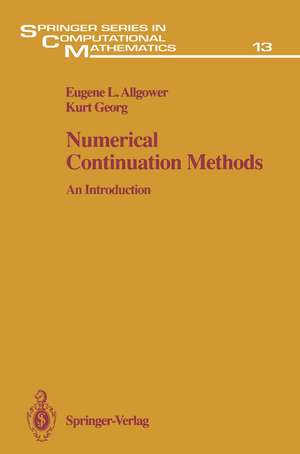
Numerical Continuation Methods: Springer Series in Computational Mathematics, cartea 13
Autor Eugene L. Allgower, Kurt Georgen Limba Engleză Paperback – oct 2011
Din seria Springer Series in Computational Mathematics
- 24%
 Preț: 854.44 lei
 - 15%
 Preț: 478.52 lei
 - 18%
 Preț: 1016.67 lei
 - 18%
 Preț: 698.75 lei
 -
 Preț: 389.12 lei
 -
 Preț: 389.18 lei
 - 18%
 Preț: 1344.60 lei
 - 18%
 Preț: 1447.04 lei
 - 20%
 Preț: 957.51 lei
 - 20%
 Preț: 949.48 lei
 - 18%
 Preț: 793.72 lei
 - 15%
 Preț: 649.61 lei
 -
 Preț: 364.92 lei
 - 18%
 Preț: 907.46 lei
 - 18%
 Preț: 1019.67 lei
 - 18%
 Preț: 1155.07 lei
 -
 Preț: 407.24 lei
 - 18%
 Preț: 911.19 lei
 - 15%
 Preț: 624.95 lei
 - 15%
 Preț: 632.63 lei
 - 15%
 Preț: 524.12 lei
 - 15%
 Preț: 680.80 lei
 - 18%
 Preț: 1448.72 lei
 - 18%
 Preț: 1162.10 lei
 - 18%
 Preț: 1265.10 lei
 - 18%
 Preț: 823.41 lei
 - 15%
 Preț: 735.86 lei
 - 24%
 Preț: 726.25 lei
 - 15%
 Preț: 642.38 lei
Preț: 379.36 lei
Puncte Express: 569
Carte tipărită la comandă
Livrare economică 26 noiembrie-10 decembrie
Livrare prin curier în România Termenul estimat este afișat lângă disponibilitate.
Transport gratuit de la 400.00 lei Plată online sau ramburs, în funcție de opțiunile comenzii.
Retur gratuit în 14 zile Comandă securizată și suport în română.
Specificații
ISBN-13: 9783642647642
ISBN-10: 3642647642
Pagini: 408
Ilustrații: XIV, 388 p.
Dimensiuni: 155 x 235 x 23 mm
Greutate: 0.62 kg
Ediția:Softcover reprint of the original 1st ed. 1990
Editura: Springer
Colecția Springer Series in Computational Mathematics
Seria Springer Series in Computational Mathematics
Locul publicării:Berlin, Heidelberg, Germany
ISBN-10: 3642647642
Pagini: 408
Ilustrații: XIV, 388 p.
Dimensiuni: 155 x 235 x 23 mm
Greutate: 0.62 kg
Ediția:Softcover reprint of the original 1st ed. 1990
Editura: Springer
Colecția Springer Series in Computational Mathematics
Seria Springer Series in Computational Mathematics
Locul publicării:Berlin, Heidelberg, Germany
V-ar putea interesa
-
 Guide to AnalysisMary Hart-31%Preț: 473.18 lei689.17 lei
 -
 An Introduction to Numerical AnalysisEndre Süli-19%Preț: 535.85 lei661.55 lei
 -
 Spline FunctionsLarry Schumaker-11%Preț: 601.48 lei675.81 lei
 -
 Regularization of Inverse ProblemsHeinz Werner Engl-18%Preț: 1150.67 lei1403.26 lei
 -
 Introduction to Numerical AnalysisJ. Stoer-15%Preț: 611.78 lei719.74 lei
 -
 Programming Finite Elements in Java(TM)Gennadiy P. Nikishkov-15%Preț: 617.58 lei726.56 lei
 -
 Geometric Numerical IntegrationErnst Hairer-18%Preț: 1448.72 lei1766.73 lei
 -
 Principles of Computational Fluid DynamicsPieter Wesseling-15%Preț: 632.63 lei744.28 lei
 -
 Mathematical Aspects of Discontinuous Galerkin MethodsDaniele Antonio Di Pietro-18%Preț: 790.26 lei963.74 lei
 -
 Preț: 458.42 lei
 -
 Elements of Scientific ComputingAslak TveitoPreț: 402.42 lei
 -
 Tensor Spaces and Numerical Tensor CalculusWolfgang Hackbusch-24%Preț: 759.08 lei998.80 lei
 -
 ASYMPTOTIC METHODS FOR INTEGRALSTemme Nico M-18%Preț: 1297.75 lei1582.62 lei
 -
 Introduction to Computational Mathematics (2nd Edition)UK" University of Cambridge, UK <p> "University of Cambridge, UK" <p> "University of Cambridge, UK" University of Cambridge, UK <p> "University of Cambridge, UK" <p> "University of Cambridge, UK" University of Cambridge, UK) Yang, Xin-She (<p> "University of CambridgePreț: 459.63 lei
Public țintă
ResearchCuprins
1 Introduction.- 2 The Basic Principles of Continuation Methods.- 2.1 Implicitly Defined Curves.- 2.2 The Basic Concepts of PC Methods.- 2.3 The Basic Concepts of PL Methods.- 3 Newton’s Method as Corrector.- 3.1 Motivation.- 3.2 The Moore-Penrose Inverse in a Special Case.- 3.3 A Newton’s Step for Underdetermined Nonlinear Systems.- 3.4 Convergence Properties of Newton’s Method.- 4 Solving the Linear Systems.- 4.1 Using a QR Decomposition.- 4.2 Givens Rotations for Obtaining a QR Decomposition.- 4.3 Error Analysis.- 4.4 Scaling of the Dependent Variables.- 4.5 Using LU Decompositions.- 5 Convergence of Euler-Newton-Like Methods.- 5.1 An Approximate Euler-Newton Method.- 5.2 A Convergence Theorem for PC Methods.- 6 Steplength Adaptations for the Predictor.- 6.1 Steplength Adaptation by Asymptotic Expansion.- 6.2 The Steplength Adaptation of Den Heijer & Rheinboldt.- 6.3 Steplength Strategies Involving Variable Order Predictors.- 7 Predictor-Corrector Methods Using Updating.- 7.1 Broyden’s “Good” Update Formula.- 7.2 Broyden Updates Along a Curve.- 8 Detection of Bifurcation Points Along a Curve.- 8.1 Simple Bifurcation Points.- 8.2 Switching Branches Via Perturbation.- 8.3 Branching Off Via the Bifurcation Equation.- 9 Calculating Special Points of the Solution Curve.- 9.1 Introduction.- 9.2 Calculating Zero Points f(c(s)) = 0.- 9.3 Calculating Extremal Points minsf((c(s)).- 10 Large Scale Problems.- 10.1 Introduction.- 10.2 General Large Scale Solvers.- 10.3 Nonlinear Conjugate Gradient Methods as Correctors.- 11 Numerically Implementable Existence Proofs.- 11.1 Preliminary Remarks.- 11.2 An Example of an Implementable Existence Theorem.- 11.3 Several Implementations for Obtaining Brouwer Fixed Points.- 11.4 Global Newton and Global Homotopy Methods.- 11.5Multiple Solutions.- 11.6 Polynomial Systems.- 11.7 Nonlinear Complementarity.- 11.8 Critical Points and Continuation Methods.- 12 PL Continuation Methods.- 12.1 Introduction.- 12.2 PL Approximations.- 12.3 A PL Algorithm for Tracing H(u) = 0.- 12.4 Numerical Implementation of a PL Continuation Algorithm.- 12.5 Integer Labeling.- 12.6 Truncation Errors.- 13 PL Homotopy Algorithms.- 13.1 Set-Valued Maps.- 13.2 Merrill’s Restart Algorithm.- 13.3 Some Triangulations and their Implementations.- 13.4 The Homotopy Algorithm of Eaves & Saigal.- 13.5 Mixing PL and Newton Steps.- 13.6 Automatic Pivots for the Eaves-Saigal Algorithm.- 14 General PL Algorithms on PL Manifolds.- 14.1 PL Manifolds.- 14.2 Orientation and Index.- 14.3 Lemke’s Algorithm for the Linear Complementarity Problem.- 14.4 Variable Dimension Algorithms.- 14.5 Exploiting Special Structure.- 15 Approximating Implicitly Defined Manifolds.- 15.1 Introduction.- 15.2 Newton’s Method and Orthogonal Decompositions Revisited.- 15.3 The Moving Frame Algorithm.- 15.4 Approximating Manifolds by PL Methods.- 15.5 Approximation Estimates.- 16 Update Methods and their Numerical Stability.- 16.1 Introduction.- 16.2 Updates Using the Sherman-Morrison Formula.- 16.3 QR Factorization.- 16.4 LU Factorization.- P1 A Simple PC Continuation Method.- P2 A PL Homotopy Method.- P3 A Simple Euler-Newton Update Method.- P4 A Continuation Algorithm for Handling Bifurcation.- P5 A PL Surface Generator.- P6 SCOUT — Simplicial Continuation Utilities.- P6.1 Introduction.- P6.2 Computational Algorithms.- P6.3 Interactive Techniques.- P6.4 Commands.- P6.5 Example: Periodic Solutions to a Differential Delay Equation.- Index and Notation.