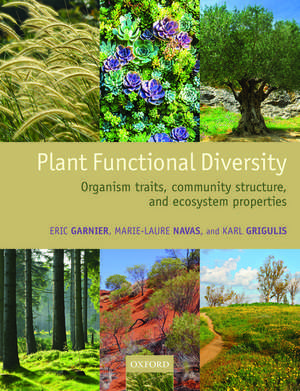
Plant Functional Diversity: Organism traits, community structure, and ecosystem properties
Autor Eric Garnier, Marie-Laure Navas, Karl Grigulisen Limba Engleză Hardback – 10 dec 2015
Preț: 997.62 lei
Preț vechi: 1481.97 lei
-33%
Puncte Express: 1496
Carte tipărită la comandă
Livrare economică 27 noiembrie-08 decembrie
Livrare prin curier în România Termenul estimat este afișat lângă disponibilitate.
Transport gratuit pentru acest produs Plată online sau ramburs, în funcție de opțiunile comenzii.
Retur gratuit în 14 zile Comandă securizată și suport în română.
Specificații
ISBN-13: 9780198757368
ISBN-10: 0198757360
Pagini: 256
Dimensiuni: 196 x 249 x 19 mm
Greutate: 0.72 kg
Editura: OUP OXFORD
Colecția OUP Oxford
Locul publicării:Oxford, United Kingdom
ISBN-10: 0198757360
Pagini: 256
Dimensiuni: 196 x 249 x 19 mm
Greutate: 0.72 kg
Editura: OUP OXFORD
Colecția OUP Oxford
Locul publicării:Oxford, United Kingdom
V-ar putea interesa
-
 -20%Preț: 357.46 lei446.14 lei
 -
 The Biology of AgroecosystemsNicola Randall-17%Preț: 371.22 lei447.66 lei
 -
 The Biology of GrasslandsBrian Wilsey-21%Preț: 384.73 lei489.62 lei
 -
 -21%Preț: 538.07 lei680.46 lei
 -
 Soil Ecology and Ecosystem ServicesDiana H. Wall-32%Preț: 1068.20 lei1581.17 lei
 -
 -28%Preț: 523.18 lei721.91 lei
 -
 Methods in Comparative Plant Population EcologyDavid Gibson-21%Preț: 483.35 lei612.26 lei
 -
 The Oxford Handbook of Climate Change and SocietyJohn S. Dryzek-19%Preț: 322.21 lei396.44 lei
 -
 The Normalized Difference Vegetation IndexNathalie Pettorelli-31%Preț: 743.63 lei1078.10 lei
 -
 Ecology of Plant-Derived Smoke: Its Use in Seed GerminationLara Jefferson-32%Preț: 533.24 lei781.16 lei
 -
 -18%Preț: 65.27 lei79.65 lei
 -
 Remote Sensing of Protected LandsYeqiao Wang-15%Preț: 558.77 lei657.38 lei
 -
 Nonlinear Regression with RChristian Ritz-15%Preț: 522.73 lei614.98 lei
 -
 Data Manipulation with RPhil Spector-15%Preț: 523.50 lei615.88 lei
 -
 Mountain Weather and ClimateRoger G. Barry-11%Preț: 651.26 lei731.76 lei
 -
 Animal, Vegetable, MiracleBarbara KingsolverPreț: 93.97 lei
 -
 Functional Plant EcologyFrancisco Pugnaire-18%Preț: 1396.12 lei1702.58 lei
 -
 Vegetation DynamicsDerek Eamus-24%Preț: 438.81 lei578.09 lei
 -
 Plant EcologyPaul A. Keddy-8%Preț: 533.65 lei580.06 lei
 -
 R Graphics CookbookWinston Chang-20%Preț: 418.45 lei523.07 lei
 -
 Remote Sensing and GIS for EcologistsMartin WegmannPreț: 359.48 lei
 -
 Numerical Ecology with RDaniel Borcard-15%Preț: 595.29 lei700.34 lei
 -
 Plants in Alpine RegionsCornelius Lütz-24%Preț: 1162.66 lei1529.81 lei
 -
 Remote Sensing Image Classification in RCourage Kamusoko-18%Preț: 923.73 lei1126.51 lei
Recenzii
Each of the ten chapters is excellently structured... The book is also nicely illustrated, extremely well referenced and has a useful index. In a nutshell, the book is an absolute must-read for graduate students, ecologists, agricultural scientists and conservation biologists interested in the functional approach to biological diversity.
The book is well written with good examples, figures and conceptual graphs to explain theoretical and applied concepts and effects of diversity... Plant functional diversity is likely to be a key reference when studying and synthesising information about plant functional diversity and its effects... I will certainly both use and recommend this book.
This book is a convincing synthesis of the principles of plant functional ecology in that it provides a profound introduction and theoretical background to the field and lists application possibilities ... It is an excellent textbook for students and will also be useful for researchers.
I expect this book to be the best entry point for any researcher interested in trait-based plant ecology. It provides an authoritative overview of trait-based ecology, while simultaneously revealing the power and limitations of this field as it currently stands. By providing a concise and nicely illustrated volume, the authors have done a tremendous service to the field.
This book lays out with impressive clarity, depth, and breadth the conceptual framework of plant functional diversity as it stands today ... The book provides a definitive reading for a graduate-level seminar on plant functional diversity and an excellent desk reference for any biologist interested in the evolutionary and ecological implications of trait variation.
Functional ecology has proven productive in understanding ecosystem structure and function, but currently, it is often not widely addressed in general ecology texts. Therefore, this book will be useful to advanced undergraduates and graduate students. ... Highly recommended.
The book is well written with good examples, figures and conceptual graphs to explain theoretical and applied concepts and effects of diversity... Plant functional diversity is likely to be a key reference when studying and synthesising information about plant functional diversity and its effects... I will certainly both use and recommend this book.
This book is a convincing synthesis of the principles of plant functional ecology in that it provides a profound introduction and theoretical background to the field and lists application possibilities ... It is an excellent textbook for students and will also be useful for researchers.
I expect this book to be the best entry point for any researcher interested in trait-based plant ecology. It provides an authoritative overview of trait-based ecology, while simultaneously revealing the power and limitations of this field as it currently stands. By providing a concise and nicely illustrated volume, the authors have done a tremendous service to the field.
This book lays out with impressive clarity, depth, and breadth the conceptual framework of plant functional diversity as it stands today ... The book provides a definitive reading for a graduate-level seminar on plant functional diversity and an excellent desk reference for any biologist interested in the evolutionary and ecological implications of trait variation.
Functional ecology has proven productive in understanding ecosystem structure and function, but currently, it is often not widely addressed in general ecology texts. Therefore, this book will be useful to advanced undergraduates and graduate students. ... Highly recommended.
Notă biografică
Eric Garnier is a researcher in plant functional ecology. His work on plant functional diversity is based on a combination of conceptual, experimental and methodological approaches, and contributes to the broad field of trait-based comparative ecology. He has pioneered some of the developments of conceptual models of relationships between plant functional traits, plant function, and biogeochemistry, and has participated in the development of standardized approaches to the measurement of plant traits towards a worldwide application. More recently, he has contributed to the emergence of ecoinformatics at the French national scale, especially through his work as the Director of CEntre for the Synthesis and Analysis of Biodiversity.Marie-Laure Navas works on the identification of the functional diversity of plant species. More precisely, her work focuses on i) the identification of assembly rules of plant communities due to biotic and abiotic processes; ii) the characterization of changes in functional structure of plant communities along environmental gradients; iii) the identification of traits related to competition and facilitation ability of plants. These questions are addressed with the example of managed grasslands, especially in the French Mediterranean area. Recently, Marie-Laure Navas also developed collaborations with researchers in crop science and weed science, in order to test the relevance of the functional approach for developing new cropping systems based on more ecological-directed regulation of pests.Karl Grigulis works as a research engineer in the Laboratoire d'Ecologie Alpine in Grenoble, France. Initially working as an agronomist in south-east Australia on topics of population ecology using pasture weeds as model systems, more recently in France he participates in projects focussed on functional and community ecology, in particular the field assessment of community functional structure as a determinant of ecosystem services.
Cuprins
1: A functional approach to biological diversity
2: Trait-based ecology: definitions, methods, and a conceptual framework
3: The functional characterisation of plants
4: Gradients, response traits, and ecological strategies
5: A functional approach to plant community structure
6: Plant traits and ecosystem properties
7: Functional diversity and ecosystem services
8: Functional diversity in agriculture: the cases of grasslands and crop weeds
9: Managing functional diversity data
10: Perspectives for functional diversity research