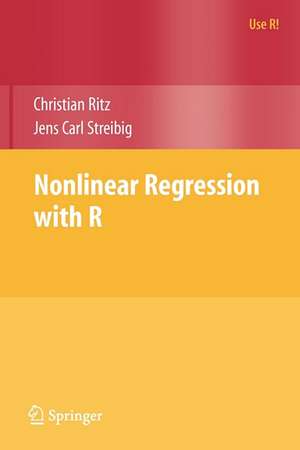
Nonlinear Regression with R
Autor Christian Ritz, Jens Carl Streibigen Limba Engleză Paperback – 21 noi 2008
Recomandată ca referință profesională și pentru studii de masterat sau doctorat în științe aplicate, Nonlinear Regression with R de Christian Ritz și Jens Carl Streibig rezolvă o problemă majoră a utilizatorilor de R: fragmentarea documentației despre regresia neliniară. Găsim în acest volum o sinteză coerentă a instrumentelor necesare pentru analiza experimentelor din biologie, chimie sau medicină, oferind o structură clară de implementare. Progresia materialului este una logică, pornind de la inițializarea parametrilor prin „self-starters” — o etapă critică și adesea dificilă în modelarea neliniară — și continuând cu explorarea detaliată a funcției nls(). Apreciem în mod deosebit capitolele dedicate diagnosticării și remediilor pentru încălcarea ipotezelor statistice, elemente esențiale pentru validitatea oricărei cercetări științifice. Finalul volumului introduce modelele cu efecte mixte, o tranziție firească spre lucrările ulterioare ale lui Christian Ritz, precum Dose-Response Analysis Using R, unde autorul aprofundează aplicațiile specifice din toxicologie și farmacologie. Cartea completează perspectiva oferită de Statistical Tools for Nonlinear Regression de Sylvie Huet. În timp ce volumul lui Huet se concentrează pe modele binomiale și Poisson folosind pachetul nls2, lucrarea de față oferă un ghid mai larg de diagnosticare și testare a ipotezelor, fiind mai potrivită pentru cercetătorul care are nevoie de o metodologie de lucru completă în mediul R standard. De asemenea, spre deosebire de An R Companion to Applied Regression, care tratează regresia la modul general, acest titlu Springer se concentrează strict pe complexitatea modelelor neliniare, oferind profunzimea necesară pentru date experimentale complexe.
Preț: 522.73 lei
Preț vechi: 614.98 lei
-15%
Carte tipărită la comandă
Livrare economică 09-23 decembrie
Specificații
ISBN-10: 0387096159
Pagini: 148
Ilustrații: XII, 148 p.
Dimensiuni: 154 x 235 x 13 mm
Greutate: 0.24 kg
Ediția:2008 edition
Editura: Springer
Locul publicării:New York, NY, United States
V-ar putea interesa
-
 The Biology of AgroecosystemsNicola Randall-17%Preț: 371.22 lei447.66 lei
 -
 The Biology of GrasslandsBrian Wilsey-18%Preț: 420.71 lei512.40 lei
 -
 -23%Preț: 485.47 lei626.91 lei
 -
 -20%Preț: 556.20 lei692.46 lei
 -
 Soil Ecology and Ecosystem ServicesDiana H. Wall-31%Preț: 1104.32 lei1609.18 lei
 -
 The Oxford Handbook of Climate Change and SocietyJohn S. Dryzek-19%Preț: 322.21 lei396.44 lei
 -
 Remote Sensing of Protected LandsYeqiao Wang-15%Preț: 558.77 lei657.38 lei
 -
 Data Manipulation with RPhil Spector-15%Preț: 523.50 lei615.88 lei
 -
 Mathematical Statistics and Probability TheoryW. Klonecki-15%Preț: 618.59 lei727.76 lei
 -
 The Mathematics of TimeSteve Smale-15%Preț: 522.85 lei615.13 lei
 -
 Preț: 362.30 lei
 -
 Preț: 374.37 lei
 -
 ProbabilityAlan F. Karr-15%Preț: 725.31 lei853.30 lei
 -
 Stochastic Epidemic Models and Their Statistical AnalysisHakan Andersson-18%Preț: 744.53 lei907.97 lei
 -
 Statistical MatchingSusanne Rässler-18%Preț: 941.56 lei1148.24 lei
 -
 Boundary Crossing of Brownian MotionHans R. LerchePreț: 365.58 lei
 -
 Discrete ProbabilityHugh Gordon-15%Preț: 519.94 lei611.69 lei
 -
 Scan StatisticsJoseph Glaz-15%Preț: 671.75 lei790.30 lei
 -
 Mountain Weather and ClimateRoger G. Barry-11%Preț: 651.26 lei731.76 lei
 -
 Functional Plant EcologyFrancisco Pugnaire-18%Preț: 1396.12 lei1702.58 lei
 -
 Vegetation DynamicsDerek Eamus-23%Preț: 452.00 lei586.09 lei
 -
 Plant EcologyPaul A. Keddy-8%Preț: 531.21 lei577.41 lei
 -
 R Graphics CookbookWinston Chang-20%Preț: 418.45 lei523.07 lei
 -
 Remote Sensing and GIS for EcologistsMartin WegmannPreț: 359.48 lei
 -
 Numerical Ecology with RDaniel Borcard-15%Preț: 595.29 lei700.34 lei
 -
 Plants in Alpine RegionsCornelius Lütz-24%Preț: 1162.66 lei1529.81 lei
 -
 Remote Sensing Image Classification in RCourage Kamusoko-18%Preț: 923.73 lei1126.51 lei
Public țintă
Professional/practitionerDe ce să citești această carte
Această carte este esențială pentru cercetătorii care lucrează cu date experimentale ce nu urmează un model liniar. Cititorul câștigă o metodologie clară pentru estimarea parametrilor, diagnosticarea erorilor și modelarea structurilor de date complexe în R. Reprezintă un salt de la utilizarea intuitivă a funcțiilor statistice la o rigoare metodologică necesară în publicațiile științifice contemporane.
Cuprins
Recenzii
"The Use R! series published by Springer is a wonderful thing. There is nothing else like it, and as far as I know there has never been anything like it, certainly not for open source software…. This book by Ritz and Streibig is a fine example. It documents, explains, and illustrates in considerable detail the venerable nls() function, available both in S and R, … a mini-course in nonlinear regression…. Books of this form are ideal for self-study,…. My guess is that about 95% of the experimenters or researchers using this book will think that the material is quite sufficient for their needs, and will not be interested in further theoretical studying. That, I think, is actually one of its greatest strengths. … In summary I think the book is excellent, and eminently useful. I hope it will serve as a model for documenting more of the larger R functions and packages." (Jan de Leeuw, Journal of Statistical Software, 2009).
"Readership: Under- and post-graduate students of statistics and of applied disciplines in biology, chemistry, engineering, fisheries science, medicine and toxicology. … The scope and topic of this book are in the title and the authors take as their starting point the function nls() and subsequently, related functions in R. … I strongly recommend this book – if you are a young scientist … then this book will save you hours of wasted exploration and investigation to find the allusive solution to your nonlinear estimation problem." (C. M. O’Brien, International Statistical Review, Vol. 77 (3), 2009)
“…A brief and focused book in Springer’s ‘Use R!’ series. …The information about nonlinear regression methodology and advice on how to use it is accurate and useful; the examples are novel and effective … and the authors provide enough information for practitioners who have little experience with nonlinear regression to begin to fit simple nonlinear models and draw inferences fromthem. … Useful as a secondary text for an applied course on non-linear regression, providing students a tutorial on implementation in R and even some exercises that could be used in such a course or for self-study. I congratulate Ritz and Steibig on a informative and well-written little book. ” (The American Statistician, February 2010, Vol. 64 No.1)
“The preface of this book clearly spells out its intended purpose: it is a how-to book on the use of the nls function in R, rather than a textbook on nonlinear regression. As such, it is intended as a reference for readers with some past experience with R and a reasonable working knowledge of linear regression, or as a supplementary text for a course on nonlinear regression. It serves both purposes pretty well and I judge it to be a handy little book… .” (Biometrics, Summer 2009, 65, 1001)
Textul de pe ultima copertă
experiments from the applied sciences. Currently, R offers a wide range of functionality for nonlinear regression analysis, but the relevant functions, packages and documentation are scattered across the R environment. This book provides a coherent and unified treatment of nonlinear regression with R by means of examples from a diversity of applied sciences such as biology, chemistry, engineering, medicine and toxicology.
The book begins with an introduction on how to fit nonlinear regression models in R. Subsequent chapters explain in more depth the salient features of the fitting function nls(), the use of model diagnostics, the remedies for various model departures, and how to do hypothesis testing. In the final chapter grouped-data structures, including an example of a nonlinear mixed-effects regression model, are considered.
Christian Ritz has a PhD in biostatistics from the Royal Veterinary and Agricultural University. For the last 5 years he has been working extensively with various applications of nonlinear regression in the life sciences and related disciplines, authoring several R packages and papers on this topic. He is currently doing postdoctoral research at the University of Copenhagen.
Jens C. Streibig is a professor in Weed Science at the University of Copenhagen. He has for more than 25 years worked on selectivity of herbicides and more recently on the ecotoxicology of pesticides and has extensive experience in applying nonlinear regression models. Together with the first author he has developed short courses on the subject of this book for students in the life sciences.