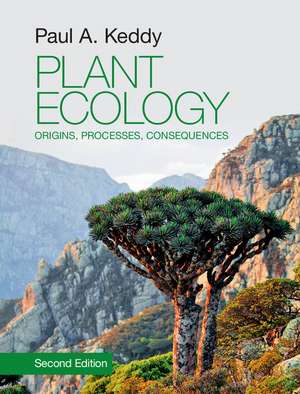
Plant Ecology
Autor Paul A. Keddyen Limba Engleză Hardback – iun 2017
Observăm că această a doua ediție a lucrării Plant Ecology pune un accent deosebit pe aplicabilitatea pedagogică, integrând 89 de exerciții și întrebări de recapitulare menite să fixeze conceptele teoretice. Remarcăm o structură logică ce ghidează cititorul de la macro-perspectiva creării biosferei către mecanismele specifice de interacțiune, precum competiția, herbivoria și mutualismul. Autorul Paul A. Keddy reușește să transforme un curs academic într-o explorare globală, aducând exemple din ecosisteme diverse, de la zonele alpine arctice până la înălțimile Guyana din America de Sud. Comparabil cu The Ecology of Plants de Jessica Gurevitch în rigoarea științifică și calitatea ilustrațiilor, volumul de față se distinge prin actualizarea modelelor de date și prin noul capitol dedicat ecologiei populațiilor, adaptat cerințelor curriculare moderne. În contextul operei sale, această lucrare sintetizează temele explorate în A Framework for Community Ecology, unde autorul analiza asamblarea comunităților, dar le plasează aici într-un cadru mult mai vast, interdisciplinar. De asemenea, expertiza sa din The World's Largest Wetlands se reflectă în capitolul final dedicat conservării și managementului, oferind soluții concrete pentru cele aproximativ o treime din speciile de plante aflate în prezent sub amenințare. Ediția revizuită nu este doar un manual de biologie, ci un instrument de lucru care integrează peste 300 de ilustrații și tabele pentru a explica gradienții de vegetație și diversitatea biologică în contextul schimbărilor climatice actuale.
Preț: 533.65 lei
Preț vechi: 580.06 lei
-8%
Carte disponibilă
Livrare economică 31 octombrie-14 noiembrie
Livrare express 17-23 octombrie pentru 74.15 lei
Specificații
ISBN-10: 1107114233
Pagini: 624
Ilustrații: 187 b/w illus. 192 colour illus. 64 tables 89 exercises
Dimensiuni: 192 x 254 x 38 mm
Greutate: 1.47 kg
Ediția:Revizuită
Editura: Cambridge University Pr.
Locul publicării:New York, United States
V-ar putea interesa
-
 The Biology of AgroecosystemsNicola Randall-17%Preț: 371.22 lei447.66 lei
 -
 The Biology of GrasslandsBrian Wilsey-21%Preț: 384.73 lei489.62 lei
 -
 -23%Preț: 485.47 lei626.91 lei
 -
 -21%Preț: 538.07 lei680.46 lei
 -
 Soil Ecology and Ecosystem ServicesDiana H. Wall-32%Preț: 1068.20 lei1581.17 lei
 -
 The Oxford Handbook of Climate Change and SocietyJohn S. Dryzek-19%Preț: 322.21 lei396.44 lei
 -
 Ecology of WisdomArne Næss-19%Preț: 63.70 lei78.26 lei
 -
 Remote Sensing of Protected LandsYeqiao Wang-15%Preț: 558.77 lei657.38 lei
 -
 Nonlinear Regression with RChristian Ritz-15%Preț: 522.73 lei614.98 lei
 -
 Data Manipulation with RPhil Spector-15%Preț: 523.50 lei615.88 lei
 -
 Vegetation Ecology of Central EuropeHeinz H. Ellenberg-11%Preț: 524.19 lei588.98 lei
 -
 -11%Preț: 475.96 lei534.79 lei
 -
 From Plant Traits to Vegetation StructureBill Shipley-11%Preț: 448.01 lei503.37 lei
 -
 Light and Photosynthesis in Aquatic EcosystemsJohn T O Kirk-11%Preț: 602.14 lei676.57 lei
 -
 Mountain Weather and ClimateRoger G. Barry-11%Preț: 651.26 lei731.76 lei
 -
 Animal, Vegetable, MiracleBarbara KingsolverPreț: 93.97 lei
 -
 Functional Plant EcologyFrancisco Pugnaire-18%Preț: 1396.12 lei1702.58 lei
 -
 Vegetation DynamicsDerek Eamus-24%Preț: 438.81 lei578.09 lei
 -
 R Graphics CookbookWinston Chang-20%Preț: 417.83 lei522.29 lei
 -
 Remote Sensing and GIS for EcologistsMartin WegmannPreț: 359.48 lei
 -
 Numerical Ecology with RDaniel Borcard-15%Preț: 595.29 lei700.34 lei
 -
 Plants in Alpine RegionsCornelius Lütz-24%Preț: 1162.66 lei1529.81 lei
 -
 Remote Sensing Image Classification in RCourage Kamusoko-18%Preț: 857.19 lei1045.35 lei
De ce să citești această carte
Această ediție este esențială pentru studenții și cercetătorii în biologie care caută o înțelegere sistemică a ecologiei vegetale. Cititorul câștigă o perspectivă globală, susținută de exerciții practice și studii de caz din diverse biomi. Este un instrument valoros pentru cei care doresc să aplice teoria ecologică în managementul resurselor și conservarea biodiversității, oferind date actualizate despre impactul uman asupra biosferei.
Despre autor
Professorul Paul A. Keddy deține catedra Edward G. Schlieder pentru studii de mediu și este recunoscut de Institute for Scientific Information ca un cercetător de elită în domeniul ecologiei. Cu o carieră dedicată studiului zonelor umede și ecologiei comunităților vegetale, a publicat peste o sută de lucrări științifice și a colaborat cu organizații internaționale prestigioase precum World Wildlife Fund. Expertiza sa vastă în cercetarea factorilor de mediu care controlează biodiversitatea se reflectă în abordarea riguroasă și totodată accesibilă a acestui manual de referință.
Descriere scurtă
Cuprins
Recenzii
'In the early pages of this distinctive and engaging book Paul Keddy explains the underrated foundational role of plants in the origin of life on Earth. This is followed in masterfully discerning style over several chapters by arguments and evidence in which he champions the plant ecologists who are advancing specific sets of plant functional traits as the basis of vegetation patterns and as key factors in ecosystem structure and dynamics and responses to climate and management. Finally in conclusion, Keddy identifies and reproaches Man as the remorseless destroyer of our plant heritage and casts a critical eye at current efforts at conservation and restoration.' Philip Grime, Buxton Climate Change Impacts Lab, University of Sheffield
'The new volume by Paul A. Keddy … provides a comprehensive overview of major concepts and hypotheses in ecology in general and plant ecology in particular. Because of the presentation of the basic concepts, this textbook could easily function as a teaching tool for general ecology, using plants as a focus group, with leaving only some subfields, such as behavioral ecology, untouched. As a volume for a plant ecology class, it provides everything that biology or ecology students can wish for, most importantly a very solid conceptual framework for the organization of knowledge on the subject.' André Kessler, The Quarterly Review of Biology
Descriere
Now in full colour, this much-awaited new edition of the book Plants and Vegetation provides a fresh and comprehensive approach to plant ecology. Keddy's clear and engaging text emphasises unifying underlying principles and processes, taking a global approach to the subject and engaging students in essential concepts through real-world examples.