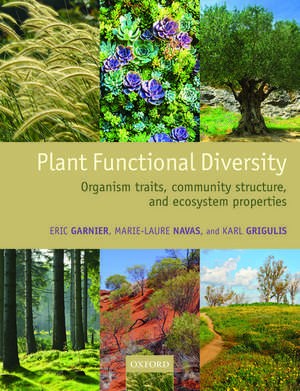
Plant Functional Diversity: Organism traits, community structure, and ecosystem properties
Autor Eric Garnier, Marie-Laure Navas, Karl Grigulisen Limba Engleză Paperback – 10 dec 2015
- The first book to present the rationale for a trait-based approach to functional diversity in the context of comparative plant ecology
- Addresses a number of highly debated questions in plant ecology, pertaining to plant responses to their environment, controls on plant community structure, ecosystem properties, and the services these deliver to human societies
- Ideal graduate seminar course, written by three renowned researchers in the field
Biological diversity, the variety of living organisms on Earth, is traditionally viewed as the diversity of taxa, and species in particular. However, other facets of diversity also need to be considered for a comprehensive understanding of evolutionary and ecological processes. This novel book demonstrates the advantages of adopting a functional approach to diversity in order to improve our understanding of the functioning of ecological systems and their components. The focus is on plants, which are major components of these systems, and for which the functional approach has led to major scientific advances over the last 20 years.
Plant Functional Diversity presents the rationale for a trait-based approach to functional diversity in the context of comparative plant ecology and agroecology. It demonstrates how this approach can be used to address a number of highly debated questions in plant ecology pertaining to plant responses to their environment, controls on plant community structure, ecosystem properties, and the services these deliver to human societies. This research level text will be of particular relevance and use to graduate students and professional researchers in plant ecology, agricultural sciences and conservation biology.
Preț: 485.47 lei
Preț vechi: 626.91 lei
-23%
Carte tipărită la comandă
Livrare economică 03-08 decembrie
Specificații
ISBN-10: 0198757379
Pagini: 256
Dimensiuni: 204 x 252 x 13 mm
Greutate: 0.48 kg
Editura: OUP OXFORD
Colecția OUP Oxford
Locul publicării:Oxford, United Kingdom
V-ar putea interesa
-
 -20%Preț: 357.46 lei446.14 lei
 -
 The Biology of AgroecosystemsNicola Randall-17%Preț: 371.22 lei447.66 lei
 -
 The Biology of GrasslandsBrian Wilsey-21%Preț: 384.73 lei489.62 lei
 -
 -21%Preț: 538.07 lei680.46 lei
 -
 Soil Ecology and Ecosystem ServicesDiana H. Wall-32%Preț: 1068.20 lei1581.17 lei
 -
 -28%Preț: 523.18 lei721.91 lei
 -
 Methods in Comparative Plant Population EcologyDavid Gibson-21%Preț: 483.35 lei612.26 lei
 -
 The Oxford Handbook of Climate Change and SocietyJohn S. Dryzek-19%Preț: 322.21 lei396.44 lei
 -
 The Normalized Difference Vegetation IndexNathalie Pettorelli-31%Preț: 743.63 lei1078.10 lei
 -
 Ecology of Plant-Derived Smoke: Its Use in Seed GerminationLara Jefferson-32%Preț: 533.24 lei781.16 lei
 -
 -18%Preț: 65.27 lei79.65 lei
 -
 Remote Sensing of Protected LandsYeqiao Wang-15%Preț: 558.77 lei657.38 lei
 -
 Nonlinear Regression with RChristian Ritz-15%Preț: 522.73 lei614.98 lei
 -
 Data Manipulation with RPhil Spector-15%Preț: 523.50 lei615.88 lei
 -
 Mountain Weather and ClimateRoger G. Barry-11%Preț: 651.26 lei731.76 lei
 -
 Animal, Vegetable, MiracleBarbara KingsolverPreț: 93.97 lei
 -
 Functional Plant EcologyFrancisco Pugnaire-18%Preț: 1396.12 lei1702.58 lei
 -
 Vegetation DynamicsDerek Eamus-24%Preț: 438.81 lei578.09 lei
 -
 Plant EcologyPaul A. Keddy-8%Preț: 533.65 lei580.06 lei
 -
 R Graphics CookbookWinston Chang-20%Preț: 418.45 lei523.07 lei
 -
 Remote Sensing and GIS for EcologistsMartin WegmannPreț: 359.48 lei
 -
 Numerical Ecology with RDaniel Borcard-15%Preț: 595.29 lei700.34 lei
 -
 Plants in Alpine RegionsCornelius Lütz-24%Preț: 1162.66 lei1529.81 lei
 -
 Remote Sensing Image Classification in RCourage Kamusoko-18%Preț: 923.73 lei1126.51 lei
Recenzii
The book is well written with good examples, figures and conceptual graphs to explain theoretical and applied concepts and effects of diversity... Plant functional diversity is likely to be a key reference when studying and synthesising information about plant functional diversity and its effects... I will certainly both use and recommend this book.
This book is a convincing synthesis of the principles of plant functional ecology in that it provides a profound introduction and theoretical background to the field and lists application possibilities ... It is an excellent textbook for students and will also be useful for researchers.
I expect this book to be the best entry point for any researcher interested in trait-based plant ecology. It provides an authoritative overview of trait-based ecology, while simultaneously revealing the power and limitations of this field as it currently stands. By providing a concise and nicely illustrated volume, the authors have done a tremendous service to the field.
This book lays out with impressive clarity, depth, and breadth the conceptual framework of plant functional diversity as it stands today ... The book provides a definitive reading for a graduate-level seminar on plant functional diversity and an excellent desk reference for any biologist interested in the evolutionary and ecological implications of trait variation.
Functional ecology has proven productive in understanding ecosystem structure and function, but currently, it is often not widely addressed in general ecology texts. Therefore, this book will be useful to advanced undergraduates and graduate students. ... Highly recommended.
Notă biografică
Cuprins
1: A functional approach to biological diversity
2: Trait-based ecology: definitions, methods, and a conceptual framework
3: The functional characterisation of plants
4: Gradients, response traits, and ecological strategies
5: A functional approach to plant community structure
6: Plant traits and ecosystem properties
7: Functional diversity and ecosystem services
8: Functional diversity in agriculture: the cases of grasslands and crop weeds
9: Managing functional diversity data
10: Perspectives for functional diversity research