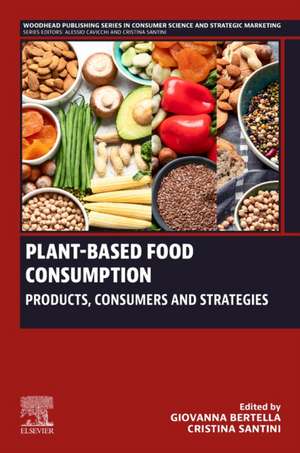
Plant-Based Food Consumption: Products, Consumers and Strategies: Woodhead Publishing Series in Consumer Science and Strategic Marketing
Editat de Giovanna Bertella, Cristina Santinien Limba Engleză Paperback – 7 noi 2023
Food scientists, food developers, food marketers, academics and students studying related areas will benefit from this important reference.
- Provides a link between theoretical information and business practices
- Presents a comprehensive overview of the phenomenon of plant-based food consumption
- Contains valuable information upon which to formulate strategic business plans or to work on plant-based food consumption research plans and projects



Preț: 970.73 lei
Preț vechi: 1415.08 lei
-31%
Puncte Express: 1456
Carte tipărită la comandă
Livrare economică 09-23 noiembrie
Livrare prin curier în România Termenul estimat este afișat lângă disponibilitate.
Transport gratuit pentru acest produs Plată online sau ramburs, în funcție de opțiunile comenzii.
Retur gratuit în 14 zile Comandă securizată și suport în română.
Specificații
ISBN-13: 9780323988285
ISBN-10: 0323988288
Pagini: 346
Dimensiuni: 152 x 229 mm
Editura: ELSEVIER SCIENCE
Seria Woodhead Publishing Series in Consumer Science and Strategic Marketing
ISBN-10: 0323988288
Pagini: 346
Dimensiuni: 152 x 229 mm
Editura: ELSEVIER SCIENCE
Seria Woodhead Publishing Series in Consumer Science and Strategic Marketing
V-ar putea interesa
-
 Mostly PlantsTracy PollanPreț: 249.41 lei
 -
 Plant Over ProcessedAndrea HannemannPreț: 150.21 lei
 -
 -15%Preț: 127.15 lei149.58 lei
 -
 Culinary Nutrition: The Science and Practice of Healthy CookingJacqueline B. Marcus-31%Preț: 571.79 lei828.15 lei
 -
 Naturally VeganJulius FiedlerPreț: 204.10 lei
 -
 Plant Academy: The CookbookCarolina Rodriguez-16%Preț: 122.26 lei146.29 lei
 -
 Plant-Based SimpleEditors of Fair Winds Press-17%Preț: 110.08 lei132.05 lei
 -
 No Meat RequiredAlicia Kennedy-19%Preț: 96.49 lei119.80 lei
 -
 Plant-Forward Cuisine: Basic Concepts and Practical ApplicationsOle G. MouritsenPreț: 394.58 leiRecomandat
 -
 Preț: 155.31 lei
 -
 Plant FuelJeffrey Boadi-28%Preț: 111.70 lei154.72 lei
 -
 -29%Preț: 140.80 lei197.38 lei
 -
 -32%Preț: 152.75 lei224.93 lei
 -
 Plant PowerLuigi FontanaPreț: 139.79 lei
 -
 Plant Powered PlusWill BulsiewiczPreț: 138.13 lei
 -
 How to Go (and Stay) VeganEd Winters-5%Preț: 129.58 lei136.40 lei
 -
 -19%Preț: 111.02 lei136.91 lei
 -
 The Kew Gardens Salad BookJenny LinfordPreț: 161.70 lei
 -
 The Complete Plant-Based CookbookAmerica'S Test Kitchen-18%Preț: 214.34 lei260.41 lei
 -
 Preț: 261.64 lei
Public țintă
Food scientists, food developers, food marketers, academics and students studying related areasCuprins
1. Introduction
Section 1:
2. Identifying conditions and opportunities for more plant-based eating practices in the Western world
3. Consumption of plant-based foods: motives and drivers among Italian consumers
4. Offer me Inspiring Values; I do not care about Branding!
5. Emerging trends in healthy and sustainable eating: the case of fresh convenience plant-based foods
6. Generation Z and novel plant-based food alternatives
7. South Korean Buddhist temple food: experiential co-creation through time and space with intertwined operand and operant resources
Section 2:
8. Plant-Based Milk Alternatives: Consumer Needs and Marketing Strategies
9. Who are the flexitarians? Improved segmentation of plant-based meat consumersin the case of Germany
10. Effective communication of plant-based foods: A case study analysis of Danish and Italian markets
11. Plant-based meat packaging and consumer dietary habits
12. The challenging path towards a hydroponic indoor home cultivation system: educating a new consumer perception of vegetables
13. A hands-on framework for the design and implementation of plant-based food experiences
14. Fresh vegetables with a story: Market gardening for a sustainable food transition
15. The power of behavioural nudges tailored to plant-based dishes when eating out
16. Conclusion
Section 1:
2. Identifying conditions and opportunities for more plant-based eating practices in the Western world
3. Consumption of plant-based foods: motives and drivers among Italian consumers
4. Offer me Inspiring Values; I do not care about Branding!
5. Emerging trends in healthy and sustainable eating: the case of fresh convenience plant-based foods
6. Generation Z and novel plant-based food alternatives
7. South Korean Buddhist temple food: experiential co-creation through time and space with intertwined operand and operant resources
Section 2:
8. Plant-Based Milk Alternatives: Consumer Needs and Marketing Strategies
9. Who are the flexitarians? Improved segmentation of plant-based meat consumersin the case of Germany
10. Effective communication of plant-based foods: A case study analysis of Danish and Italian markets
11. Plant-based meat packaging and consumer dietary habits
12. The challenging path towards a hydroponic indoor home cultivation system: educating a new consumer perception of vegetables
13. A hands-on framework for the design and implementation of plant-based food experiences
14. Fresh vegetables with a story: Market gardening for a sustainable food transition
15. The power of behavioural nudges tailored to plant-based dishes when eating out
16. Conclusion
Recenzii
“I found this book very informative and useful to understand consumer needs and perceptions and what drives behaviour in the plant-based foods category, as this can be driven by ethical, health and environmental sustainability concerns or a combination of these… I would recommend this book to academics as a teaching resource, companies intending to enter or already in the plant-based space, as well as to media companies wanting to provide their readers with objective case study information on this very topical and debated issue…" --Professor Gunnar Sigge, FST Magazine