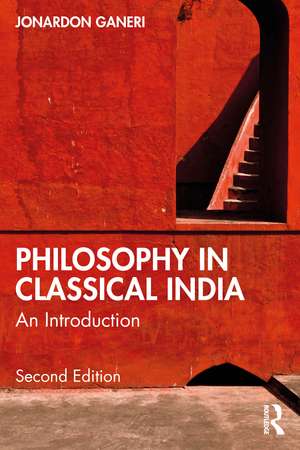
Philosophy in Classical India: An Introduction
Autor Jonardon Ganerien Limba Engleză Paperback – 14 sep 2026
- the motive and method of rational inquiry: the early Nyāya
- rationality, emptiness and the objective view: the philosophy of Nāgārjuna’s Madhyamaka Buddhism
- the rational basis of metaphysics: Vaiśeṣika metaphysics
- reduction, exclusion and rational reconstruction: the philosophy of Diṅnāga’s Yogācāra Buddhism
- rationality, harmony and perspective: Jaina epistemology and metaphysics
- reason in equilibrium: Gaṅgeśa’s new Nyāya
- balance and repost: public reason in Theravāda Buddhism
- practical reasoning in Mīmāṃsā and the Dharmaśāstra
All chapters and further reading have been updated to reflect changes in scholarship and the publication of new editions and translations of primary texts, making Philosophy in Classical India an ideal introduction to Indian philosophy from the perspective of analytical philosophy.
Preț: 428.30 lei
Nou
Puncte Express: 642
Carte tipărită la comandă
Livrare economică 02-16 decembrie
Livrare prin curier în România Termenul estimat este afișat lângă disponibilitate.
Transport gratuit pentru acest produs Plată online sau ramburs, în funcție de opțiunile comenzii.
Retur gratuit în 14 zile Comandă securizată și suport în română.
Specificații
ISBN-13: 9781041215080
ISBN-10: 1041215088
Pagini: 284
Ilustrații: 54
Dimensiuni: 156 x 234 mm
Greutate: 0.53 kg
Ediția:2
Editura: Taylor & Francis
Colecția Routledge
Locul publicării:Oxford, United Kingdom
ISBN-10: 1041215088
Pagini: 284
Ilustrații: 54
Dimensiuni: 156 x 234 mm
Greutate: 0.53 kg
Ediția:2
Editura: Taylor & Francis
Colecția Routledge
Locul publicării:Oxford, United Kingdom
V-ar putea interesa
-
 Bringing Yoga to LifeDonna FarhiPreț: 99.00 lei
 -
 -11%Preț: 352.78 lei397.68 lei
 -
 -21%Preț: 371.67 lei472.82 lei
 -
 -11%Preț: 337.28 lei380.41 lei
 -
 Zhuangzi - Basic WritingsZhuangziPreț: 174.23 lei
 -
 A History of Islamic Philosophy 3eMajid FakhryPreț: 357.80 lei
 -
 An Inquiry into the GoodKitaro NishidaPreț: 183.62 lei
 -
 -15%Preț: 457.38 lei538.09 lei
 -
 Preț: 467.95 lei
 -
 The Heart of Yoga: Developing a Personal PracticeT. K. V. Desikachar-21%Preț: 106.46 lei135.12 lei
 -
 Preț: 125.00 lei
 -
 An Introduction to Indian Philosophy: Hindu and Buddhist Ideas from Original SourcesDr Christopher Bartley-23%Preț: 247.59 lei320.08 lei
 -
 -31%Preț: 79.59 lei114.61 lei
 -
 The Heart of AwarenessThomas Byrom-31%Preț: 99.78 lei145.17 lei
 -
 Psychotherapy East and WestAlan Watts-20%Preț: 90.89 lei113.46 lei
 -
 -26%Preț: 569.11 lei767.45 lei
 -
 Deep AwakeTim FrekePreț: 71.15 lei
 -
 -16%Preț: 97.04 lei115.01 lei
 -
 The Buddha in Me, The Buddha in YouDavid Hare-35%Preț: 88.00 lei135.83 lei
 -
 -24%Preț: 185.58 lei244.54 lei
 -
 Inside the NowThich Nhat Hanh-30%Preț: 92.23 lei131.20 lei
Public țintă
Postgraduate and Undergraduate AdvancedCuprins
Preface to the Second Edition Introduction 1. The Motive and Method of Rational Inquiry 2. Rationality, Emptiness and the Objective View 3. The Rational Basis of Metaphysics 4. Reduction, Exclusion and Rational Reconstruction 5. Rationality, Harmony and Perspective 6. Reason in Equilibrium 7. Balance and Repost in Public Reason 8. Practical Reason and the Use of Particulars as Prototypes. Notes Texts Bibliography Index
Recenzii
Praise for the First Edition:
'... a brilliant contribution to the study of some of the basic questions of classical Indian Philosophy, and at the same time quite a convincing presentation of new philosophical paradigms ... What is striking in Ganeri's work is the commendable combination of sound grasp of the Sanskrit texts with outstanding interpretive skills. There is no doubt that the book will be acknowledged as a pathfinder in the interpretation of classical Indian Philosophy.' - John Vattanky, Nagoya Studies in Indian Culture and Buddhism
'This is a remarkable piece of scholarship and an absolute pleasure to read. What makes this work so outstanding is that the author is both an extremely accomplished philosopher as well as being proficient in the Indian source languages.' - John Peacock
'I cannot think of any book in English with such a wide coverage of Indian philosophy written with so much originality, accessibility and grounding in the texts.' - Arindam Chakrabarti, University of Hawaii, USA
'Ganeri has a highly developed knack for discovering issues of relevance to contemporary philosophical discussions as well as a profound knowledge of the Indian philosophical traditions and the modern scholarly studies on them, [and] this monograph should be of great interest to the Indologist and to the reader conversant in contemporary trends of Western philosophy who is also interested in Classical Indian thought… The value of Ganeri’s book is greatly increased by the fact that in addition to a judicious selection of materials and their interpretations that are already known to the specialist, the author offers new solutions to difficult points.' - Horst Lasic, University of Vienna, Austria
'One of the most remarkable qualities of this book is that it can be profitably read by anyone with some philosophical sophistication. It requires special knowledge neither of India nor of Sanskrit. … This book is a delight to read. It is eminently readably by the non-expert and contributes to the growing literature which takes the philosophical content of these texts seriously, presenting novel interpretations of their many vexatious passages. Whether you are a specialist in the field or a novice to Indian thought, as long as you have an appetite for philosophy you will find it rewarding.' - Brendan Gillon, McGill University, Canada
'Philosophy in Classical India is a brave and challenging book. In my view, it is among the most thought provoking and philosophically sophisticated discussions of Sanskrit philosophy to date…It is among the very few books that can be read with interest, profit, and enjoyment by professional philosophers, and if my own informal survey has any merit it is a book that will go a long way towards convincing those who still need to be convinced that Sanskrit philosophy deserves to be part of any philosophy curriculum. Ganeri’s work will also begin to teach professional philosophers how to think about, and with, Sanskrit texts in their own idiom, and will hopefully encourage them to seek out and study the available translations for themselves.' - Parimal Patil, Harvard University, USA
'... a brilliant contribution to the study of some of the basic questions of classical Indian Philosophy, and at the same time quite a convincing presentation of new philosophical paradigms ... What is striking in Ganeri's work is the commendable combination of sound grasp of the Sanskrit texts with outstanding interpretive skills. There is no doubt that the book will be acknowledged as a pathfinder in the interpretation of classical Indian Philosophy.' - John Vattanky, Nagoya Studies in Indian Culture and Buddhism
'This is a remarkable piece of scholarship and an absolute pleasure to read. What makes this work so outstanding is that the author is both an extremely accomplished philosopher as well as being proficient in the Indian source languages.' - John Peacock
'I cannot think of any book in English with such a wide coverage of Indian philosophy written with so much originality, accessibility and grounding in the texts.' - Arindam Chakrabarti, University of Hawaii, USA
'Ganeri has a highly developed knack for discovering issues of relevance to contemporary philosophical discussions as well as a profound knowledge of the Indian philosophical traditions and the modern scholarly studies on them, [and] this monograph should be of great interest to the Indologist and to the reader conversant in contemporary trends of Western philosophy who is also interested in Classical Indian thought… The value of Ganeri’s book is greatly increased by the fact that in addition to a judicious selection of materials and their interpretations that are already known to the specialist, the author offers new solutions to difficult points.' - Horst Lasic, University of Vienna, Austria
'One of the most remarkable qualities of this book is that it can be profitably read by anyone with some philosophical sophistication. It requires special knowledge neither of India nor of Sanskrit. … This book is a delight to read. It is eminently readably by the non-expert and contributes to the growing literature which takes the philosophical content of these texts seriously, presenting novel interpretations of their many vexatious passages. Whether you are a specialist in the field or a novice to Indian thought, as long as you have an appetite for philosophy you will find it rewarding.' - Brendan Gillon, McGill University, Canada
'Philosophy in Classical India is a brave and challenging book. In my view, it is among the most thought provoking and philosophically sophisticated discussions of Sanskrit philosophy to date…It is among the very few books that can be read with interest, profit, and enjoyment by professional philosophers, and if my own informal survey has any merit it is a book that will go a long way towards convincing those who still need to be convinced that Sanskrit philosophy deserves to be part of any philosophy curriculum. Ganeri’s work will also begin to teach professional philosophers how to think about, and with, Sanskrit texts in their own idiom, and will hopefully encourage them to seek out and study the available translations for themselves.' - Parimal Patil, Harvard University, USA
Notă biografică
Jonardon Ganeri read mathematics at Cambridge before pursuing graduate studies in philosophy at London and Oxford. He is the author of a dozen books about Indian philosophy. He joined the Fellowship of the British Academy in 2015 and won the Infosys Prize in the Humanities the same year, the only philosopher to do so. He delivered the 2024 John Locke Lectures at the University of Oxford, entitled Seeing and Subjectivity (Ganeri: 2027). He is currently Distinguished Professor of Philosophy at the University of Toronto.
Descriere
Philosophical rather than mystical or religious in approach and assuming no prior knowledge of key texts, this second edition has been substantially updated, with the addition of new chapters on Theravāda and Mīmāṃsā. An ideal introduction to Indian philosophy from the perspective of analytical philosophy.