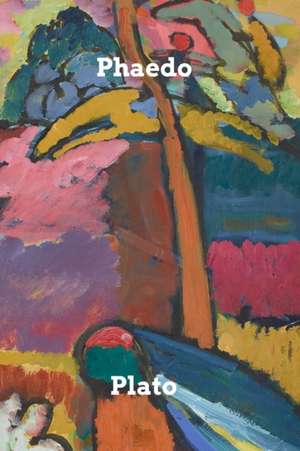
Phaedo
Autor Platoen Limba Engleză Paperback – 23 aug 2022
Preț: 80.69 lei
Puncte Express: 121
Carte disponibilă
Livrare economică 06-20 noiembrie
Livrare prin curier în România Termenul estimat este afișat lângă disponibilitate.
Transport gratuit de la 400.00 lei Plată online sau ramburs, în funcție de opțiunile comenzii.
Retur gratuit în 14 zile Comandă securizată și suport în română.
Specificații
ISBN-13: 9781006313653
ISBN-10: 1006313656
Pagini: 120
Dimensiuni: 152 x 229 x 7 mm
Greutate: 0.17 kg
Editura: Blurb
ISBN-10: 1006313656
Pagini: 120
Dimensiuni: 152 x 229 x 7 mm
Greutate: 0.17 kg
Editura: Blurb
V-ar putea interesa
-
 Behavior in Public PlacesErving Goffman-41%Preț: 75.07 lei127.96 lei
 -
 The Secret Diaries of Miss Miranda CheeverJulia QuinnPreț: 53.65 lei
 -
 Just Like HeavenJulia QuinnPreț: 62.60 lei
 -
 The Sum of All KissesJulia QuinnPreț: 57.88 lei
 -
 Because of Miss BridgertonJulia QuinnPreț: 57.69 lei
 -
 The Other Miss BridgertonJulia QuinnPreț: 58.57 lei
 -
 The Wit and Wisdom of BridgertonJulia QuinnPreț: 103.90 lei
 -
 Of Human FreedomEpictetus-21%Preț: 44.70 lei56.30 lei
 -
 If I Stay CollectionGayle FormanPreț: 158.84 lei
 -
 How to Be a StoicRobert Dobbin-20%Preț: 44.80 lei56.35 lei
 -
 A Night Like ThisJulia Quinn-25%Preț: 54.48 lei72.76 lei
 -
 The Secrets of Sir Richard KenworthyJulia Quinn-25%Preț: 59.50 lei79.76 lei
 -
 What Happens In LondonJulia Quinn-25%Preț: 49.08 lei65.50 lei
 -
 -26%Preț: 53.28 lei71.81 lei
 -
 -25%Preț: 49.42 lei65.72 lei
 -
 -25%Preț: 59.71 lei79.90 lei
 -
 -25%Preț: 54.41 lei72.72 lei
 -
 Preț: 79.65 lei
 -
 -26%Preț: 59.27 lei79.65 lei
 -
 The Lady Most Likely: A Novel in Three PartsJulia Quinn-26%Preț: 59.31 lei79.66 lei
 -
 The Lady Most Willing: A Novel in Three PartsJulia Quinn-26%Preț: 59.31 lei79.65 lei
 -
 Preț: 255.86 lei
 -
 EnchiridionEpictetus-20%Preț: 22.92 lei28.48 lei
 -
 Emotional Intelligence: Why It Can Matter More Than IQDaniel Goleman-25%Preț: 43.33 lei58.05 lei
 -
 -25%Preț: 60.57 lei80.42 lei
 -
 Ten Things I Love About YouJulia Quinn-25%Preț: 60.27 lei80.23 lei
 -
 Elon MuskAshlee VancePreț: 71.47 lei
 -
 HeroesStephen Fry-17%Preț: 67.68 lei81.10 lei
 -
 Preț: 49.00 lei
Notă biografică
Plato (c.428 to c.347 bc) was an Athenian philosopher during the Classical period in Ancient Greece, founder of the Platonist school of thought, and the Academy, the first institution of higher learning in the Western world. He is widely considered the pivotal figure in the history of Ancient Greek and Western philosophy, along with his teacher, Socrates, and his most famous student, Aristotle. Plato was the innovator of the written dialogue and dialectic forms in philosophy. Plato is also considered the founder of Western political philosophy. His most famous contribution is the theory of Forms known by pure reason, in which Plato presents a solution to the problem of universals known as Platonism (also ambiguously called either Platonic realism or Platonic idealism. He is also the namesake of Platonic love and the Platonic solids. His own most decisive philosophical influences are usually thought to have been along with Socrates, the pre-Socratics Pythagoras, Heraclitus and Parmenides, although few of his predecessors' works remain extant and much of what we know about these figures today derives from Plato himself. Unlike the work of nearly all of his contemporaries, Plato's entire body of work is believed to have survived intact for over 2,400 years. Although their popularity has fluctuated over the years, the works of Plato have never been without readers since the time they were written.
Descriere
Descriere de la o altă ediție sau format:
The Phaedo is acknowledged to be one of Plato's greatest masterpieces, showing him both as a philosopher and as a dramatist at the height of his powers. For its moving account of the execution of Socrates, the Phaedo ranks among the supreme literary achievements of antiquity. It is also a seminal document for many ideas deeply ingrained in western culture, and provides one of the best introductions to Plato's thought. This new edition is a revised version of the Clarendon Press translation, and is eminently suitable for readers new to Plato, and ideal for classroom use, thanks to the provision of Stephanus page and letter numbering. ABOUT THE SERIES: For over 100 years Oxford World's Classics has made available the widest range of literature from around the globe. Each affordable volume reflects Oxford's commitment to scholarship, providing the most accurate text plus a wealth of other valuable features, including expert introductions by leading authorities, helpful notes to clarify the text, up-to-date bibliographies for further study, and much more.
The Phaedo is acknowledged to be one of Plato's greatest masterpieces, showing him both as a philosopher and as a dramatist at the height of his powers. For its moving account of the execution of Socrates, the Phaedo ranks among the supreme literary achievements of antiquity. It is also a seminal document for many ideas deeply ingrained in western culture, and provides one of the best introductions to Plato's thought. This new edition is a revised version of the Clarendon Press translation, and is eminently suitable for readers new to Plato, and ideal for classroom use, thanks to the provision of Stephanus page and letter numbering. ABOUT THE SERIES: For over 100 years Oxford World's Classics has made available the widest range of literature from around the globe. Each affordable volume reflects Oxford's commitment to scholarship, providing the most accurate text plus a wealth of other valuable features, including expert introductions by leading authorities, helpful notes to clarify the text, up-to-date bibliographies for further study, and much more.
Recenzii
"This marvelously conceived new translation of Plato's most important dialogue will set the standard for classroom use for many years to come. . . . The authors' imaginative new interpretation will inspire students and generate scholarly controversy-and is thus certain to accomplish what it suggests is the true aim of Socratic inquiry: the weaving, unweaving, and perpetual re-weaving of the Logos." —Dr. George R. Lucas, Jr., Professor of Philosophy, US Naval Academy, Annapolis