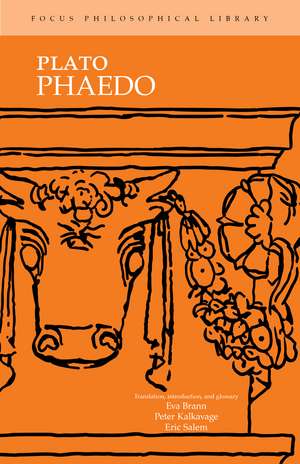
Phaedo
Autor Plato Editat de Eva Brann, Peter Kalkavage, Eric Salemen Limba Engleză Paperback – sep 1998
This is an English translation of one of Plato’s great dialogues of Socrates talking about death, dying, and the soul due to his impending execution. Included is an introduction and glossary of key terms.
Focus Philosophical Library translations are close to and are non-interpretative of the original text, with the notes and a glossary intending to provide the reader with some sense of the terms and the concepts as they were understood by Plato's immediate audience.
Preț: 85.11 lei
Preț vechi: 104.46 lei
-19%
Puncte Express: 128
Carte disponibilă
Livrare economică 05-19 noiembrie
Livrare express 21-27 octombrie pentru 34.97 lei
Livrare prin curier în România Termenul estimat este afișat lângă disponibilitate.
Transport gratuit de la 400.00 lei Plată online sau ramburs, în funcție de opțiunile comenzii.
Retur gratuit în 14 zile Comandă securizată și suport în română.
Specificații
ISBN-13: 9780941051699
ISBN-10: 0941051692
Pagini: 120
Ilustrații: none
Dimensiuni: 140 x 216 x 8 mm
Greutate: 0.12 kg
Ediția:First Edition
Editura: Hackett Publishing Company,Inc
Colecția Focus
Locul publicării:United States
ISBN-10: 0941051692
Pagini: 120
Ilustrații: none
Dimensiuni: 140 x 216 x 8 mm
Greutate: 0.12 kg
Ediția:First Edition
Editura: Hackett Publishing Company,Inc
Colecția Focus
Locul publicării:United States
V-ar putea interesa
-
 Behavior in Public PlacesErving Goffman-41%Preț: 75.07 lei127.96 lei
 -
 The Secret Diaries of Miss Miranda CheeverJulia QuinnPreț: 53.65 lei
 -
 Just Like HeavenJulia QuinnPreț: 62.93 lei
 -
 The Sum of All KissesJulia QuinnPreț: 57.88 lei
 -
 Because of Miss BridgertonJulia QuinnPreț: 57.69 lei
 -
 The Other Miss BridgertonJulia QuinnPreț: 58.57 lei
 -
 The Wit and Wisdom of BridgertonJulia QuinnPreț: 103.90 lei
 -
 Of Human FreedomEpictetus-21%Preț: 44.70 lei56.30 lei
 -
 If I Stay CollectionGayle FormanPreț: 158.84 lei
 -
 How to Be a StoicRobert Dobbin-20%Preț: 44.80 lei56.35 lei
 -
 A Night Like ThisJulia Quinn-25%Preț: 54.48 lei72.76 lei
 -
 The Secrets of Sir Richard KenworthyJulia Quinn-25%Preț: 59.50 lei79.76 lei
 -
 What Happens In LondonJulia Quinn-25%Preț: 49.08 lei65.50 lei
 -
 -26%Preț: 53.28 lei71.81 lei
 -
 -25%Preț: 49.42 lei65.72 lei
 -
 -25%Preț: 59.71 lei79.90 lei
 -
 -25%Preț: 54.41 lei72.72 lei
 -
 Preț: 79.65 lei
 -
 -26%Preț: 59.27 lei79.65 lei
 -
 The Lady Most Likely: A Novel in Three PartsJulia Quinn-26%Preț: 59.31 lei79.66 lei
 -
 The Lady Most Willing: A Novel in Three PartsJulia Quinn-26%Preț: 57.89 lei78.55 lei
 -
 Preț: 255.86 lei
 -
 EnchiridionEpictetus-20%Preț: 22.92 lei28.48 lei
 -
 Emotional Intelligence: Why It Can Matter More Than IQDaniel Goleman-25%Preț: 43.33 lei58.05 lei
 -
 -25%Preț: 60.57 lei80.42 lei
 -
 Ten Things I Love About YouJulia Quinn-25%Preț: 60.27 lei80.23 lei
 -
 Elon MuskAshlee VancePreț: 71.47 lei
 -
 HeroesStephen Fry-17%Preț: 67.68 lei81.10 lei
 -
 Preț: 49.00 lei
Recenzii
"This marvelously conceived new translation of Plato's most important dialogue will set the standard for classroom use for many years to come. . . . The authors' imaginative new interpretation will inspire students and generate scholarly controversy-and is thus certain to accomplish what it suggests is the true aim of Socratic inquiry: the weaving, unweaving, and perpetual re-weaving of the Logos." —Dr. George R. Lucas, Jr., Professor of Philosophy, US Naval Academy, Annapolis
Notă biografică
Plato (428/427 or 424/423 - 348/347 BC) was an Athenian philosopher during the Classical period in Ancient Greece, founder of the Platonist school of thought, and the Academy, the first institution of higher learning in the Western world. He is widely considered the pivotal figure in the history of Ancient Greek and Western philosophy, along with his teacher, Socrates, and his most famous student, Aristotle.[a] Plato has also often been cited as one of the founders of Western religion and spirituality.[4] The so-called Neoplatonism of philosophers like Plotinus and Porphyry influenced Saint Augustine and thus Christianity. Alfred North Whitehead once noted: "the safest general characterization of the European philosophical tradition is that it consists of a series of footnotes to Plato."[5] Plato was the innovator of the written dialogue and dialectic forms in philosophy. Plato is also considered the founder of Western political philosophy. His most famous contribution is the theory of Forms known by pure reason, in which Plato presents a solution to the problem of universals known as Platonism (also ambiguously called either Platonic realism or Platonic idealism). He is also the namesake of Platonic love and the Platonic solids. His own most decisive philosophical influences are usually thought to have been along with Socrates, the pre-Socratics Pythagoras, Heraclitus and Parmenides, although few of his predecessors' works remain extant and much of what we know about these figures today derives from Plato himself.[b] Unlike the work of nearly all of his contemporaries, Plato's entire body of work is believed to have survived intact for over 2,400 years.[7] Although their popularity has fluctuated over the years, the works of Plato have never been without readers since the time they were written