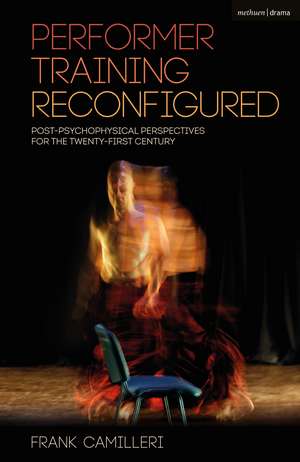
Performer Training Reconfigured: Post-Psychophysical Perspectives for the Twenty-First Century: Performance Books
Autor Frank Camillerien Limba Engleză Paperback – 6 feb 2020
Frank Camilleri puts forward the 'post-psychophysical' as a more extended form of psychophysical discussion and practice that emerged and dominated in the 20th century. The 'post-psychophysical' updates the concept of an integrated bodymind in various ways, such as the notion of a performer's bodyworld that incorporates technology and the material world. Offering invaluable introductions to a wide range of theories around which the book is structured - including postphenomenological, sociomaterial, affect and situated cognition - this volume provides readers with an enticing array of critical approaches to training and creative processes.
Din seria Performance Books
- 20%
 Preț: 144.82 lei
 - 22%
 Preț: 121.86 lei
 - 10%
 Preț: 161.51 lei
 - 22%
 Preț: 252.39 lei
 - 16%
 Preț: 183.31 lei
 - 23%
 Preț: 246.39 lei
 - 17%
 Preț: 207.47 lei
 - 19%
 Preț: 192.87 lei
 - 22%
 Preț: 299.24 lei
 - 22%
 Preț: 127.44 lei
 - 9%
 Preț: 181.02 lei
 - 17%
 Preț: 133.91 lei
 - 18%
 Preț: 153.57 lei
 - 25%
 Preț: 182.25 lei
 - 18%
 Preț: 251.19 lei
 - 15%
 Preț: 146.50 lei
 - 17%
 Preț: 184.18 lei
 - 26%
 Preț: 169.47 lei
 - 25%
 Preț: 202.76 lei
 - 20%
 Preț: 181.66 lei
 - 17%
 Preț: 184.77 lei
 - 22%
 Preț: 201.84 lei
 - 26%
 Preț: 468.40 lei
 - 24%
 Preț: 213.16 lei
 - 19%
 Preț: 248.26 lei
 - 18%
 Preț: 154.87 lei
 - 17%
 Preț: 169.95 lei
 - 17%
 Preț: 133.69 lei
 -
 Preț: 191.97 lei
 - 22%
 Preț: 168.98 lei
 - 20%
 Preț: 195.73 lei
 - 25%
 Preț: 1087.98 lei
 - 23%
 Preț: 249.26 lei
 - 19%
 Preț: 184.91 lei
 - 17%
 Preț: 170.22 lei
 - 22%
 Preț: 190.49 lei
 - 24%
 Preț: 241.64 lei
 - 27%
 Preț: 185.65 lei
 - 25%
 Preț: 179.72 lei
 - 55%
 Preț: 162.43 lei
 - 11%
 Preț: 535.50 lei
 - 17%
 Preț: 156.19 lei
Preț: 185.29 lei
Preț vechi: 233.28 lei
-21%
Puncte Express: 278
Carte disponibilă
Livrare economică 07-21 noiembrie
Livrare express 24-30 octombrie pentru 76.05 lei
Livrare prin curier în România Termenul estimat este afișat lângă disponibilitate.
Transport gratuit de la 400.00 lei Plată online sau ramburs, în funcție de opțiunile comenzii.
Retur gratuit în 14 zile Comandă securizată și suport în română.
Specificații
ISBN-13: 9781350149229
ISBN-10: 1350149225
Pagini: 288
Dimensiuni: 216 x 138 x 18 mm
Greutate: 0.38 kg
Editura: Bloomsbury Publishing
Colecția Methuen Drama
Seria Performance Books
Locul publicării:London, United Kingdom
ISBN-10: 1350149225
Pagini: 288
Dimensiuni: 216 x 138 x 18 mm
Greutate: 0.38 kg
Editura: Bloomsbury Publishing
Colecția Methuen Drama
Seria Performance Books
Locul publicării:London, United Kingdom
V-ar putea interesa
-
 The Body and the Senses in Greek TragedyAfroditi Angelopoulou-19%Preț: 604.81 lei746.67 lei
 -
 Digital PerformanceSteve DixonPreț: 436.41 lei
 -
 -8%Preț: 527.58 lei573.46 lei
 -
 Preț: 189.17 lei
 -
 Preț: 248.30 lei
 -
 Preț: 379.65 leiRecomandat
 -
 Stanislavsky and Mindfulness: Being in the MomentDawn InglesonPreț: 379.01 lei
 -
 Preț: 381.06 lei
 -
 (toward) a phenomenology of actingPhillip ZarrilliPreț: 375.97 lei
 -
 Performance Costume: New Perspectives and MethodsDr Sofia Pantouvaki-38%Preț: 196.60 lei318.75 lei
 -
 Movement Training for ActorsJackie Snow-23%Preț: 273.06 lei354.31 lei
 -
 Anatomy of Performance TrainingJohn Matthews-23%Preț: 283.68 lei367.64 lei
 -
 Immaterial BodiesLisa Blackman-8%Preț: 489.98 lei532.58 lei
 -
 The Art of Being PosthumanFrancesca FerrandoPreț: 168.00 lei
 -
 Performing PowerMarcus MorganPreț: 157.34 lei
 -
 We Are Movement: A User's Guide to the Human BodyWayne McGregor-26%Preț: 91.12 lei123.04 lei
 -
 The PerformerRichard SennettPreț: 92.52 lei
 -
 Flesh and TextSara GiddensPreț: 377.80 lei
 -
 Preț: 108.14 lei
 -
 -18%Preț: 309.95 lei380.00 lei
Cuprins
Preface
Note on Text
Introduction
Assemblage Theory
Problematising Presence
Relations of Exteriority
'Other Way Around' Perspectives
Talking Training (or a Literature Review)
Transitioning to Posthuman Perspectives
New Fields of Study
Crossroads of Psychophysicality
Chapter 1. Towards Post-Psychophysical Perspectives
Instrumental Perceptions
Enabling Technology
Things that Matter
Man and Machine
'Available Time' Hypothesis
Project Hybrid
Chapter 2. Experiencing Bodyworld: Postphenomenological Perspectives
Conventional Psychophysicality
Introducing Ihde
Postphenomenology
Multistabilities in Performance
Interrelational Ontology
Hybrid Relations, Embodied Hermeneutic
Other Relations
Bodies (Merleau-Ponty) to Bodies (Zarrilli) to Bodies (Ihde)
Suggestions for Practice
Chapter 3. Of Materiality and Dynamic Hybrids: Sociomaterial Perspectives
Constructing Latour
Dynamic Relations of Social Networks
Dynamic Hybrids
Trinity of Actants
Hybrids in Performance
Ideological and Ethical Approaches
Material and Immaterial Labour
Future Trainings
Hyphenated Perspectives for Hyphenated Practices
Tips for Practice Analysis
Chapter 4. Unfolding Materialities of Practice: Methodological Perspectives
Working Art
Ecology of Connected Elements in Work Practices
A Methodological Framework
Case Study: Practitioner-Academic Hybrid Practice
Towards a Blended Methodology
Tips for Practice Analysis
Chapter 5. Incorporeal Materiality: Perspectives of Affect
Perspective of Affect
Intensities of Affect
Materialities of the World Unite
Ecologies of Affect for Performance
Affective Logic, Habit, and Technique
Mime and the Punctuation of Movement
Post-Psychophysical Implications of Affect
Suggestions for Practice
Chapter 6. Tuning to the Post-Psychophysical Dance: Perspectives from Situated Cognition
Fritz Writing Fritz
Re(sonant)-Cognition and On-the-line Embodiment
Sensorimotor Contingencies
Fritz Observing Ryszard
Body Image, Body Schema
Sensorimotor Subjectivity
Sensorimotor Exigencies and Affective Framing
Technology and Objects: Expansion, Extension, Incorporation
Incorporated Extension
Epistemic Action
Conclusion
Suggestions for Practice
Glossary of Terms
Notes
Bibliography
Index
Note on Text
Introduction
Assemblage Theory
Problematising Presence
Relations of Exteriority
'Other Way Around' Perspectives
Talking Training (or a Literature Review)
Transitioning to Posthuman Perspectives
New Fields of Study
Crossroads of Psychophysicality
Chapter 1. Towards Post-Psychophysical Perspectives
Instrumental Perceptions
Enabling Technology
Things that Matter
Man and Machine
'Available Time' Hypothesis
Project Hybrid
Chapter 2. Experiencing Bodyworld: Postphenomenological Perspectives
Conventional Psychophysicality
Introducing Ihde
Postphenomenology
Multistabilities in Performance
Interrelational Ontology
Hybrid Relations, Embodied Hermeneutic
Other Relations
Bodies (Merleau-Ponty) to Bodies (Zarrilli) to Bodies (Ihde)
Suggestions for Practice
Chapter 3. Of Materiality and Dynamic Hybrids: Sociomaterial Perspectives
Constructing Latour
Dynamic Relations of Social Networks
Dynamic Hybrids
Trinity of Actants
Hybrids in Performance
Ideological and Ethical Approaches
Material and Immaterial Labour
Future Trainings
Hyphenated Perspectives for Hyphenated Practices
Tips for Practice Analysis
Chapter 4. Unfolding Materialities of Practice: Methodological Perspectives
Working Art
Ecology of Connected Elements in Work Practices
A Methodological Framework
Case Study: Practitioner-Academic Hybrid Practice
Towards a Blended Methodology
Tips for Practice Analysis
Chapter 5. Incorporeal Materiality: Perspectives of Affect
Perspective of Affect
Intensities of Affect
Materialities of the World Unite
Ecologies of Affect for Performance
Affective Logic, Habit, and Technique
Mime and the Punctuation of Movement
Post-Psychophysical Implications of Affect
Suggestions for Practice
Chapter 6. Tuning to the Post-Psychophysical Dance: Perspectives from Situated Cognition
Fritz Writing Fritz
Re(sonant)-Cognition and On-the-line Embodiment
Sensorimotor Contingencies
Fritz Observing Ryszard
Body Image, Body Schema
Sensorimotor Subjectivity
Sensorimotor Exigencies and Affective Framing
Technology and Objects: Expansion, Extension, Incorporation
Incorporated Extension
Epistemic Action
Conclusion
Suggestions for Practice
Glossary of Terms
Notes
Bibliography
Index
Recenzii
Camilleri boldly argues that we should move on from the psychophysical paradigm which has dominated acting theories for the last decade or more. With the term post-psychophysical, his innovative approach encompasses the much broader social and technological context in which today's performer operates, opening up new horizons for acting practices and theories. Performer Training Reconfigured is not only an important book for researchers of performance and philosophy but also one that will be useful for practitioners who will be inspired by Camilleri's perspectives and suggestions.
An excellent study of performance training that goes beyond the limits of psychophysical approaches to performance, and that introduces current thoughts about science, art and the phenomenological experience.
Density, diversity and accuracy characterize this book. It recreates a panorama that makes visible the extraordinary adventure of training, highlighting a lateral apprenticeship to the traditional preparation for acting. The book made me reflect on the material conditions in which training takes place, including as it relates to my practice, on the links between ways of thinking and acting.
It is an impressive and potentially paradigm shifting account, arising from the various turns to affect and cognition, encompassing and integrating perspectives from phenomenology, new materialism posthumanism, technoscience, suggest an alternative approaches to performance studies and practical processes. It documents how material circumstances shape and affect processes of training and performance making. In some respects it is a manifesto for the 21st century, challenging mind/body dualisms through a relational and ecological approach, conceptualized as "post psycho-physical". It invites controversy but the quality of scholarship is one of its strengths.
Performer Training Reconfigured is the culminating product of three decades of applied studio research... It is a work that navigates between analysis and practice in a re-examination of performer training and body-centered dramaturgy viewed through the lens of the post-postmodern. This is a 'must read' work for scholars and practitioners alike who are interested in theatre training and embodied practice in an age of what Camilleri identifies as post-psychophysical, that is, an epistemic universe in which technology and the material world are as important to training and expression as the corporeal self.
Frank Camilleri has opened up the ways to think about performer training in scholarship and in practice. Looking beyond the mind-body binary to the post-psychophysical, he situates performing practices within a broader spectrum of socio-materialist, technological and cognitive paradigms and pulls the discourse of performer training into the new millennium. With detail and rigour Camilleri harnesses an impressive range of theoretical constructs to sharpen the tools of analysis and to re-conceptualise the agency of the performer. His concept of bodyworld is a game changer.
This book provide diverse and well-informed perspectives on training theory and practice in an emergent discourse of this field. The scope and imagination of the book is compelling and its invitation to the reader is warm. Being as systematic and wide-reaching as it is in its hypotheses and proposals for theory after the predominant mind-body discourse, this book helps to move our critical thinking in the field substantially closer to new and more relevant questions about ourselves.
Performer Training Reconfigured examines training discourse and practice through a set of contemporary theories, including new materialism and postphenomenology, updating the field in exciting ways. Drawing on examples of contemporary practice as well as the author's long standing engagement with performance training and making, this is an account that makes an invaluable argument in a rigorous and accessible way. Camilleri asks us, as students and practitioners of performance, to re-consider our relationship with the practice in terms of the materiality that makes it and those involved possible in the first place.
This book is one of those rare animals that simultaneously engages with highly theoretical material - or 'Theory with a capital "T"' - while still retaining the in-the-trenches gravity that comes from an author steeped in lifelong practice. This is important to our fields of theatre and performance as many of us still fight to resist binaries of thinker and doer, scholar and maker, objective analyzer and subjective practitioner. [I]t also feels like Camilleri is positing his post-psychophysical as a clarion call 'Assemble!' In other words, it feels like he is suggesting that by overtly acknowledging training as an assemblage that moves from, through, and beyond the psychophysical, we can envision and make something new together in the realm of performer training.
In this stimulating volume, Frank Camilleri draws on his experience as a theatre practitioner-scholar to carefully tease out those aspects of performer training that are often left in the background during discussions of psychophysical performance practices. This marginalisation is performed even by those whose practices might already be post-psychophysical in Camilleri's terms. Drawing on a combination of theoretical approaches including agential realism, assemblage theory and postphenomenology, Camilleri practises a critical posthumanist reconfiguration of performer training that respectfully builds on and supplements the insights of the dominant psychophysical performance paradigm.
An excellent study of performance training that goes beyond the limits of psychophysical approaches to performance, and that introduces current thoughts about science, art and the phenomenological experience.
Density, diversity and accuracy characterize this book. It recreates a panorama that makes visible the extraordinary adventure of training, highlighting a lateral apprenticeship to the traditional preparation for acting. The book made me reflect on the material conditions in which training takes place, including as it relates to my practice, on the links between ways of thinking and acting.
It is an impressive and potentially paradigm shifting account, arising from the various turns to affect and cognition, encompassing and integrating perspectives from phenomenology, new materialism posthumanism, technoscience, suggest an alternative approaches to performance studies and practical processes. It documents how material circumstances shape and affect processes of training and performance making. In some respects it is a manifesto for the 21st century, challenging mind/body dualisms through a relational and ecological approach, conceptualized as "post psycho-physical". It invites controversy but the quality of scholarship is one of its strengths.
Performer Training Reconfigured is the culminating product of three decades of applied studio research... It is a work that navigates between analysis and practice in a re-examination of performer training and body-centered dramaturgy viewed through the lens of the post-postmodern. This is a 'must read' work for scholars and practitioners alike who are interested in theatre training and embodied practice in an age of what Camilleri identifies as post-psychophysical, that is, an epistemic universe in which technology and the material world are as important to training and expression as the corporeal self.
Frank Camilleri has opened up the ways to think about performer training in scholarship and in practice. Looking beyond the mind-body binary to the post-psychophysical, he situates performing practices within a broader spectrum of socio-materialist, technological and cognitive paradigms and pulls the discourse of performer training into the new millennium. With detail and rigour Camilleri harnesses an impressive range of theoretical constructs to sharpen the tools of analysis and to re-conceptualise the agency of the performer. His concept of bodyworld is a game changer.
This book provide diverse and well-informed perspectives on training theory and practice in an emergent discourse of this field. The scope and imagination of the book is compelling and its invitation to the reader is warm. Being as systematic and wide-reaching as it is in its hypotheses and proposals for theory after the predominant mind-body discourse, this book helps to move our critical thinking in the field substantially closer to new and more relevant questions about ourselves.
Performer Training Reconfigured examines training discourse and practice through a set of contemporary theories, including new materialism and postphenomenology, updating the field in exciting ways. Drawing on examples of contemporary practice as well as the author's long standing engagement with performance training and making, this is an account that makes an invaluable argument in a rigorous and accessible way. Camilleri asks us, as students and practitioners of performance, to re-consider our relationship with the practice in terms of the materiality that makes it and those involved possible in the first place.
This book is one of those rare animals that simultaneously engages with highly theoretical material - or 'Theory with a capital "T"' - while still retaining the in-the-trenches gravity that comes from an author steeped in lifelong practice. This is important to our fields of theatre and performance as many of us still fight to resist binaries of thinker and doer, scholar and maker, objective analyzer and subjective practitioner. [I]t also feels like Camilleri is positing his post-psychophysical as a clarion call 'Assemble!' In other words, it feels like he is suggesting that by overtly acknowledging training as an assemblage that moves from, through, and beyond the psychophysical, we can envision and make something new together in the realm of performer training.
In this stimulating volume, Frank Camilleri draws on his experience as a theatre practitioner-scholar to carefully tease out those aspects of performer training that are often left in the background during discussions of psychophysical performance practices. This marginalisation is performed even by those whose practices might already be post-psychophysical in Camilleri's terms. Drawing on a combination of theoretical approaches including agential realism, assemblage theory and postphenomenology, Camilleri practises a critical posthumanist reconfiguration of performer training that respectfully builds on and supplements the insights of the dominant psychophysical performance paradigm.