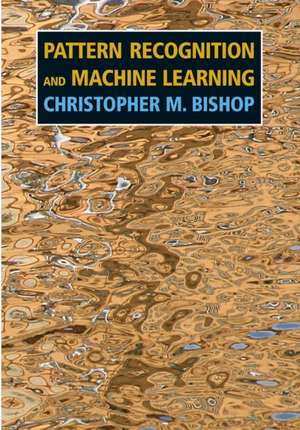
Pattern Recognition and Machine Learning: Information Science and Statistics
Autor Christopher M. Bishopen Limba Engleză Paperback – 23 aug 2016
În ecosistemul învățării automate, Pattern Recognition and Machine Learning reprezintă un pilon fundamental care unifică perspectiva inginerească a recunoașterii formelor cu rigoarea informatică a machine learning-ului. Observăm cum Christopher M. Bishop reușește să transforme metodele bayesiene dintr-o nișă academică într-un instrument de lucru mainstream, integrând totodată modelele grafice ca un cadru general pentru descrierea modelelor probabilistice. Apreciem în mod deosebit modul în care autorul abordează aplicabilitatea practică prin algoritmi de inferență aproximativă, cum sunt variational Bayes și expectation propagation, elemente esențiale în procesarea volumelor mari de date. Pe linia practică a lui Bayesian Reasoning and Machine Learning, dar cu un focus mai pronunțat pe fundamentarea teoretică necesară cercetării avansate, lucrarea de față ghidează cititorul prin 760 de pagini de analiză structurată. Cuprinsul reflectă o progresie logică: de la distribuții de probabilitate și modele liniare pentru regresie și clasificare, către rețele neuronale și metode kernel. Descoperim aici o evoluție naturală față de lucrarea sa anterioară, Neural Networks for Pattern Recognition, Bishop trecând de la o analiză centrată strict pe rețele feed-forward la un spectru mult mai larg ce include procese gaussiene, modele de amestec (Mixture Models) și variabile latente continue. Structura este riguroasă, dar intuitivă, beneficiind de numeroase ilustrații geometrice care ajută la vizualizarea spațiilor de date multidimensionale. Deși este un text de referință pentru studenții de la nivel doctoral, claritatea expunerii îl face accesibil și practicienilor care stăpânesc algebra liniară și analiza matematică multivariată, oferind o bază solidă pentru specializări ulterioare în domenii precum vederea artificială sau procesarea limbajului natural.
Din seria Information Science and Statistics
- 18%
 Preț: 1428.29 lei
 - 18%
 Preț: 1150.73 lei
 - 18%
 Preț: 1166.60 lei
 - 24%
 Preț: 1454.88 lei
 - 15%
 Preț: 672.68 lei
 - 18%
 Preț: 1786.94 lei
 - 20%
 Preț: 1031.53 lei
 - 20%
 Preț: 740.95 lei
 - 15%
 Preț: 674.94 lei
 - 18%
 Preț: 1382.06 lei
 - 20%
 Preț: 624.36 lei
 - 24%
 Preț: 847.02 lei
 - 15%
 Preț: 595.95 lei
 -
 Preț: 376.65 lei
 - 20%
 Preț: 1250.59 lei
 -
 Preț: 397.95 lei
 - 20%
 Preț: 962.08 lei
 - 18%
 Preț: 927.22 lei
 - 20%
 Preț: 325.50 lei
 - 18%
 Preț: 900.55 lei
 - 20%
 Preț: 618.09 lei
Preț: 494.07 lei
Preț vechi: 617.59 lei
-20%
Carte disponibilă
Livrare economică 05-19 noiembrie
Livrare express 21-27 octombrie pentru 73.95 lei
Specificații
ISBN-10: 1493938436
Pagini: 760
Ilustrații: XX, 778 p.
Dimensiuni: 178 x 254 x 41 mm
Greutate: 1.4 kg
Ediția:2006
Editura: Springer
Colecția Information Science and Statistics
Seria Information Science and Statistics
Locul publicării:New York, NY, United States
De ce să citești această carte
Este resursa definitivă pentru oricine dorește să înțeleagă mecanismele matematice din spatele algoritmilor de machine learning. Spre deosebire de ghidurile axate doar pe cod, această carte oferă fundamentul bayesian necesar pentru a inova și a depana modele complexe. Veți câștiga o înțelegere profundă a modelelor grafice și a metodelor kernel, instrumente indispensabile în cercetarea AI contemporană.
Despre autor
Christopher M. Bishop este o figură centrală în peisajul inteligenței artificiale, ocupând funcția de Director Adjunct la Microsoft Research Cambridge și fiind Profesor de Informatică la Universitatea din Edinburgh. Expertiza sa în recunoașterea formelor este dublată de o capacitate pedagogică remarcabilă, demonstrată în lucrări de referință precum Neural Networks for Pattern Recognition și cel mai recent volum al său, Deep Learning. Cariera sa îmbină cercetarea de vârf din mediul corporate cu rigoarea academică, Bishop fiind unul dintre pionierii care au susținut tranziția domeniului către metodele probabilistice moderne.
Descriere scurtă
Cuprins
Recenzii
"This beautifully produced book is intended for advanced undergraduates, PhD students, and researchers and practitioners, primarily in the machine learning or allied areas...A strong feature is the use of geometric illustration and intuition...This is an impressive and interesting book that might form the basis of several advanced statistics courses. It would be a good choice for a reading group." John Maindonald for the Journal of Statistical Software
"In this book, aimed at senior undergraduates or beginning graduate students, Bishop provides an authoritative presentation of many of the statistical techniques that have come to be considered part of ‘pattern recognition’ or ‘machine learning’. … This book will serve as an excellent reference. … With its coherent viewpoint, accurate and extensive coverage, and generally good explanations, Bishop’s book is a useful introduction … and a valuable reference for the principle techniques used in these fields." (Radford M. Neal, Technometrics, Vol. 49 (3), August, 2007)
"This book appears in the Information Science and Statistics Series commissioned by the publishers. … The book appears to have been designed for course teaching, but obviously contains material that readers interested in self-study can use. It is certainly structured for easy use. … For course teachers there is ample backing which includes some 400 exercises. … it does contain important material which can be easily followed without the reader being confined to a pre-determined course of study." (W. R. Howard, Kybernetes, Vol. 36 (2), 2007)
"Bishop (Microsoft Research, UK) has prepared a marvelous book that provides a comprehensive, 700-page introduction to the fields of pattern recognition and machine learning. Aimed at advanced undergraduates and first-year graduate students, as well as researchers and practitioners, the book assumes knowledge of multivariate calculus and linear algebra … . SummingUp: Highly recommended. Upper-division undergraduates through professionals." (C. Tappert, CHOICE, Vol. 44 (9), May, 2007)
"The book is structured into 14 main parts and 5 appendices. … The book is aimed at PhD students, researchers and practitioners. It is well-suited for courses on machine learning, statistics, computer science, signal processing, computer vision, data mining, and bio-informatics. Extensive support is provided for course instructors, including more than 400 exercises, lecture slides and a great deal of additional material available at the book’s web site … ." (Ingmar Randvee, Zentralblatt MATH, Vol. 1107 (9), 2007)
"This new textbook by C. M. Bishop is a brilliant extension of his former book ‘Neural Networks for Pattern Recognition’. It is written for graduate students or scientists doing interdisciplinary work in related fields. … In summary, this textbook is an excellent introduction to classical pattern recognition and machine learning (in the senseof parameter estimation). A large number of very instructive illustrations adds to this value." (H. G. Feichtinger, Monatshefte für Mathematik, Vol. 151 (3), 2007)
"Author aims this text at advanced undergraduates, beginning graduate students, and researchers new to machine learning and pattern recognition. … Pattern Recognition and Machine Learning provides excellent intuitive descriptions and appropriate-level technical details on modern pattern recognition and machine learning. It can be used to teach a course or for self-study, as well as for a reference. … I strongly recommend it for the intended audience and note that Neal (2007) also has given this text a strong review to complement its strong sales record." (Thomas Burr, Journal of the American Statistical Association, Vol. 103 (482), June, 2008)
"This accessible monograph seeks to provide a comprehensive introduction to the fields of pattern recognition and machine learning. It presents a unified treatment of well-known statistical pattern recognition techniques. … The book can be used by advanced undergraduates and graduate students … . The illustrative examples and exercises proposed at the end of each chapter are welcome … . The book, which provides several new views, developments and results, is appropriate for both researchers and students who work in machine learning … ." (L. State, ACM Computing Reviews, October, 2008)
"Chris Bishop’s … technical exposition that is at once lucid and mathematically rigorous. … In more than 700 pages of clear, copiously illustrated text, he develops a common statistical framework that encompasses … machine learning. … it is a textbook, with a wide range of exercises, instructions to tutors on where to go for full solutions, and the color illustrations that have become obligatory in undergraduate texts. … its clarity and comprehensiveness will make it a favorite desktop companion for practicing data analysts." (H. Van Dyke Parunak, ACM Computing Reviews, Vol. 49 (3), March, 2008)
Notă biografică
Textul de pe ultima copertă
This completely new textbook reflects these recent developments while providing a comprehensive introduction to the fields of pattern recognition and machine learning. It is aimed at advanced undergraduates or first-year PhD students, as well as researchers and practitioners. No previous knowledge of pattern recognition or machine learning concepts is assumed. Familiarity with multivariate calculus and basic linear algebra is required, and some experience in the use of probabilities would be helpful though not essential as the book includes a self-contained introduction to basic probability theory.
The book is suitable for courses on machine learning, statistics, computer science, signal processing, computer vision, data mining, and bioinformatics. Extensive support is provided for course instructors, including more than 400 exercises, graded according to difficulty. Example solutions for a subset of the exercises are available from the book web site, while solutions for the remainder can be obtained by instructors from the publisher. The book is supported by a great deal of additional material, and the reader is encouraged to visit the book web site for the latest information.
Christopher M. Bishop is Deputy Director of Microsoft Research Cambridge, and holds a Chair inComputer Science at the University of Edinburgh. He is a Fellow of Darwin College Cambridge, a Fellow of the Royal Academy of Engineering, and a Fellow of the Royal Society of Edinburgh. His previous textbook "Neural Networks for Pattern Recognition" has been widely adopted.
Coming soon:
*For students, worked solutions to a subset of exercises available on a public web site (for exercises marked "www" in the text)
*For instructors, worked solutions to remaining exercises from the Springer web site
*Lecture slides to accompany each chapter
*Data sets available for download